
Is AI Creating Your Content… or Making Your Brand Look Like Everyone Else?
Artificial Intelligence has transformed marketing faster than any technology in recent history.
From social media graphics and ad creatives to blog posts and product videos, AI tools allow businesses to create content within minutes instead of days.
While this has made content creation faster and more affordable, it has also created a new challenge.
Thousands of businesses now use the same AI tools, similar prompts, and identical design templates.
The result?
Many brands look and sound exactly alike.
In 2026, customers are no longer impressed by generic AI-generated content. They expect brands to be authentic, trustworthy, and memorable.
The businesses that combine AI efficiency with human creativity are the ones building stronger customer relationships and long-term brand value.
This guide explains why generic AI creatives are no longer enough and how brands can create content that stands out in the AI era.
Why It Matters
AI-generated content has become incredibly accessible.
However, many businesses make these common mistakes:
❌ Publishing unedited AI-generated content
❌ Using identical prompts as competitors
❌ Copying trending designs
❌ Ignoring brand identity
❌ Creating generic messaging
❌ Prioritizing quantity over quality
The result?
Lower engagement.
Reduced trust.
Poor brand recognition.
Lower conversion rates.
When every business looks the same, customers struggle to remember any of them.
What You Will Learn
By the end of this guide, you’ll understand:
✅ Why generic AI creatives fail
✅ The biggest branding challenges in 2026
✅ How AI is changing customer expectations
✅ Why authenticity matters more than ever
✅ How to combine AI with human creativity
✅ Best practices for AI-powered branding
✅ How to create memorable marketing campaigns
Table of Contents
- Why AI Content Is Everywhere
- The Problem with Generic AI Creatives
- Why Customers Want Authentic Brands
- Human Creativity vs AI
- The Future of Brand Identity
- How to Use AI Without Losing Your Brand Voice
- Best Practices for AI-Assisted Marketing
- Real Business Example
- AI Creative Comparison
- Frequently Asked Questions
- Conclusion
Why AI Content Is Everywhere
AI tools have become a standard part of modern marketing.
Businesses use AI to create:
- Social media posts
- Display advertisements
- Blog articles
- Product descriptions
- Email campaigns
- Video scripts
- Marketing images
- Landing page copy
These tools save time and reduce production costs.
However, because millions of marketers use the same platforms, many outputs appear repetitive.
The Problem with Generic AI Creatives
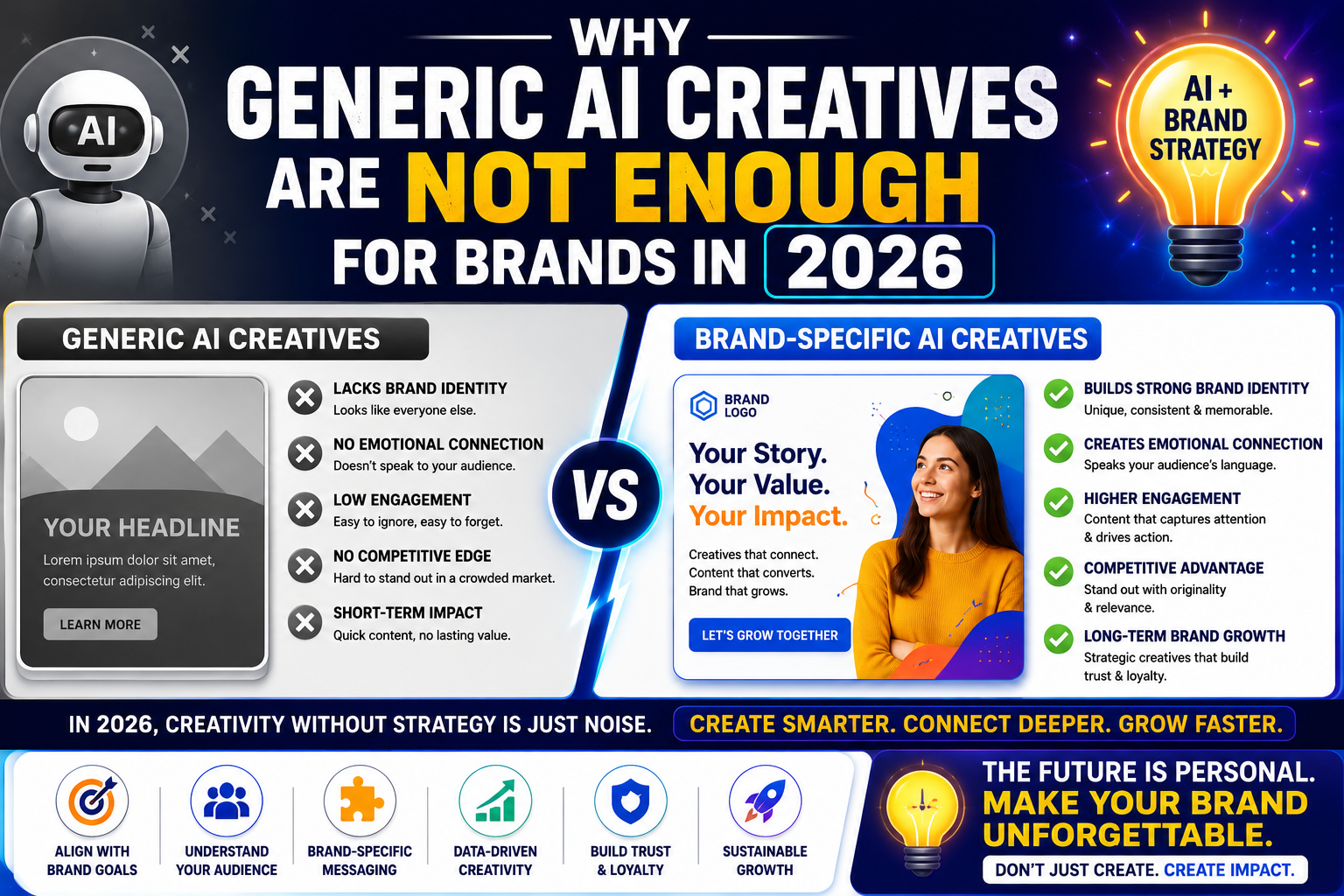
Generic AI content usually lacks:
Original ideas
Brand personality
Emotional storytelling
Customer-focused messaging
Unique visual identity
Real experiences
As more companies rely entirely on AI, audiences quickly recognize repetitive styles and become less engaged.
Why Customers Want Authentic Brands
Modern consumers value authenticity.
People buy from businesses they trust.
Customers connect with brands that demonstrate:
- Real expertise
- Human stories
- Consistent messaging
- Transparent communication
- Unique perspectives
Authenticity builds stronger customer relationships than perfectly polished AI-generated content.
Human Creativity vs AI
AI is an excellent assistant.
Humans remain essential creators.
| Human Creativity | AI Creativity |
| Original ideas | Pattern generation |
| Emotional storytelling | Predictive writing |
| Brand strategy | Content assistance |
| Cultural understanding | Data analysis |
| Creative direction | Automation |
The most successful brands use AI to accelerate creativity—not replace it.
Why Brand Identity Matters More Than Ever
Your brand identity includes:
Logo
Typography
Colors
Photography
Tone of voice
Messaging
Values
Customer experience
Generic AI creatives often ignore these elements, resulting in inconsistent branding.
Strong brands maintain a recognizable identity across every marketing channel.
How AI Can Strengthen Branding
When used correctly, AI helps businesses:
Generate ideas
Research audiences
Improve SEO
Personalize campaigns
Analyze customer behavior
Optimize advertising
Scale content production
AI becomes far more effective when guided by a clear brand strategy.
Personalization Is the Future
Customers increasingly expect personalized experiences.
Instead of creating one generic advertisement, brands should develop content tailored to:
Customer interests
Purchase history
Location
Industry
Buying stage
Personalized marketing consistently delivers higher engagement and better conversions.
Storytelling Wins Over Generic Content
Facts inform.
Stories persuade.
Instead of saying:
“We provide digital marketing services.”
Tell a story.
Explain how your strategy helped a local business double its leads or increase online sales.
Stories make brands memorable.
AI can help organize ideas, but genuine experiences create trust.
Consistency Builds Recognition
Every piece of content should reinforce your brand identity.
Maintain consistency across:
Website
Social media
Email marketing
Advertisements
Videos
Blogs
Presentations
Consistent branding improves customer recognition and trust over time.
Common AI Branding Mistakes
Avoid these common mistakes:
❌ Copying AI-generated designs without customization
❌ Publishing inaccurate information
❌ Ignoring brand guidelines
❌ Overusing stock visuals
❌ Writing generic headlines
❌ Forgetting emotional storytelling
❌ Inconsistent messaging
Real Business Example
Local Interior Design Company
Challenge
The company produced daily AI-generated social media graphics.
Despite frequent posting, engagement remained low.
Strategy
The business introduced:
Original project photography
Customer testimonials
Designer interviews
Behind-the-scenes videos
AI-assisted captions
Consistent branding
Results
Higher engagement
More inquiries
Improved customer trust
Stronger brand recognition
Better lead quality
AI-Assisted Creative Workflow
Brand Strategy
↓
Audience Research
↓
Creative Concept
↓
AI Content Generation
↓
Human Editing
↓
Brand Review
↓
Publishing
↓
Performance Analysis
↓
Continuous Improvement
When Should Brands Use AI?
AI works best for:
Brainstorming ideas
Writing first drafts
SEO optimization
Image generation
Content scheduling
Data analysis
Automation
Humans should remain responsible for:
Creative direction
Brand voice
Storytelling
Customer relationships
Final approval
Future Branding Trends for 2026
The strongest brands will focus on:
Human-centered storytelling
AI-assisted creativity
Hyper-personalization
Community building
Video-first content
Authentic customer experiences
Brands that combine technology with creativity will outperform businesses relying solely on automation.
Frequently Asked Questions
Is AI replacing designers?
No. AI supports designers by improving productivity.
Should brands stop using AI?
No. AI should enhance—not replace—creative processes.
Why do AI-generated ads look similar?
Many businesses use identical prompts and templates.
Does AI improve marketing performance?
Yes, when combined with human creativity and strategy.
Can AI create a brand identity?
AI can assist, but human strategy defines a strong brand.
Is originality important in 2026?
More than ever.
How can small businesses compete?
By combining AI tools with authentic storytelling and customer experiences.
What type of content performs best?
Helpful, original, and emotionally engaging content.
Does branding affect SEO?
Yes. Strong brands build trust, authority, and higher engagement.
What is the future of AI marketing?
AI will become a powerful creative assistant while human creativity remains the differentiator.
Key Takeaways
- AI speeds up content creation.
- Generic AI creatives reduce brand differentiation.
- Authenticity builds trust.
- Storytelling increases engagement.
- Brand consistency strengthens recognition.
- Personalization improves marketing performance.
- Human creativity remains essential.
- AI should support—not replace—creative strategy.
- Strong brands combine technology with originality.
- The future belongs to businesses that balance AI efficiency with human insight.
Final Thoughts
AI has fundamentally changed the way brands create content, but speed alone does not build lasting customer relationships.
In 2026, audiences are surrounded by AI-generated posts, ads, and visuals every day. What captures attention is no longer simply producing more content—it is producing content with purpose, personality, and authenticity.
The brands that succeed will use AI as a creative partner while preserving their unique voice, values, and customer experience.
Instead of asking, “How can AI create more content?“
Start asking:
“How can AI help us create better, more human-centered experiences?”
That shift will define the strongest brands of the AI era.