
Getting mentioned by an AI search engine is only half the battle—the real business opportunity begins when an AI-referred visitor lands on your website.
Introduction
Search is becoming more conversational.
Instead of typing a short keyword such as “digital marketing agency Bangalore,” a potential customer might ask an AI-powered search engine:
“Which digital marketing agencies can help a small Indian business generate leads through Google and Meta Ads?”
The search experience can now provide summaries, recommendations, comparisons, citations, and follow-up answers.
Google’s AI search experiences include AI Overviews and AI Mode, while Microsoft’s Copilot Search combines traditional search with generative answers and prominent source citations.
This creates a new challenge for businesses.
How do you turn an AI search mention into an actual business opportunity?
The answer is not simply “add more keywords.”
You need a website that is:
- Easy for search systems to understand
- Useful enough to be cited or referenced
- Fast and mobile-friendly
- Clear about what the business offers
- Designed around visitor intent
- Trustworthy and credible
- Built with strong calls to action
- Capable of converting visitors who already know what they need
Google’s current guidance specifically recommends focusing on unique, valuable content, providing a good page experience, making content accessible to crawlers, and ensuring structured data accurately represents visible content.
This article shows you how to put those principles into practice.
Why AI Search Visitors Matter for Your Business
Traditional search often begins with a keyword.
AI search increasingly begins with a question, problem, comparison, or specific goal.
For example:
Traditional search:
“best website developer Bangalore”
AI search:
“I run a small manufacturing company in Karnataka. What should I look for when choosing a website development agency that can generate B2B enquiries?”
The second visitor has already revealed:
- Their industry
- Their location
- Their problem
- Their buying intent
- The type of solution they want
That information creates an opportunity for businesses with strong websites.
Google says that users interacting with AI search experiences are asking longer and more specific questions and often using follow-up questions. Google also recommends evaluating the value of search visits using conversion and engagement indicators rather than focusing only on clicks.
The new conversion journey
The customer journey increasingly looks like this:
Question → AI answer → Citation/Recommendation → Website visit → Trust → Offer → Lead → Sales conversation
Your website needs to perform well at every stage after the click.
Key Facts: AI Search and Website Visibility
KEY FACTS
- Google has expanded Search with AI Overviews and AI Mode.
- Google says AI-search visitors can be highly engaged and recommends measuring conversion value rather than clicks alone.
- Google Search Console began rolling out dedicated reporting for visibility in generative AI features in June 2026.
- Bing Webmaster Tools introduced AI Performance reporting that shows when publisher pages are cited in AI-generated answers.
- Google recommends that structured data accurately represent visible page content.
- Google’s current Core Web Vitals targets include LCP ≤ 2.5 seconds, INP ≤ 200 milliseconds, and CLS ≤ 0.1 at the recommended 75th percentile.
What Makes an AI-Search-Ready Website Different?
An AI-search-ready website does not mean a website filled with AI-generated articles.
It means a website that clearly communicates:
- Who you are
- What you do
- Who you serve
- What problems you solve
- Why customers should trust you
- What evidence supports your claims
- What the visitor should do next
Think of your website as a conversion layer between AI discovery and business action.
Step 1: Match the Page to the Visitor’s Search Intent
One of the biggest mistakes businesses make is sending every visitor to the homepage.
Imagine someone asks an AI search engine:
“How much does a website for a small Indian business cost?”
If the AI sends them to your website, they shouldn’t have to search through your homepage to find pricing information.
Create a dedicated page addressing that intent.
Build pages around questions such as:
- What does your service cost?
- Who is your service for?
- How does your process work?
- How long does implementation take?
- What results can customers expect?
- What makes your service different?
- Which solution is best for a particular business?
- What mistakes should customers avoid?
Intent-to-page example
| Search Intent | Recommended Page |
| “What does SEO cost?” | SEO pricing guide |
| “Best website agency for startups” | Startup website service page |
| “How long does website development take?” | Website development guide |
| “Digital marketing agency Bangalore” | Location/service landing page |
| “SEO vs Google Ads” | Comparison article |
| “Need a website for my business” | Website development service page |
The principle is simple: give every important search intent a logical destination.
Step 2: Make Your Value Proposition Obvious
AI-referred visitors may arrive with less patience.
They may already have received a summary from an AI search engine.
Your website therefore needs to answer the most important question immediately:
“Why should I choose you?”
Your hero section should communicate:
What you do + Who you help + Primary benefit + CTA
Weak example
Welcome to our digital marketing agency.
Stronger example
Performance-Driven Digital Marketing for Indian Businesses
Generate more qualified enquiries through SEO, Google Ads, Meta Ads and conversion-focused websites.
CTA: Get a Free Strategy Consultation
The visitor should understand your business within seconds.
Step 3: Create Content That AI Systems Can Understand
There is no magic “AI SEO” trick that guarantees inclusion in AI answers.
Google’s current guidance continues to emphasize the fundamentals: unique, valuable, people-first content, strong page experience, crawlability, and accurate structured data.
Write content in clear information blocks
Instead of:
We offer a comprehensive suite of innovative solutions designed to empower businesses…
Use:
What We Do
We help small and growing businesses generate leads through SEO, Google Ads, Meta Ads, website development and conversion optimization.
Then explain each service separately.
Clear writing helps both humans and machines understand the subject.
Step 4: Answer Questions Directly
AI search is heavily question-oriented.
Therefore, your website should answer real customer questions.
Use a structure such as:
What is conversion rate optimization?
Conversion rate optimization is the process of improving a website so that a larger percentage of visitors complete a desired action, such as submitting a form, calling a business or booking a consultation.
Then expand with examples.
Why does this matter?
Because your content can become useful to:
- Search visitors
- AI systems looking for supporting information
- Potential customers
- Sales teams
- Existing clients
Google has stated that people are using AI Search to ask longer, more specific questions and follow-up questions.
Step 5: Build Topic Clusters Instead of Random Blog Posts
A single article rarely demonstrates everything your business knows.
Create topic clusters.
For example, if your company sells website development services:
Pillar Page
Website Development for Small Businesses
Supporting content:
- How much does a business website cost?
- Website vs landing page: What’s the difference?
- How to choose a website development company
- Website conversion optimization guide
- Mobile-first website best practices
- Website speed optimization guide
- SEO-friendly website structure
- How to build a service business website
Connect these pages with contextual internal links.
Google recommends crawlable links and descriptive anchor text so that users and search engines can better understand linked pages.
Step 6: Add Proof Everywhere It Matters
AI search may introduce a visitor to your company.
Your website must convince them to trust you.
Add:
- Client testimonials
- Case studies
- Reviews
- Portfolio examples
- Before-and-after results
- Certifications
- Team information
- Years of experience
- Process explanations
- Business address
- Contact information
- Clear company information
Don’t simply say:
We deliver excellent results.
Show:
Client generated 47 qualified enquiries in 60 days after implementing our SEO and landing-page strategy.
Whenever possible, explain:
Problem → Strategy → Implementation → Result
Step 7: Create Conversion Paths for Different Visitor Types
Not every AI-search visitor is ready to buy.
You need multiple conversion options.
High-intent visitors
Offer:
- Book a consultation
- Request a quote
- Start a project
- Schedule a demo
Medium-intent visitors
Offer:
- Download a guide
- Get a free audit
- Request pricing
- Watch a case study
Low-intent visitors
Offer:
- Subscribe to newsletter
- Read related articles
- Follow your social channels
- Download an educational checklist
This creates a conversion ladder.
Step 8: Use Strong Calls to Action
A CTA should tell the visitor exactly what happens next.
Weak CTAs
- Submit
- Click Here
- Learn More
- Contact Us
Better CTAs
- Get My Free Website Audit
- Request a Custom SEO Strategy
- Book a 30-Minute Consultation
- Get a Website Quote
- See How We Can Generate More Leads
The CTA should match the visitor’s intent.
Step 9: Build Dedicated Landing Pages
Suppose an AI search visitor asks:
“Which agency can help Indian businesses run Google Ads?”
Sending them to your generic homepage wastes the opportunity.
Create:
/google-ads-management/
The page could contain:
- Clear headline
- Business problem
- Your solution
- Benefits
- Process
- Campaign examples
- Case studies
- FAQs
- Pricing guidance
- CTA
- Contact form
This page becomes both a search destination and a sales asset.
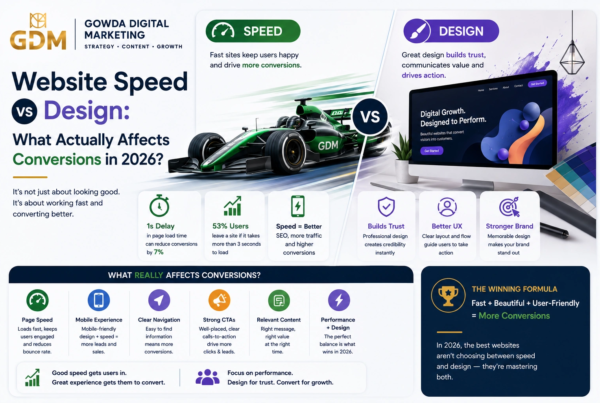
Step 10: Make Your Website Fast
A beautiful website that loads slowly can lose visitors before your sales message appears.
Google’s Core Web Vitals currently focus on:
- LCP: Loading performance
- INP: Responsiveness
- CLS: Visual stability
Google recommends LCP within 2.5 seconds, INP at 200 milliseconds or less, and CLS at 0.1 or less for a good user experience at the 75th percentile.
Website speed checklist
- Compress images
- Use modern image formats
- Minimize unnecessary JavaScript
- Reduce third-party scripts
- Use browser caching
- Use a CDN where appropriate
- Optimize fonts
- Remove unused plugins
- Improve server response time
- Test mobile performance
Step 11: Make the Website Mobile-First
A visitor discovering your company through search may be using a smartphone.
Your mobile website should make it easy to:
- Read
- Scroll
- Call
- Submit a form
- Navigate
- View pricing
- Read testimonials
- Book an appointment
Mobile conversion rule
Don’t make the visitor pinch, zoom, hunt or think.
Put the primary action within easy reach.
Step 12: Use Structured Data Correctly
Structured data gives search engines explicit information about page content.
Google explains that structured data can help Search understand the content of a page and can make pages eligible for certain richer search appearances. However, structured data does not guarantee that a rich result will appear.
Depending on your business, relevant structured data may include:
- Organization
- LocalBusiness
- Article
- Breadcrumb
- Product
- Service-related entity information where appropriate
Important
Never add structured data simply because you want to manipulate search results.
The markup should accurately describe information visible on the page.
Step 13: Make Your Business Entity Clear
AI systems need to understand who your business is.
Create a strong About page containing:
- Company name
- Services
- Locations served
- Team
- Experience
- Contact information
- Business identity
- Areas of expertise
- Relevant social profiles
- Customer proof
For local businesses, keep business details consistent across important online profiles.
Microsoft’s Bing Webmaster Tools also highlights accurate local business information as particularly important when AI experiences surface location-based answers.
Step 14: Use Internal Linking Strategically
Internal links should guide visitors toward the next logical step.
For example:
Blog: How to Improve Google Ads ROI
↓
Service: Google Ads Management
↓
Case Study: How We Improved Lead Quality
↓
CTA: Request a Strategy Call
This turns informational content into a sales journey.
Good anchor text
Explore our Google Ads management services
Less useful
Click here
Step 15: Design for Trust Before Conversion
A visitor may have discovered you through an AI-generated recommendation.
They may still ask:
“Can I trust this company?”
Create a trust section close to important CTAs.
Example
Why Businesses Choose Us
- Transparent communication
- Strategy before execution
- Dedicated support
- Measurable reporting
- Conversion-focused campaigns
- Customized solutions
Then prove these claims with evidence.
Step-by-Step Visual: AI Visitor to Lead
Use this as a visual graphic inside the blog:
┌──────────────────────┐
│ User asks AI Search │
│ a business question │
└──────────┬───────────┘
↓
┌──────────────────────┐
│ AI provides answer │
│ + supporting sources │
└──────────┬───────────┘
↓
┌──────────────────────┐
│ Visitor clicks │
│ your website │
└──────────┬───────────┘
↓
┌──────────────────────┐
│ Clear value │
│ proposition │
└──────────┬───────────┘
↓
┌──────────────────────┐
│ Proof + useful │
│ information │
└──────────┬───────────┘
↓
┌──────────────────────┐
│ Relevant CTA │
│ + low-friction offer │
└──────────┬───────────┘
↓
┌──────────────────────┐
│ LEAD │
│ Form / Call / Demo │
└──────────────────────┘
AI Search Website vs Traditional SEO Website
| Feature | Traditional SEO Website | AI-Search-Ready Website |
| Keyword targeting | Important | Still important |
| Search intent | Important | Extremely important |
| Long-form content | Useful | Useful when it adds value |
| Direct answers | Useful | Essential |
| Entity clarity | Useful | Very important |
| Structured data | Helpful | Helpful |
| Internal linking | Important | Important |
| Conversion design | Important | Critical |
| Trust signals | Important | Critical |
| Clear FAQs | Useful | Highly valuable |
| Case studies | Valuable | Highly valuable |
| Page experience | Important | Important |
| AI citation visibility | Not traditionally measured | Increasingly important |
The important point is that AI search does not eliminate SEO.
It expands the search environment.
Google explicitly says the fundamentals that have long mattered for Search continue to apply to its AI experiences.
Case Study Example: A Local Service Business
Consider a hypothetical Indian interior-design company.
Before
The website has:
- Generic homepage
- One services page
- No case studies
- No pricing guidance
- Weak CTAs
- No FAQ content
- Slow mobile performance
An AI-search visitor lands on the homepage but doesn’t immediately find an answer to their question.
After
The company creates:
- Service-specific landing pages
- Location-specific pages
- Project case studies
- Cost guides
- FAQs
- Comparison articles
- Testimonials
- Strong CTAs
- WhatsApp contact option
- Mobile-first design
- Faster pages
Resulting journey
AI question → Relevant content → Service page → Case study → Trust → Consultation
This example illustrates the strategy rather than claiming a measured client result.
Expert Perspective
Google’s current guidance can be summarized around a simple principle:
Focus on unique, valuable content that satisfies visitors rather than trying to create content specifically to manipulate AI systems.
That distinction is important.
AI-search optimization should not become another excuse for mass-producing generic content.
Google warns that generating many pages with AI without adding value can fall under its scaled-content-abuse spam policy.
How to Measure AI Search Lead Generation
Don’t only track:
Traffic
Track:
Acquisition
- AI/search impressions
- Organic clicks
- Landing pages
- Search queries
- Referral sources
Engagement
- Engagement rate
- Time on important pages
- Scroll depth
- Returning visitors
Conversion
- Form submissions
- Phone calls
- WhatsApp conversations
- Demo bookings
- Quote requests
- Newsletter subscriptions
Business outcomes
- Marketing-qualified leads
- Sales-qualified leads
- Opportunities
- Revenue
- Customer acquisition cost
Google introduced dedicated generative-AI performance reporting in Search Console in June 2026, initially rolling it out to a subset of websites.
Bing Webmaster Tools also introduced AI Performance reporting that can show citations, cited pages and grounding queries across supported AI experiences.
The AI Search Conversion Formula
A useful framework is:
AI Visibility × Relevance × Trust × UX × Offer × CTA = Lead Potential
If one element is weak, conversion potential falls.
For example:
High AI visibility + poor website = wasted traffic
Excellent website + no visibility = limited discovery
Good traffic + weak offer = low conversion
Your goal is to optimize the entire journey.
Highlight Box: Don’t Optimize Only for AI
IMPORTANT
You do not need to build a website that “talks to AI.”
Build a website that clearly explains your business to people and machines.
The strongest AI-search strategy is usually built on fundamentals:
useful content + clear structure + technical accessibility + trust + excellent user experience + strong conversion paths.
10 FAQs
1. What is an AI search visitor?
An AI search visitor is someone who discovers your website after interacting with an AI-powered search experience, such as Google AI features or Microsoft Copilot Search.
2. Is AI SEO different from traditional SEO?
AI-search optimization introduces additional considerations around conversational queries, source visibility, entity clarity and answer-oriented content. However, traditional SEO fundamentals such as crawlability, relevance, useful content, links and page experience remain important.
3. Can I guarantee that AI search engines will mention my business?
No. There is no reliable method that guarantees inclusion or citation in an AI-generated answer.
Your goal should be to create authoritative, useful, accessible content that deserves to be referenced.
4. Should I create hundreds of AI-generated articles?
No.
Publishing large quantities of generic content without meaningful value can create quality and spam-policy risks. Google specifically warns against scaled content abuse.
5. What should my homepage contain?
At minimum:
- Clear value proposition
- Primary services
- Target audience
- Differentiators
- Trust signals
- Testimonials or proof
- Strong CTA
- Contact options
- Relevant internal links
6. Are FAQs still useful for AI search?
Yes, FAQs can be useful as human-readable question-and-answer content. However, don’t assume FAQ schema automatically creates a Google FAQ rich result. Google removed documentation for the FAQ rich-result feature in 2026.
7. Does structured data guarantee AI visibility?
No.
Structured data can help search engines understand page content, but Google does not guarantee a particular search appearance even when markup is correctly implemented.
8. Should every AI-search visitor see the same CTA?
No.
Match your CTA to the visitor’s intent.
Someone researching a problem may prefer a guide, while someone comparing providers may be ready for a consultation.
9. How fast should my website be?
Aim for good Core Web Vitals. Google’s current recommended thresholds are LCP of 2.5 seconds or less, INP of 200 milliseconds or less, and CLS of 0.1 or less at the 75th percentile.
10. How can I tell whether AI search is sending me leads?
Track search visibility, landing pages and conversion events together.
Where available, use Google Search Console’s generative AI reporting and Bing Webmaster Tools’ AI Performance reporting, then connect that visibility data to your analytics and CRM.
How Do You Convert AI Search Visitors Into Leads?
To convert AI search visitors into leads, build pages that directly satisfy their search intent, clearly explain your value proposition, demonstrate trust with evidence, provide a fast mobile-friendly experience, use relevant internal links, and offer a strong next step such as a consultation, quote, audit or downloadable resource.
The process is:
AI discovery → Relevant landing page → Clear value → Proof → Useful information → CTA → Lead
Actionable AI Search Website Checklist
- Identify your top customer questions
- Map each question to an appropriate page
- Rewrite hero sections around customer outcomes
- Create dedicated service landing pages
- Add detailed FAQs
- Publish original case studies
- Add testimonials and trust signals
- Improve internal linking
- Check mobile usability
- Measure Core Web Vitals
- Compress images
- Improve page loading speed
- Implement relevant structured data
- Validate structured data
- Check robots.txt and indexing
- Submit/update your sitemap
- Connect Google Search Console
- Monitor AI-search visibility where reporting is available
- Connect website conversions to your CRM
- Test different CTAs
- Test lead forms
- Create downloadable lead magnets
- Review and update high-value pages regularly
30-Day Implementation Plan
Week 1: Research
Identify:
- 20 customer questions
- 10 commercial search intents
- 5 competitor pages
- 5 major customer objections
- 5 conversion opportunities
Week 2: Website Optimization
Improve:
- Homepage
- Service pages
- Contact page
- About page
- Mobile experience
- CTAs
- Internal links
Week 3: Content
Create:
- 2 detailed guides
- 2 comparison articles
- 1 case study
- 1 pricing/cost guide
- 1 FAQ resource
Week 4: Measurement
Set up:
- Google Search Console
- Analytics
- Conversion tracking
- Form tracking
- Call tracking where appropriate
- CRM attribution
- AI-search visibility monitoring where available
What Not to Do
Avoid these common mistakes:
Don’t publish generic AI content at scale
AI can help with research and organization, but content still needs original value and human quality control.
Don’t stuff keywords everywhere
Write naturally for the person asking the question.
Don’t hide important information
Make pricing guidance, services, processes and contact options easy to find.
Don’t use misleading schema
Structured data must represent visible content.
Don’t make every page a sales pitch
Educational content can build trust and bring visitors deeper into your funnel.
Don’t focus only on rankings
A visitor who converts is more valuable than a visitor who simply clicks.
Summary: Key Takeaways
AI search is changing the discovery phase of the customer journey.
But the fundamental business objective remains the same:
Turn attention into action.
The best strategy is to build a website that:
- Answers real customer questions.
- Matches search intent.
- Clearly communicates your value proposition.
- Demonstrates expertise and trust.
- Provides original information.
- Uses strong internal linking.
- Loads quickly.
- Works exceptionally well on mobile.
- Uses accurate structured data where appropriate.
- Provides relevant CTAs.
- Offers multiple conversion paths.
- Measures leads and business outcomes—not just traffic.
Google’s own guidance emphasizes useful content, good page experience, technical accessibility and accurate structured data for AI search experiences.
The opportunity isn’t simply to appear in AI search.
The bigger opportunity is to make your website the place where the visitor takes the next step.
Final Conclusion
The future of search isn’t simply about ten blue links.
People increasingly discover businesses through conversational questions, AI-generated summaries, recommendations and cited sources.
That changes what happens before a website visit—but it doesn’t eliminate the importance of the website itself.
In fact, it can make your website even more important.
When an AI search visitor clicks through, your website needs to immediately answer:
“Am I in the right place?”
Then:
“Can I trust this company?”
And finally:
“What should I do next?”
If your website can answer all three questions quickly and convincingly, AI-search traffic can become much more than another source of visitors.
It can become a reliable source of qualified leads and revenue.
Want More Leads From Your Website?
If your website gets traffic but doesn’t generate enough enquiries, it may not be a traffic problem.
It may be a conversion problem.
At gowdadigital.marketing, you can use this strategy to evaluate your website’s SEO, user experience, landing pages, content and conversion paths.
Subscribe to the gowdadigital.marketing newsletter for practical SEO, website, AI-search and digital marketing strategies.
And tell us in the comments:
Have you already seen traffic or enquiries coming from AI-powered search? What has worked—or not worked—for your business?
References & Sources
- Google Search Central — Top ways to ensure your content performs well in Google’s AI experiences on Search
Google Search Central: AI Search Guidance - Google Search Central — Guidance on Generative AI Content
Google Search Central: Generative AI Content Guidance - Google Search Central — Structured Data
Google Search Central: Structured Data Documentation - Google Search Central — General Structured Data Guidelines
Google Search Central: Structured Data Guidelines - Google Search Central — Generative AI Performance Reports
Google Search Central: Search Generative AI Performance Reports - Google Web.dev — Core Web Vitals
web.dev: Core Web Vitals - Google Search Central — Link Best Practices
Google Search Central: Link Best Practices - Microsoft Bing — Copilot Search
Bing Search Blog: Copilot Search - Microsoft Bing Webmaster Tools — AI Performance
Bing Webmaster Blog: AI Performance