
People may discover your brand through a logo, but they often learn to trust it through the people behind it.
A polished company page can explain what your business does. Your employees and founder can show why people should believe in it.
That difference matters.
In a social media environment filled with advertisements, polished graphics, AI-generated posts, and repetitive promotional messaging, real people can provide something corporate content often struggles to communicate: human credibility.
Why Employee and Founder Content Matters
Customers don’t only evaluate what a business sells. They also evaluate the people, values, expertise, and experiences behind the business.
Founder posts can communicate vision and expertise.
Employee content can demonstrate culture and real-world experience.
Behind-the-scenes content can demonstrate how the business actually operates.
Customer-facing employees can explain problems from the perspective of people who deal with them every day.
Together, these voices can make a company feel less like a faceless organization and more like a group of knowledgeable people solving real problems.
This is especially important for small businesses, professional service firms, agencies, consultants, startups, local businesses, and B2B companies where trust is often a prerequisite for purchase.
The trust problem businesses face
Many businesses follow this pattern:
Company posts → promotional message → product feature → offer → company post → promotional message.
The result is predictable.
The audience sees the business talking about itself.
A stronger approach is:
Founder insight → employee experience → customer problem → useful advice → behind-the-scenes story → business solution.
Now the audience sees the people and expertise behind the business.
The Promise: Turn People Into Proof
Employee and founder content shouldn’t simply make your social media “more personal.”
It should make your brand more believable.
The goal is to use real people to demonstrate:
- Expertise
- Experience
- Values
- Culture
- Transparency
- Problem-solving ability
- Customer understanding
- Leadership
- Consistency
Your people become evidence of what your brand claims to be.
Key Facts & Statistics
📊 Brand Trust Snapshot
48% of people in India surveyed in the 2026 Edelman Trust Barometer showed an unwillingness or hesitancy to trust people who differ from them in values, sources, approaches to societal problems, or background. The report also found that among Indians with an insular mindset, 83% trust “my CEO”.
Edelman’s 2024 Employee Trust Research found that employees who trust their employer are 4× more likely to advocate, 3× more likely to be loyal, 3× more committed and 4× prouder.
LinkedIn’s employee advocacy research has reported that employee-shared content can achieve stronger engagement and reach than identical content shared directly by a company.
Important: These statistics come from different studies, years, samples, and methodologies. They should be used as directional evidence rather than as a guarantee that employee content will produce a specific result for every business.
What Is Employee and Founder Content?
Employee and founder content is content published by or featuring the people behind a business.
It can appear on:
- YouTube
- X
- Company blogs
- Podcasts
- Newsletters
- Webinars
- Short-form video platforms
Founder content
Founder content typically focuses on:
- Lessons learned
- Industry opinions
- Business decisions
- Customer problems
- Company vision
- Mistakes and failures
- Leadership lessons
- Market observations
- Product development
- Personal experiences
Employee content
Employee content can include:
- Day-in-the-life stories
- Expert tips
- Behind-the-scenes videos
- Team achievements
- Project experiences
- Customer problem-solving
- Work processes
- Industry observations
- Employee perspectives
- Company culture
The important distinction is that this shouldn’t become constant company promotion.
The content should provide value even when the audience isn’t ready to buy.
Why Human Voices Build Trust
1. People Can Explain What Brands Can’t
A company website might say:
“We provide customized digital marketing solutions.”
A founder might say:
“We started offering customized marketing because we noticed small businesses were spending money on campaigns they couldn’t understand or measure.”
The second statement creates context.
It gives the audience a reason to believe the business exists.
2. People Demonstrate Expertise
Instead of saying:
“We are digital marketing experts.”
Show expertise through:
- An employee explaining a campaign decision
- A founder breaking down an industry trend
- A designer explaining a design choice
- A developer explaining how a feature solves a customer problem
- A salesperson explaining a common buying mistake
Don’t claim expertise. Demonstrate it.
3. People Make Company Values Visible
A business can publish:
“Customer satisfaction is our priority.”
But an employee explaining how the team handled a difficult customer problem provides much stronger evidence.
The principle is simple:
Don’t only tell people what your company values. Show them how your people behave.
Founder Content vs Employee Content
| Content Type | Founder Content | Employee Content |
| Main strength | Vision and authority | Experience and relatability |
| Best for | Thought leadership | Practical expertise |
| Voice | Strategic | Personal and specialized |
| Typical topics | Industry trends, lessons, vision | Tips, projects, processes |
| Trust signal | Leadership | Real-world experience |
| Best platforms | LinkedIn, YouTube, podcasts | LinkedIn, Instagram, YouTube |
| Main risk | Becoming self-promotional | Becoming overly scripted |
The strongest strategy uses both.
Founder content answers:
“Where is this business going, and what does it believe?”
Employee content answers:
“What is it actually like to work with these people?”
What Types of Employee and Founder Content Should You Create?
1. Educational Content
Teach something your audience genuinely wants to understand.
Examples:
- “3 mistakes local businesses make with Instagram”
- “What most businesses misunderstand about website SEO”
- “How we approach a new client project”
- “What I learned after managing 50 campaigns”
Educational content builds credibility without requiring a sales pitch.
2. Behind-the-Scenes Content
Show how work actually happens.
Examples:
- Team brainstorming
- Product development
- Client preparation
- Office routines
- Design revisions
- Content planning
- Campaign meetings
- Team celebrations
Behind-the-scenes content gives audiences access to information they normally wouldn’t see.
3. Founder Lessons
Founders have something employees may not: a long-term perspective on the company’s journey.
Post about:
- Your first client
- A major business mistake
- A difficult decision
- Why you started the company
- What changed your strategy
- A lesson from losing a customer
- How your business evolved
Example
Instead of:
“We are proud to announce our 5th year in business.”
Try:
“Five years ago, I thought getting more clients would solve every business problem. I was wrong. Our biggest growth came when we learned how to say no to the wrong projects.”
The second version creates a story.
4. Employee Expertise
Your employees know things your marketing team may not.
A developer can discuss technology.
A designer can discuss visual psychology.
A sales employee can explain customer objections.
A customer-support employee can identify recurring problems.
Turn that knowledge into content.
5. Customer Stories
Let employees explain what they learned from helping customers.
For example:
“One thing we noticed while working with local retailers is that many don’t have a traffic problem—they have a conversion problem.”
This combines employee expertise with customer insight.
How to Build an Employee Content Strategy
Step 1: Identify Your Internal Experts
Create a simple list.
| Employee | Expertise | Content Topics | Best Format |
| Founder | Business strategy | Lessons, trends | LinkedIn posts |
| Designer | Branding | Design tips | Reels/carousels |
| Developer | Technology | Tech explainers | Video/blog |
| Salesperson | Customer needs | FAQs | Short videos |
| Support team | Customer problems | Tips/stories | Posts/reels |
You don’t need 50 employee creators.
Start with 2–5 willing people.
Step 2: Ask Employees What They Actually Want to Talk About
Don’t simply send employees a list of corporate messages.
Ask:
- What topics do you know well?
- What questions do customers ask you?
- What industry changes interest you?
- What do you wish customers understood?
- What lessons have you learned?
- What topics could you discuss for 10 minutes without preparation?
Those answers can become your content bank.
Step 3: Create Content Pillars
Choose 3–5 recurring categories.
For example:
Pillar 1: Expertise
Tips, explanations and industry insights.
Pillar 2: People
Team stories and employee experiences.
Pillar 3: Founder Perspective
Lessons, opinions and business decisions.
Pillar 4: Proof
Customer stories, projects and outcomes.
Pillar 5: Culture
Values, routines and behind-the-scenes moments.
This creates consistency without making every post identical.
How to Build a Founder Content Strategy
Founder content works best when the founder becomes a recognizable voice, not another corporate spokesperson.
Use the 70/20/10 approach
A practical starting point could be:
- 70%: Educational and industry insights
- 20%: Personal experiences and company stories
- 10%: Direct promotion
This isn’t a universal rule. Adjust the mix based on your audience, platform and business objectives.
Founder content formula
Use:
Observation → Experience → Lesson → Advice
Example:
Observation: Many small businesses post every day but still struggle to generate inquiries.
Experience: We’ve seen this happen when businesses focus on volume rather than relevance.
Lesson: Posting more isn’t always the answer.
Advice: Start by identifying the five questions your customers ask before buying.
That’s a useful founder post.
The 5-Part Brand Trust Content Framework
A simple framework for employee and founder content is:
1. Human
Show the person.
2. Helpful
Teach something useful.
3. Honest
Talk about mistakes, challenges or lessons.
4. Specific
Use real examples rather than vague statements.
5. Consistent
Publish regularly enough for people to recognize the voice.
Visual Framework
Person → Experience → Insight → Proof → Trust
For example:
Employee
↓
Real customer problem
↓
Professional insight
↓
Example/result
↓
Audience trust
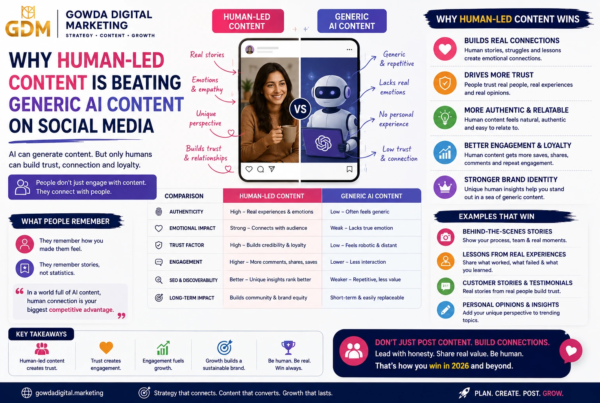
Comparison: Corporate Content vs Human-Led Content
| Corporate-First Content | Human-Led Content |
| “We offer excellent services.” | “Here’s how we approach this problem.” |
| Product features | Customer problems |
| Company announcements | Personal lessons |
| Stock images | Real people |
| Generic claims | Specific experiences |
| Promotional language | Educational language |
| One brand voice | Multiple expert voices |
| Company-centric | Audience-centric |
The goal isn’t to eliminate branded content.
The goal is to balance branded communication with human communication.
Case Studies & Examples
Example 1: A Digital Marketing Agency
Instead of publishing:
“Our SEO service helps businesses increase visibility.”
The founder could publish:
“One of the biggest SEO mistakes I see small businesses make is trying to rank for keywords their customers rarely search for.”
Then an SEO employee could create:
“Here’s how I find the search terms I would target for a local business.”
The company has now created two trust-building pieces from the same expertise.
Example 2: A Restaurant
Instead of posting only food photos, employees could share:
- How a dish is prepared
- Why the chef chose an ingredient
- A staff member’s favorite menu item
- A story about a regular customer
- A behind-the-scenes preparation video
The restaurant becomes more than a menu.
It becomes a place with people and stories.
Example 3: A SaaS Startup
Founder:
“Why we decided not to build a feature customers were requesting.”
Employee:
“What our support team learned from 100 customer conversations.”
Product manager:
“How we redesigned the onboarding experience.”
These posts demonstrate expertise and transparency without constantly saying:
“Buy our software.”
Quote / Expert Perspective
“The brand has to be human: communicated through authentic, credible individuals.”
— LinkedIn Marketing Solutions, discussing brand trust and thought leadership.
The underlying lesson is powerful: people can become important trust assets when their content demonstrates genuine expertise, values and experience.
Edelman’s more recent research reinforces the importance of employee trust. Its 2024 Employee Trust Research found that trusted employees are significantly more likely to advocate for their employer and feel proud of the organization.
How to Avoid Making Employee Content Feel Forced
This is one of the biggest challenges.
Employees don’t want to feel like unpaid influencers.
Avoid:
- Mandatory daily posting
- Copy-paste captions
- Scripts that sound corporate
- Excessive brand promotion
- Controlling every sentence
- Asking employees to pretend they love something
- Requiring personal accounts to promote company content
Instead:
- Make participation voluntary
- Provide ideas rather than commands
- Let employees use their own voice
- Give them training
- Offer simple templates
- Celebrate useful contributions
- Protect personal boundaries
- Create clear social media guidelines
LinkedIn’s employee advocacy guidance similarly emphasizes identifying willing employee participants, helping them succeed and giving them room to build their own professional reputation.
Common Mistakes to Avoid
Mistake 1: Turning Every Employee Into a Salesperson
Your employees aren’t walking advertisements.
Their value comes from their experience and perspective.
Mistake 2: Making Every Post About the Company
A good employee post might never mention the company.
That’s okay.
If the employee is demonstrating useful expertise, the association with your business can develop naturally.
Mistake 3: Writing Everything in Corporate Language
Replace:
“We are delighted to leverage innovative solutions…”
With:
“Here’s what we learned from doing this.”
Human language is usually easier to understand.
Mistake 4: Only Showing Perfect Moments
If everything looks perfect, audiences may become skeptical.
Appropriate stories about mistakes, lessons and challenges can make the brand more relatable.
Mistake 5: Ignoring Employees Who Have Expertise
Your best content creator might not work in marketing.
They might be sitting in:
- Sales
- Customer service
- Product
- Operations
- Design
- Development
- Finance
- HR
Find the knowledge inside your organization.
How to Measure Brand Trust Content
Don’t measure success only through likes.
Track:
Awareness Metrics
- Reach
- Impressions
- Profile visits
- Video views
- Follower growth
Engagement Metrics
- Comments
- Shares
- Saves
- Meaningful conversations
- Direct messages
Trust Signals
- Positive comments
- Questions from prospects
- Employee participation
- Mentions by customers
- Inbound recommendations
- Repeat interactions
Business Metrics
- Website visits
- Leads
- Demo requests
- Consultation requests
- Newsletter subscriptions
- Assisted conversions
Employee Metrics
- Number of participating employees
- Posts published
- Employee-generated impressions
- Employee engagement
- Participation rate
LinkedIn’s employee advocacy research recommends measuring concrete outcomes rather than treating advocacy as an activity without business objectives.
A Simple 30-Day Employee + Founder Content Plan
| Week | Founder Content | Employee Content |
| Week 1 | Founder story | Employee introduction |
| Week 2 | Industry opinion | Expert tip |
| Week 3 | Business lesson | Behind-the-scenes |
| Week 4 | Customer lesson | FAQ/explainer |
Weekly rhythm
Monday: Founder insight
Tuesday: Employee tip
Wednesday: Educational carousel
Thursday: Behind-the-scenes content
Friday: Founder story or lesson
The exact frequency can change depending on your resources.
Consistency matters more than overwhelming your team.
10 FAQs
1. What is employee-generated content?
Employee-generated content is content created by employees that shares their experiences, expertise, perspectives, stories or involvement with a business.
It can include videos, posts, photos, articles, testimonials, interviews and behind-the-scenes content.
2. How does employee content build brand trust?
It can humanize a business by showing the people behind the products or services. Employees can demonstrate expertise, explain real customer problems and provide authentic perspectives.
3. What is founder-led content?
Founder-led content is content created or presented by a company’s founder. It commonly includes business lessons, industry opinions, personal experiences, company decisions and leadership insights.
4. Should every employee create content?
No.
Participation should generally be voluntary. Start with employees who are interested, knowledgeable and comfortable communicating publicly.
5. What should founders post on LinkedIn?
Founders can post about:
- Industry trends
- Business lessons
- Customer problems
- Leadership
- Company decisions
- Mistakes
- Market observations
- Personal experiences
The best posts usually provide an insight rather than simply promoting the company.
6. Should employees promote company products?
They can, but promotional content should not be the entire strategy.
Educational, experiential and industry-related content often provides more value and can make promotional posts more credible when they appear.
7. How often should employees post?
There is no universal frequency.
A small business could start with one useful employee post every one or two weeks and increase frequency when employees are comfortable.
8. What if employees don’t want to post publicly?
Don’t force them.
They can contribute through:
- Internal interviews
- Blog articles
- Videos
- Podcasts
- Quotes
- Case studies
- Content interviews
A marketing team can turn their expertise into content while keeping participation comfortable.
9. Can small businesses use employee advocacy?
Absolutely.
In fact, small businesses may have an advantage because their founders and employees can often communicate more personally than large corporate brands.
Start small and focus on quality.
10. How do I measure whether employee content is working?
Track a combination of reach, engagement, profile visits, website traffic, leads, inquiries, employee participation and qualitative trust signals such as recommendations and meaningful conversations.
How Do You Turn Employee and Founder Content Into Brand Trust?
The simplest way to turn employee and founder content into brand trust is to use real people to demonstrate expertise, experience, values and transparency. Instead of asking employees to constantly promote products, give them opportunities to share useful insights, customer lessons, behind-the-scenes experiences and authentic perspectives. Consistent, human-led content can make a brand more relatable and credible.
The process:
Identify experts → Choose content pillars → Capture real stories → Let people use their own voice → Publish consistently → Measure trust and business outcomes.
Highlight Box: The Golden Rule
💡 Don’t manufacture authenticity.
Create the conditions for authenticity.
Give employees and founders the freedom, tools and confidence to communicate what they genuinely know.
Step-by-Step Visual: From Employee Expertise to Brand Trust
Step 1
Find internal expertise
↓
Step 2
Interview the employee
↓
Step 3
Extract one useful insight
↓
Step 4
Turn it into a post, reel, carousel or article
↓
Step 5
Publish in the employee’s natural voice
↓
Step 6
Encourage genuine conversation
↓
Step 7
Measure engagement, leads and trust signals
↓
Result
Employee expertise → Human content → Credibility → Relationships → Brand trust
Actionable To-Do List
- Identify 3 employees with useful expertise.
- Identify 5 subjects each person could discuss.
- Choose 3–5 content pillars.
- Create a simple employee social media guideline.
- Interview your founder for 10 potential stories.
- Create a shared content idea bank.
- Record two short employee videos.
- Publish one founder insight.
- Publish one employee expertise post.
- Publish one behind-the-scenes story.
- Track engagement and inbound inquiries.
- Review the results after 30 days.
- Double down on the content themes that generate meaningful conversations.
Summary: Key Takeaways
Employee and founder content isn’t simply a social media trend.
It is a way to make your brand visible through the people who actually understand the business.
Remember:
- People can humanize a brand.
- Founders can provide vision and authority.
- Employees can demonstrate practical expertise.
- Behind-the-scenes content can make businesses more transparent.
- Educational content is usually stronger than constant promotion.
- Participation should feel voluntary, not forced.
- Authenticity cannot be created through corporate scripts.
- Measure conversations and business outcomes, not only likes.
- Start with a small group of willing employee creators.
- Consistency is more valuable than occasional viral content.
Conclusion
Your brand already has content creators.
They may be sitting in your sales department.
They may be answering customer questions.
They may be designing your products.
They may be building your technology.
And one of them may be your founder.
The opportunity is to turn that existing knowledge into useful, authentic content.
Instead of asking:
“What should our company post today?”
Start asking:
“What does someone on our team know that our audience would genuinely find useful?”
That question can completely change your social media strategy.
Because the strongest brand voice isn’t always the company logo.
Sometimes, it’s the person standing behind it.
References & Sources
- Edelman — 2026 Trust Barometer, India: Research on trust, insularity, employers and CEOs in India. Edelman 2026 Trust Barometer – India
- Edelman — 2026 India Top 10 Findings: Includes the 48% insularity finding and trust in “my CEO” among Indians with an insular mindset. Edelman 2026 India Trust Findings PDF
- Edelman — The People Side of Change: Insights from the 2024 Edelman Employee Trust Research. Edelman Employee Trust Research Insights
- Edelman — Trust and the New Employee-Employer Contract: Research on employee trust, advocacy and employer credibility. Edelman Employee-Employer Trust Research
- LinkedIn Marketing Solutions — Employee Advocacy Guide: Guidance and research on employee advocacy and brand reach. LinkedIn Official Guide to Employee Advocacy
- LinkedIn Marketing Solutions — How to Encourage Employees to Advocate: Practical guidance for developing employee advocates. LinkedIn Employee Advocacy Strategy
- LinkedIn Marketing Solutions — Brand Marketing, Value and Trust: Research and perspectives on human voices, employees, executives and brand trust. LinkedIn Brand Marketing: Building Value and Trust
- LinkedIn Marketing Solutions — Employee Advocacy Statistics: Additional employee advocacy research and examples. LinkedIn Employee Advocacy Statistics
Want More Practical Digital Marketing Tips?
Subscribe to the Gowda Digital Marketing newsletter for practical insights on social media marketing, SEO, content strategy, websites, apps and digital growth for modern businesses.
Have you ever bought from or trusted a business because of its founder or employees?
Leave a comment and share your experience.
If your business needs help turning founder expertise and employee knowledge into a consistent social media strategy, Gowda Digital Marketing can help you build a human-led content system designed around your brand.