
Your Brand Does Not Need to Go Viral to Become Valuable
A viral post can give you attention for a day. A recognizable brand can keep earning attention for years.
Every week, social media marketers are told to jump on something new: a trending sound, meme format, challenge, reaction, hook, editing style, or controversial topic.
The pressure can make business owners feel that they are losing if their latest post gets 300 views instead of 300,000.
But virality and brand growth are not the same thing.
A viral post can attract thousands of people who have no interest in your business. A smaller, highly relevant audience can generate enquiries, referrals, repeat purchases and long-term loyalty.
That is why building an organic social media brand should be less about chasing the next trend and more about becoming consistently useful, recognizable and trustworthy.
Why This Matters for Businesses in 2026
Organic social media is not dead. It has simply become more strategic.
Sprout Social’s 2026 research emphasizes that organic social still has value for community building and sustained engagement, while its 2025 research found that originality helps brands stand out.
At the same time, social media is increasingly functioning as a discovery and search channel. Consumers use social platforms to research products, evaluate experiences and find recommendations.
This means your social profiles are not merely places where you publish advertisements.
They are becoming:
- A digital storefront
- A trust-building channel
- A customer education platform
- A portfolio of your expertise
- A community hub
- A discovery channel
- A source of social proof
The goal is not to make every post viral. The goal is to make every post reinforce why someone should remember, trust or choose your brand.
The Promise: Build Recognition Instead of Chasing Reach
By the end of this guide, you will know how to:
- Define a recognizable social media identity.
- Create content pillars that do not depend on trends.
- Build an evergreen content engine.
- Use trends selectively instead of constantly chasing them.
- Turn followers into a community.
- Measure meaningful organic growth.
- Create a practical 30-day social media plan.
What Is an Organic Social Media Brand?
An organic social media brand is a business presence that grows primarily through unpaid content, conversations, recommendations, community participation and consistent audience value.
It is not simply an account that posts regularly.
A strong organic brand has recognizable characteristics.
People can often identify its:
- Tone of voice
- Visual style
- Topics
- Opinions
- Expertise
- Personality
- Content formats
- Values
without seeing the logo.
Example
Imagine a local Indian digital marketing agency that consistently posts about:
- Google Business Profile optimization
- Local SEO
- Website mistakes
- Social media strategy
- Small-business marketing
- Real campaign lessons
After several months, someone sees a post about local SEO and immediately thinks:
“This sounds like Gowda Digital Marketing.”
That is brand recognition.
It is much more valuable than simply getting one random post to 100,000 views.
Why Chasing Viral Trends Can Hurt Your Brand
Trends are not inherently bad.
The problem begins when your entire content strategy depends on them.
Trend-dependent marketing can create several problems.
1. Your content becomes inconsistent
One day you are posting educational content.
The next day you are copying a meme.
The day after that you are reacting to celebrity news.
Your audience starts wondering what your brand actually stands for.
2. You attract the wrong audience
A funny viral Reel might attract thousands of viewers who enjoy the joke but have zero interest in your product or service.
High views do not automatically equal high-quality leads.
3. You create unsustainable pressure
If every post must outperform the previous post, content creation becomes exhausting.
You start asking:
“What is trending today?”
instead of:
“What does my audience need today?”
4. Your brand becomes replaceable
If your content is based entirely on formats anyone can copy, another business can produce almost identical content tomorrow.
Your expertise, perspective and personality are harder to copy.
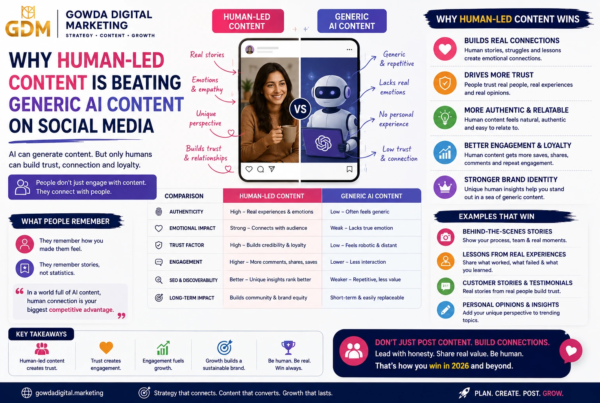
Viral Content vs. Brand-Building Content
| Viral Content | Brand-Building Content |
| Optimized for immediate attention | Optimized for long-term recognition |
| Often trend-driven | Usually insight-driven |
| Can attract broad audiences | Attracts relevant audiences |
| Short-term spikes | Compounding visibility |
| May have little business relevance | Closely connected to business goals |
| Often difficult to predict | Easier to systemize |
| Focuses heavily on reach | Focuses on trust, relevance and relationships |
The best strategy?
You do not have to choose one or the other.
Use trends as distribution opportunities, while your brand’s core content remains original.
Key Facts: Organic Social Media in 2026
📊 KEY FACTS
- Sprout Social reports that almost half of consumers surveyed said their favorite brands stand out on social because they post original content.
- Sprout Social’s 2026 research highlights community management as an increasingly important part of organic social strategy.
- Social search is becoming an important way for consumers to discover products, businesses and experiences.
- HubSpot’s 2026 research identifies authenticity, community building and social search among the important shifts affecting social media marketing.
Sources: Sprout Social – Organic Social Media Growth · Sprout Social – 2026 Social Media Trends · HubSpot – Future of Social Media 2026
Step 1: Build Your Brand Foundation
Before creating content, answer five questions.
Who are you helping?
Be specific.
Instead of:
“We help businesses grow.”
Try:
“We help Indian local businesses generate more enquiries through websites, SEO and social media.”
What problem do you solve?
Identify the problem your audience repeatedly experiences.
What do you want to be known for?
Choose a small number of associations.
For example:
Affordable digital marketing for Indian small businesses.
What makes your approach different?
Maybe you emphasize:
- Practical strategies
- Transparent pricing
- Local expertise
- Education
- Results
- Simplicity
What personality should your brand have?
Choose three to five characteristics.
For example:
Helpful + Practical + Honest + Modern + Approachable
These decisions become the foundation for your content.
Step 2: Create 4–6 Strong Content Pillars
One of the easiest ways to stop relying on trends is to create content pillars.
Content pillars are recurring subjects your brand can talk about repeatedly.
Example for a Digital Marketing Agency
Pillar 1: Education
Explain concepts your customers do not understand.
Examples:
- What is local SEO?
- How does Google Business Profile work?
- Why does website speed matter?
- What is organic social media?
Pillar 2: Mistakes
Show people what they are doing wrong.
Examples:
- 5 Instagram mistakes small businesses make
- Why your website gets traffic but no leads
- Common Google Business Profile mistakes
Pillar 3: Case Studies
Show what happened in real situations.
Examples:
- How we improved a local business’s visibility
- What changed after redesigning a landing page
- Lessons from a failed campaign
Pillar 4: Behind the Scenes
Show the people and processes behind your company.
Examples:
- How we plan content
- A day inside the agency
- Website audit process
- Client onboarding
Pillar 5: Opinions
Develop a point of view.
Examples:
- Why every business does not need to be on every platform
- Why chasing followers is overrated
- Why small businesses should prioritize Google search and social proof
Pillar 6: Community
Make your audience part of the content.
Examples:
- Answer follower questions
- Feature customer stories
- Share user-generated content
- Run polls
- Ask for opinions
Step 3: Build a Repeatable Content System
You do not need to invent something completely new every day.
Instead, build repeatable formats.
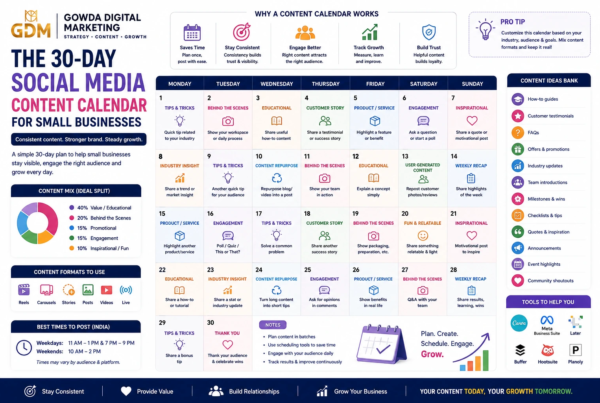
Example Weekly System
| Day | Content Type | Example |
| Monday | Educational | “3 SEO mistakes local businesses make” |
| Tuesday | Story | “What we learned from a failed campaign” |
| Wednesday | Carousel | “Website checklist for small businesses” |
| Thursday | Opinion | “Why more followers won’t necessarily mean more customers” |
| Friday | Behind the scenes | “How we create a monthly content strategy” |
| Saturday | Community | “What is your biggest marketing challenge?” |
| Sunday | Repurpose | Best lesson from the week |
This gives you structure without forcing you to post whatever happens to be trending.
Step 4: Create Content That Can Be Reused
One strong idea can become multiple pieces of content.
Step-by-Step Visual
ONE CORE IDEA
↓
Long-form blog
↓
LinkedIn post
↓
Instagram carousel
↓
Short Reel
↓
Story poll
↓
Email newsletter
↓
FAQ
↓
Website resource
This is called content repurposing.
It reduces creative pressure while increasing the number of places your ideas can appear.
Example
Core idea:
“Why small businesses should stop copying competitors’ websites.”
Turn it into:
- Blog: Why Copying Competitors Is a Bad Website Strategy
- Reel: 3 reasons copying competitors hurts your business
- Carousel: What to copy vs. what not to copy
- LinkedIn post: Your competitor’s website is not your strategy
- Story poll: “Have you ever copied a competitor?”
- Newsletter: How to develop a unique business position
One idea becomes an entire content ecosystem.
Step 5: Use Trends Without Becoming Trend-Dependent
You do not have to ignore trends.
You simply need to filter them.
Before using a trend, ask:
The 5-Question Trend Filter
- Does it fit my audience?
- Does it fit my brand personality?
- Can I connect it to my expertise?
- Will it still make sense if the trend disappears tomorrow?
- Would I post this if it were not trending?
If the answer is mostly no, skip it.
💡 CALLOUT
Do not ask: “How can my business use this trend?”
Ask: “Can this trend help me communicate something my audience already needs to know?”
That small change can dramatically improve content quality.
Step 6: Build Community, Not Just Followers
Followers are a number.
Community is a relationship.
Strong organic brands actively participate in conversations instead of treating social media like a publishing machine.
Sprout Social’s research has emphasized that consumers value connection and that community-building can influence loyalty and business outcomes.
Do more of this:
- Reply to comments thoughtfully.
- Ask follow-up questions.
- Respond to DMs.
- Mention customers.
- Share useful audience contributions.
- Ask your followers what they want to learn.
- Turn frequently asked questions into content.
- Celebrate customer wins.
- Engage with relevant industry conversations.
A simple rule
Do not spend 60 minutes creating a post and 0 minutes talking to people who respond to it.
Publishing starts the conversation.
It does not finish it.
Step 7: Make Your Content Search-Friendly
Social media is increasingly being used for discovery and research.
That means your content should not only be entertaining.
It should also be understandable.
Use the language your audience actually searches for.
Instead of a vague headline:
“You are doing this wrong.”
Try:
“5 Instagram Marketing Mistakes Small Businesses Should Avoid.”
The second version clearly communicates the topic.
Optimize your social content with:
- Specific titles
- Relevant keywords
- Clear captions
- Descriptive on-screen text
- Natural questions
- Location references when relevant
- Helpful explanations
- Accurate hashtags where useful
Do not stuff keywords unnaturally.
Write for humans first.
Step 8: Develop a Recognizable Brand Voice
Your visual identity is important.
But your voice can become equally recognizable.
Imagine two agencies posting about the same topic.
Agency A:
“Social media marketing is essential for businesses looking to increase their digital presence.”
Agency B:
“Posting every day won’t save a strategy that nobody understands.”
The second statement has personality.
Create a simple voice guide
Your brand might be:
Do:
- Be direct.
- Explain complex ideas simply.
- Use examples.
- Challenge bad marketing advice.
- Share practical steps.
Don’t:
- Use unnecessary jargon.
- Sound corporate.
- Make unrealistic promises.
- Copy competitors.
- Pretend every strategy works for everyone.
A recognizable voice makes ordinary information more memorable.
Case Studies and Examples
Example 1: Glossier
Glossier provides a useful example of how brands can move toward more relatable, community-oriented content.
Sprout Social highlights Glossier’s use of real people and relatable routines rather than relying solely on highly polished product presentation.
The lesson is not:
“Copy Glossier.”
The lesson is:
Find ways to let real people and real experiences become part of your brand story.
Example 2: A Local Indian Service Business
Imagine a Bengaluru-based home cleaning company.
Instead of posting only:
“Book our cleaning service today!”
it could build recurring content around:
- Home cleaning tips
- Before-and-after transformations
- Customer questions
- Cleaning mistakes
- Staff introductions
- Product explanations
- Maintenance checklists
- Seasonal cleaning guides
- Customer testimonials
Now the brand becomes a useful resource.
The customer may not book immediately.
But when they eventually need professional cleaning, the brand is already familiar.
Example 3: Gowda Digital Marketing
For a digital marketing brand such as Gowda Digital Marketing, a long-term content engine could focus on:
Education → Proof → Personality → Community
For example:
Education:
“How to improve your Google Business Profile”
Proof:
“What we changed during a local SEO audit”
Personality:
“3 marketing myths we disagree with”
Community:
“What is your biggest challenge with digital marketing?”
This creates a recognizable brand ecosystem without requiring daily viral content.
What Should You Measure?
If you only measure views, you may accidentally train your team to chase entertainment instead of business value.
Track a broader set of metrics.
Awareness Metrics
- Reach
- Impressions
- Profile visits
- Branded searches
Engagement Metrics
- Comments
- Shares
- Saves
- Replies
- DMs
Trust Metrics
- Positive mentions
- Customer testimonials
- Repeat interactions
- Community participation
Business Metrics
- Website visits
- Enquiries
- Leads
- Bookings
- Sales
- Newsletter signups
A better question
Instead of asking:
“Did this Reel go viral?”
ask:
“Did this content move the right person closer to trusting our business?”
30-Day Organic Social Media Roadmap
Week 1: Foundation
Day 1
Define your audience.
Day 2
Write your brand positioning statement.
Day 3
Choose 4–6 content pillars.
Day 4
Define your brand voice.
Day 5
Audit your existing social profiles.
Day 6
Review your best-performing content.
Day 7
Build your content calendar.
Week 2: Content Engine
Create:
- 2 educational posts
- 1 opinion post
- 1 case study
- 1 behind-the-scenes post
- 1 community post
- 1 short-form video
Focus on consistency rather than perfection.
Week 3: Community
Spend additional time:
- Replying to comments
- Answering DMs
- Asking questions
- Engaging with relevant accounts
- Collecting customer questions
- Turning questions into future content
Week 4: Measure and Improve
Review:
- Which topics generated saves?
- Which posts generated shares?
- Which content produced conversations?
- Which posts attracted relevant profile visits?
- Which topics generated enquiries?
- Which content formats were easiest to produce?
Then create more of what worked.
Common Mistakes to Avoid
1. Posting without positioning
If you talk about everything, people remember nothing.
2. Copying competitors
Competitor research is useful.
Competitor imitation is not a brand strategy.
3. Treating every trend as mandatory
Some trends simply do not belong to your brand.
Skip them.
4. Measuring vanity metrics only
10,000 views from irrelevant people may be less valuable than 500 views from potential customers.
5. Posting promotional content constantly
Your audience should not feel like every post is an advertisement.
6. Ignoring comments
Community is built through interaction.
7. Changing strategy every week
Organic growth compounds through consistency.
Give your strategy enough time to produce meaningful data.
Featured Snippet: How Do You Build an Organic Social Media Brand?
To build an organic social media brand, define a clear audience and positioning, establish consistent content pillars, publish useful original content, maintain a recognizable brand voice, engage actively with your community, use trends selectively, optimize content for social search, and measure business-relevant outcomes instead of focusing only on viral reach.
10 FAQs
1. Can a business grow on social media without going viral?
Yes. Organic growth can come from consistent content, search discovery, recommendations, shares, community engagement and repeat exposure. Viral content is only one possible source of reach.
2. Should I completely avoid trending content?
No. Trends can be useful when they naturally fit your audience and brand. The goal is to use trends selectively rather than depending on them.
3. How often should a business post?
There is no universal number. Choose a sustainable publishing frequency that allows you to maintain quality and consistency.
4. What is the most important type of social media content?
There is no single best format. Educational, entertaining, community-focused, proof-based and behind-the-scenes content can all serve different purposes.
5. How long does organic social media growth take?
It varies by industry, platform, audience, content quality and consistency. Think in months rather than expecting overnight results.
6. Should small businesses be active on every social media platform?
Usually not. Start with platforms where your target audience actually spends time and where your business can consistently create useful content.
7. What should I post when there are no trends?
Use your content pillars. Answer customer questions, explain common problems, share expertise, publish case studies and document your business.
8. Is follower count important?
Follower count provides context, but it does not directly tell you whether your audience is relevant or likely to become customers.
9. How can I make social media content more authentic?
Show real people, real processes, genuine opinions, customer experiences, lessons learned and behind-the-scenes moments. Avoid manufacturing artificial personality.
10. Can organic social media generate sales?
Yes. Organic social can support discovery, trust, education, community building and lead generation. Its effectiveness depends on the business model and how well social connects with the broader customer journey.
Quick Comparison: Trend Chasing vs. Organic Brand Building
| Area | Trend Chasing | Organic Brand Building |
| Main goal | Reach | Recognition + trust |
| Content source | Trends | Expertise + audience needs |
| Time horizon | Short-term | Long-term |
| Audience quality | Variable | More targeted |
| Brand identity | Often inconsistent | Consistent |
| Measurement | Views | Engagement + leads + business outcomes |
| Sustainability | Low to medium | High |
| Creative pressure | High | More manageable |
| Community | Often secondary | Core strategy |
Step-by-Step Visual: The Organic Brand Flywheel
Know Your Audience
↓
Define Your Positioning
↓
Create Content Pillars
↓
Publish Useful Original Content
↓
Start Conversations
↓
Build Community
↓
Earn Trust
↓
Generate Referrals + Leads
↓
Learn From Audience Data
↓
Improve Content
↓
Repeat
The flywheel becomes stronger over time because each cycle gives you more audience insights, examples, social proof and brand recognition.
Highlight Box: The 80/20 Content Principle
80% of your content should primarily educate, help, entertain or connect with your audience.
20% can focus directly on products, services, offers or promotions.
The exact ratio does not need to be rigid. The principle is simple: earn attention before asking for the sale.
Your Organic Social Media To-Do List
- Define your ideal audience.
- Write a one-sentence brand positioning statement.
- Choose four to six content pillars.
- Define three to five brand personality traits.
- Create five repeatable content formats.
- Build a 30-day content calendar.
- Create one core content idea every week.
- Repurpose each strong idea into multiple formats.
- Respond to comments and DMs consistently.
- Track saves, shares, comments and profile visits.
- Track enquiries and conversions.
- Review performance monthly.
- Remove content types that consistently attract irrelevant audiences.
- Double down on topics that generate meaningful conversations.
Lead Magnet Ideas
Turn this blog into a lead-generation asset by offering a free resource.
Lead Magnet 1: 30-Day Organic Social Media Calendar
A downloadable calendar containing:
- Daily content ideas
- Content pillars
- Caption prompts
- Reel ideas
- CTA examples
Lead Magnet 2: Social Media Brand Audit Checklist
Help businesses evaluate:
- Profile optimization
- Brand positioning
- Content quality
- Engagement
- Consistency
- Calls to action
Lead Magnet 3: 50 Evergreen Social Media Ideas
Create a categorized list for:
- Service businesses
- E-commerce
- Local businesses
- Startups
- Agencies
- Personal brands
Lead Magnet 4: Organic Social Media Strategy Template
Provide a fill-in-the-blank strategy document that businesses can use to create their own plan.
Collaboration Ideas With Other Creators and Blogs
Organic growth becomes easier when you build relationships outside your own account.
Consider collaborating with:
Local Business Creators
Create joint content around:
“5 Marketing Mistakes Local Businesses Make.”
SEO Consultants
Create a joint post about:
“How SEO and Social Media Work Together.”
Web Designers
Discuss:
“Why Your Website and Social Profiles Should Tell the Same Brand Story.”
Business Coaches
Create:
“How Small Businesses Can Build a Personal Brand Without Becoming Influencers.”
Startup Communities
Host a webinar:
“Building Your First Organic Social Media Strategy.”
Local Media and Business Blogs
Pitch guest articles about:
- Digital marketing for Indian SMEs
- Social media marketing
- Local SEO
- Building a digital brand
- Content marketing
The objective is not just backlinks.
It is shared credibility and audience access.
Monetization Idea: Turn Organic Content Into a Service Funnel
If you are a digital marketing agency, your content can become the first stage of a service funnel.
Step 1: Publish Educational Content
Example:
“Why Your Instagram Account Gets Views But No Leads.”
↓
Step 2: Offer a Free Resource
CTA:
“Download our free Social Media Audit Checklist.”
↓
Step 3: Collect Email Leads
Build an email list of interested business owners.
↓
Step 4: Nurture
Send useful weekly content about:
- SEO
- Websites
- Social media
- Lead generation
- Content strategy
↓
Step 5: Offer a Low-Friction Service
For example:
Paid Social Media Audit
↓
Step 6: Upsell the Right Clients
Offer:
- Social media management
- Content creation
- SEO
- Website development
- Digital advertising
- Branding
This transforms organic content from a vanity exercise into a measurable acquisition channel.
A Simple Content Formula You Can Use
When you do not know what to post, use:
Problem → Insight → Example → Action
Problem:
“Your business posts regularly but receives almost no enquiries.”
Insight:
“Posting frequency is not the same as strategic relevance.”
Example:
“Instead of posting another promotional graphic, answer one question your customers ask before buying.”
Action:
“Create three posts this week based on your top three customer questions.”
Simple.
Useful.
Repeatable.
What Expert Opinions Tell Us
Sprout Social’s 2026 trend research points toward community management becoming increasingly important as brands recognize that organic reach depends not only on what they publish but also on how they engage with audiences.
Sprout Social also reports that original content is a meaningful differentiator for brands, reinforcing the case for developing a distinctive content identity instead of simply copying whatever is popular.
And HubSpot’s 2026 research identifies authenticity, community building and social search among major developments shaping social media marketing.
The broader lesson is straightforward:
Build something people recognize, not something algorithms temporarily reward.
Key Takeaways
1. Virality is not the same as brand growth.
A viral post can create awareness, but consistent relevance creates recognition.
2. Build around content pillars.
Your business should have recurring subjects that you can discuss for months or years.
3. Originality matters.
Your perspective is part of your competitive advantage.
4. Trends should support your strategy.
Do not allow trends to become your strategy.
5. Community is an asset.
Comments, DMs, conversations, customer stories and referrals can be more valuable than passive impressions.
6. Make your content discoverable.
Use clear language and topics people actually search for.
7. Measure business value.
Track meaningful engagement, enquiries, leads, conversions and brand signals—not only views.
Conclusion: Build a Brand People Remember
The easiest way to lose your social media identity is to constantly ask what everyone else is doing.
The better question is:
“What can our brand consistently say, teach, show or contribute that our audience will find valuable?”
You do not need a viral Reel every week.
You need a recognizable voice.
You need useful ideas.
You need consistency.
You need conversations.
And you need enough patience to allow trust to compound.
Trends will come and go.
Algorithms will change.
Content formats will evolve.
But a brand that consistently helps its audience can remain relevant through all of them.
Do not build your social media strategy around becoming famous for one post. Build it around becoming known for something.
Want more practical digital marketing strategies for growing a business online?
Subscribe to the Gowda Digital Marketing newsletter for actionable insights about social media marketing, SEO, websites, content strategy and digital growth.
And tell us in the comments:
What is your biggest challenge with organic social media—creating content, getting engagement, finding ideas, or converting followers into customers?
Your answer could become the topic of our next article.
References & Sources
- Sprout Social – How to Drive Organic Social Media Growth in 2026
- Sprout Social – Post Performance Report: Brand Content Franchises
- Sprout Social – The State of Social Media 2026
- Sprout Social – Social Media Search in 2026
- Sprout Social – 7 Social Media Trends to Know in 2026
- Sprout Social – BrandsGetReal: Social Connection Research
- HubSpot – The Future of Social Media: 2026 Research
- HubSpot – Social Media Trends to Watch in 2026