
A brand can publish excellent content every day and still feel completely invisible if nobody is managing the conversations happening around it.
Introduction
Most social media strategies begin with a familiar question:
“What should we post this week?”
Teams create content calendars, write captions, design carousels, shoot Reels, schedule posts and track likes, reach and impressions.
But there is another question that often receives far less attention:
“What are we doing after people respond?”
That is where community management enters the picture.
Social media is not simply a publishing channel. It is a conversation environment. People ask questions in comments, send DMs, tag friends, share experiences, recommend products, complain about problems and discuss brands without waiting for a business to publish another post.
Community management gives a business a structured way to participate in those conversations.
Research from Sprout Social reinforces this shift. Its 2025 Social Index surveyed more than 4,000 consumers, 900 social practitioners and 300+ marketing leaders, highlighting the growing importance of authentic, human and relevant brand interactions on social media.
For businesses, this means social media success is increasingly about more than publishing content.
It is about building relationships around that content.
Why Most Social Media Strategies Stop Too Early
A typical social media workflow looks like this:
Research → Create → Publish → Report
The missing stage is:
Engage → Listen → Respond → Build relationships
This creates a major gap.
A business might receive 50 comments on a post but reply to only five.
Someone may ask a buying question in a DM and receive a response two days later.
A customer may mention the brand in a Story, but nobody acknowledges it.
A follower may repeatedly comment on posts but never receive recognition.
Over time, the account starts behaving like a billboard instead of a community.
Why this matters
Social media gives customers a public and direct way to communicate with brands.
According to Sprout Social, comments and DMs increasingly function as customer-service touchpoints, while user-generated content and communities can contribute to loyalty and advocacy.
If your business only focuses on content production, you may be optimizing the part of social media that your audience sees first—but ignoring the part that makes people stay.
Callout:
Content gets attention. Community management turns attention into relationships.
What Is Community Management?
Community management is the process of actively building, maintaining and strengthening relationships with people around a brand on social platforms and other digital spaces.
It can include:
- Replying to comments
- Responding to DMs
- Answering customer questions
- Monitoring brand mentions
- Acknowledging user-generated content
- Starting conversations
- Encouraging followers to interact with one another
- Handling complaints
- Identifying recurring customer concerns
- Sharing useful community feedback with internal teams
- Recognizing loyal followers
- Connecting customers with relevant resources
- Maintaining the brand’s tone during conversations
Community management is therefore different from simply posting content.
Social media content vs. community management
| Social Media Content | Community Management |
| Starts conversations | Continues conversations |
| Focuses on publishing | Focuses on interaction |
| Usually brand-led | Audience-led and brand-supported |
| Measures reach and engagement | Measures relationship and interaction quality |
| Creates awareness | Builds trust |
| Pushes messages outward | Brings audience feedback inward |
| Often scheduled | Often requires real-time attention |
The two should not compete.
They should work together.
Why Community Management Is the Missing Part of Social Media Strategy
1. Your Audience Is Already Talking
You don’t have to create every conversation.
Your audience may already be discussing:
- Your products
- Your services
- Your competitors
- Industry problems
- Customer experiences
- Pricing
- Product features
- Trends
- Questions
- Recommendations
The opportunity is to listen and participate.
Social media culture is fundamentally participatory. Sprout Social notes that what distinguishes social media from traditional media is the ability for people to participate through comments, polls, conversations and other interactive formats.
That makes community management an essential part of the medium—not an optional extra.
2. It Humanizes the Brand
People do not want every interaction to feel automated.
A polished brand account can attract attention, but genuine human interaction can create familiarity.
Compare these two experiences:
Experience A:
A customer comments, “How much does this cost?”
The brand replies:
“Please check our website.”
Experience B:
The brand replies:
“Hi Rahul! This plan starts at ₹X/month. If you tell us how many people are on your team, we can suggest the most suitable option.”
The second response is more useful, personal and conversational.
That difference is community management.
3. It Builds Brand Trust
Trust is rarely created by a single post.
It develops through repeated experiences.
A potential customer may notice:
- How quickly you answer questions
- Whether you acknowledge criticism
- How you treat unhappy customers
- Whether you thank people for compliments
- Whether employees participate
- Whether your responses sound human
- Whether you remember recurring community members
Those small interactions collectively shape brand perception.
Sprout Social’s research has found strong links between consumer connection and brand loyalty. In one study, 64% of consumers said their loyalty increases when they feel connected to a brand, while 76% said they would choose a brand they feel connected to over a competitor.
The Community Management Flywheel
A useful way to visualize community management is:
Content → Conversation → Response → Trust → Advocacy → More Content
Step-by-step visual
1. Publish useful content
↓
2. People react, comment or DM
↓
3. Brand responds thoughtfully
↓
4. Audience feels heard
↓
5. Trust increases
↓
6. Customers participate more often
↓
7. UGC, referrals and advocacy increase
↓
8. Community creates new content opportunities
This creates a cycle rather than a one-way publishing system.
Content Without Community vs. Content With Community
| Without Community Management | With Community Management |
| Publish and move on | Publish and participate |
| Focus on reach | Focus on reach + relationships |
| Comments are treated as metrics | Comments are treated as conversations |
| DMs may be neglected | DMs become customer touchpoints |
| Followers remain passive | Followers become participants |
| Feedback gets lost | Feedback informs strategy |
| Brand speaks | Brand listens and responds |
| Short-term attention | Long-term relationship building |
Key lesson:
A strong social media strategy needs both content creation and community participation.
The Business Benefits of Community Management
1. Better Customer Experience
Customers increasingly use social platforms to ask questions and seek help.
A timely response can reduce friction.
Instead of making customers:
Search → Find website → Locate contact page → Submit form → Wait
they can often:
Comment → Receive answer → Continue buying journey
That convenience matters.
Sprout Social reported that 73% of consumers in its cited research would take their business elsewhere if a brand failed to respond on social media.
2. More Customer Insights
Community managers are sitting close to the voice of the customer.
They can identify recurring questions such as:
- “Does this work for small businesses?”
- “What is the delivery time?”
- “Can I customize this?”
- “Do you offer a monthly plan?”
- “Is this available in Bangalore?”
- “How is this different from your competitor?”
These questions are content ideas.
They can become:
- Reels
- FAQs
- Blog posts
- Carousels
- Product pages
- Email campaigns
- Tutorials
Your community can therefore become a free research department.
3. More User-Generated Content
Customers can become content contributors.
For example:
A customer posts a photo using your product.
Your community manager can:
- Like the post.
- Comment genuinely.
- Ask permission to repost.
- Tag the customer.
- Share it to Stories.
- Save it for future campaigns.
- Thank the customer publicly.
One customer interaction can become a trust-building content asset.
4. Stronger Customer Loyalty
People are more likely to remember businesses that make them feel recognized.
Recognition can be simple:
“Thanks for being with us since 2024!”
or:
“We loved your setup—thanks for sharing it with the community!”
These moments may appear small internally.
They can feel significant to the customer.
A Practical Community Management Strategy for Indian Businesses
Step 1: Define Your Community
Don’t begin with:
“How many followers do we need?”
Start with:
“Who do we want to build relationships with?”
Define:
- Ideal customers
- Existing customers
- Prospects
- Industry professionals
- Creators
- Partners
- Advocates
- Employees
- Local communities
Step 2: Choose Your Priority Platforms
You don’t need to manage every platform equally.
For many businesses, priorities might include:
- YouTube
- X
- Industry-specific communities
Choose platforms based on where your customers actually communicate.
Step 3: Create a Response System
Set basic response standards.
For example:
| Interaction | Target Response |
| Simple comment | Same business day |
| Product question | Same business day |
| DM inquiry | As quickly as practical |
| Complaint | Acknowledge promptly |
| Spam | Remove/restrict where appropriate |
| Complex issue | Escalate to relevant team |
| Positive UGC | Thank and engage |
These are internal operating targets, not universal platform rules.
The goal is consistency.
Step 4: Build a Community Response Playbook
Your team should know how to respond to different situations.
Positive comments
Don’t respond with:
“Thanks!”
Try:
“Thank you! What did you like most about it?”
The second response opens a conversation.
Questions
Answer directly first.
Then add useful context.
Complaints
Use this structure:
Acknowledge → Clarify → Help → Escalate if necessary
Avoid arguing publicly.
Trolls
Not every comment deserves a debate.
Know when to:
- Ignore
- Hide
- Restrict
- Report
- Respond once
- Escalate
Spam
Protect the quality of the community.
Step 5: Create Conversation-First Content
Instead of ending every caption with:
“Buy now.”
Try conversation prompts.
Examples:
- “Which option would you choose?”
- “What is your biggest challenge with this?”
- “Have you experienced this?”
- “What would you add to this list?”
- “Small business owners: what is one task you wish you could automate?”
- “Which feature would you want us to launch next?”
The objective is not to manufacture comments.
It is to give people a reason to contribute.
Step 6: Recognize Your Regulars
Every community has recurring participants.
They may be:
- Loyal customers
- Industry experts
- Micro-creators
- Superfans
- Employees
- Helpful community members
Recognize them.
Possible approaches:
- Feature their content
- Thank them
- Invite them to events
- Ask for feedback
- Offer early access
- Highlight their expertise
- Create customer spotlights
Recognition can turn followers into advocates.
Step 7: Turn Community Feedback Into Content
Create a simple feedback loop:
Comments + DMs + Mentions
↓
Identify recurring questions
↓
Group by topic
↓
Create content
↓
Publish answers
↓
Measure response
↓
Repeat
This makes your content strategy more customer-driven.
Step 8: Measure What Actually Matters
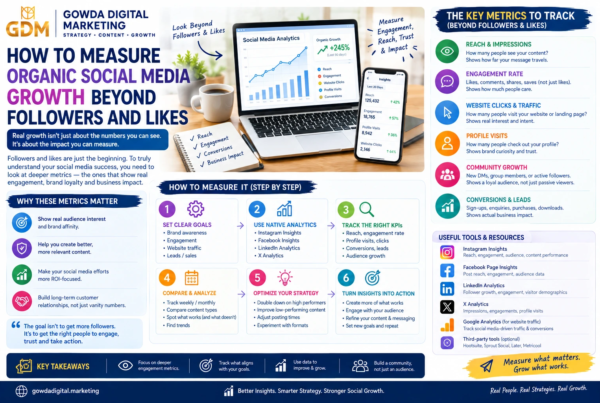
Likes are useful, but community management needs broader metrics.
Track:
Engagement metrics
- Comment volume
- Meaningful comments
- Replies per post
- Conversation depth
- DM volume
- Mentions
- Shares
- Saves
Customer experience metrics
- Response time
- Resolution time
- Questions answered
- Complaints resolved
- Escalations
Community health metrics
- Repeat commenters
- UGC volume
- Community participation
- Positive mentions
- Advocate activity
Business metrics
Where attribution is possible:
- Leads from social conversations
- Assisted conversions
- Customer retention
- Referral activity
- Sales influenced by social interactions
CMX’s community research highlights the continuing pressure on community teams to demonstrate impact and connect their work with business outcomes. Its 2026 report also notes that community teams are operating with expanding mandates while remaining lean.
Key Facts & Statistics Box
📊 Social Media Community Management: Key Facts
93% of consumers surveyed in Sprout Social’s 2025 Index said it is important for brands to keep up with online culture.
64% of consumers in Sprout Social research said their loyalty increases when they feel connected to a brand.
76% said they would choose a brand they feel connected to over a competitor.
73% of consumers cited by Sprout Social said they would take their business elsewhere if a brand doesn’t respond on social media.
93% of community professionals in CMX’s 2026 report were using AI tools, illustrating how community roles are increasingly combining human relationship-building with technology.
Statistics are based on the cited studies and their respective survey methodologies; they should not be interpreted as universal figures for every market.
Expert Perspective
“What defines social media over other forms of media is the ability to participate.”
— Savanna Sargent, Manager, Content at Sprout Social
That idea captures the heart of community management.
Social media isn’t simply a place where brands distribute information.
It is a place where audiences participate.
The brands that understand this distinction can build social strategies around interaction rather than interruption.
Mini Case Study: A Local Indian Service Business
Imagine a Bengaluru-based digital marketing agency.
Its existing strategy is:
- 4 Instagram posts per week
- 2 Reels
- 1 carousel
- Paid advertising
- Monthly analytics report
The team receives:
- Questions about pricing
- DMs asking about services
- Comments from business owners
- Questions about SEO
- Requests for website audits
But the team treats these interactions as secondary.
The community-led approach
The agency creates a system.
Every day:
- Check comments
- Respond to relevant DMs
- Monitor mentions
- Identify customer questions
- Save useful questions
Every week:
- Turn recurring questions into content
- Feature one client story
- Highlight useful community comments
- Review unanswered conversations
Every month:
- Analyze common questions
- Identify content gaps
- Measure response times
- Track leads originating from conversations
- Identify potential advocates
The content calendar now comes from real conversations.
That’s the strategic advantage.
Mini Case Study: A D2C Brand
Consider an Indian skincare brand.
A customer comments:
“Is this suitable for oily skin?”
Instead of replying with a generic product link, the brand can answer the question clearly and explain how the product is intended to be used.
Then the question can inspire:
- A Reel about choosing products for oily skin
- An FAQ carousel
- A Story poll
- A blog post
- A product-page FAQ
One comment becomes an entire content cluster.
Community management and content strategy begin feeding each other.
A 30-Day Community Management Framework
Week 1: Listen
Focus on:
- Comments
- DMs
- Mentions
- Customer questions
- Competitor conversations
- Industry conversations
Create a list of recurring themes.
Week 2: Respond
Create response templates for:
- Questions
- Complaints
- Compliments
- Product inquiries
- Collaboration requests
- Spam
Keep templates flexible rather than robotic.
Week 3: Activate
Start:
- Conversation posts
- Polls
- Q&As
- UGC features
- Customer spotlights
- Expert discussions
Week 4: Learn
Review:
- Most common questions
- Best conversations
- Highest-quality comments
- Response times
- UGC generated
- Leads from conversations
Then use the findings to improve the next month’s strategy.
What Community Managers Should NOT Do
Community management is not about replying to everything with the same template.
Avoid:
❌ Copy-paste responses
They make the brand sound automated.
❌ Arguing with customers
Public arguments rarely improve brand perception.
❌ Chasing every trend
Sprout Social’s research suggests that simply jumping on viral trends can backfire; authenticity and relevance matter more than blindly participating in every trend.
❌ Ignoring negative feedback
Silence doesn’t make a problem disappear.
❌ Treating comments only as metrics
A comment is not just a number.
It may be a question, objection, opportunity or signal.
❌ Making every conversation about sales
Sometimes the best response is simply helpful.
Community Management vs. Social Media Management
| Area | Social Media Management | Community Management |
| Content calendar | Core responsibility | Supports with audience insights |
| Publishing | Core responsibility | Secondary |
| Comments | Monitors | Actively manages |
| DMs | Often handled | Core responsibility |
| Customer conversations | Sometimes | Core responsibility |
| Brand mentions | Monitors | Engages |
| UGC | May collect | Encourages and nurtures |
| Customer feedback | Reports | Actively gathers |
| Brand relationships | Supports | Core focus |
| Community health | Secondary | Primary |
In smaller businesses, one person may perform both roles.
That is perfectly normal.
The important thing is to ensure the community function doesn’t disappear because content production feels more urgent.
How AI Can Support Community Management
AI can help community teams work faster, but it shouldn’t replace human judgment.
Useful applications include:
- Categorizing comments
- Summarizing recurring questions
- Drafting response variations
- Identifying sentiment patterns
- Creating FAQ databases
- Organizing community feedback
- Detecting repeated customer issues
- Turning conversations into content ideas
But sensitive conversations still need human oversight.
A useful principle is:
Automate the administration. Humanize the interaction.
CMX’s 2026 research indicates that AI adoption among community professionals is becoming mainstream, but the role continues to involve strategic relationship-building and business impact.
What Is Community Management in Social Media?
Community management in social media is the process of building and maintaining relationships with a brand’s audience through comments, DMs, mentions, conversations, user-generated content and other interactions. Unlike content management, which focuses primarily on publishing, community management focuses on listening, responding, helping and encouraging participation.
Why Is Community Management Important?
Community management is important because it helps brands turn social media attention into relationships. It can improve customer experience, strengthen trust, collect customer insights, encourage user-generated content, support loyalty and create opportunities for leads and advocacy.
10 FAQs
1. What is community management in social media?
Community management is the process of interacting with and supporting a brand’s audience across social platforms. It includes comments, DMs, mentions, questions, complaints, UGC and relationship-building activities.
2. Is community management different from social media management?
Yes. Social media management usually includes strategy, content creation, publishing and reporting. Community management focuses more heavily on conversations, relationships, audience feedback and customer interactions.
However, the two functions often overlap in smaller businesses.
3. Why does community management matter for small businesses?
Small businesses can benefit significantly because personal interaction can help them differentiate themselves from larger competitors. Responding thoughtfully to questions and recognizing customers can make a smaller brand feel accessible and trustworthy.
4. Should every comment receive a reply?
No.
Prioritize meaningful comments, customer questions, purchase-related inquiries and conversations where a useful response adds value. You do not need to engage with spam or obvious trolling.
5. How quickly should a business respond to DMs?
As quickly as realistically possible based on the business and platform. The important principle is to establish an internal response standard and maintain consistency.
6. Can community management generate sales?
Yes, community management can support sales by answering questions, reducing friction, helping prospects understand products and moving conversations toward appropriate next steps.
However, not every community interaction should be treated as a sales opportunity.
7. What should a community manager post?
Community managers can contribute conversation starters, questions, polls, customer stories, UGC, educational content and discussions based on audience interests.
8. Can one person handle social media and community management?
Yes, especially for small businesses.
The key is to allocate dedicated time for community interaction rather than allowing content creation to consume the entire schedule.
9. How do you measure community management?
Useful metrics include meaningful comments, response time, DMs, mentions, UGC, repeat participants, customer issues resolved, leads influenced and other relationship or business outcomes.
10. Is community management worth paying for?
For businesses that receive meaningful social interaction, customer questions or brand mentions, professional community management can be valuable. The right investment depends on audience size, interaction volume, platform mix and business goals.
Highlight Box: The 80/20 Community Principle
A practical starting point is to think about community work in terms of:
80% helpful interaction + 20% promotional interaction
This is not a universal rule or platform requirement.
It is simply a useful strategic reminder:
If every interaction tries to sell, the community stops feeling like a community.
Actionable Community Management To-Do List
- Identify your top three social platforms.
- Define your ideal community members.
- Audit unanswered comments and DMs.
- Create a community response playbook.
- Establish internal response-time targets.
- Create rules for complaints, spam and trolling.
- Track recurring customer questions.
- Turn recurring questions into content.
- Identify loyal followers and advocates.
- Encourage user-generated content.
- Create at least one conversation-focused post each week.
- Review community metrics monthly.
- Share customer insights with sales and product teams.
- Test AI for administrative tasks while retaining human oversight.
Summary: Key Takeaways
Community management is not an optional add-on to social media marketing.
It is the layer that connects content with people.
The most important lessons are:
- Content starts conversations; community management continues them.
- Comments and DMs can be customer-experience touchpoints.
- Authentic interaction can strengthen brand trust.
- Community feedback can become a source of content ideas.
- UGC can turn customers into brand advocates.
- Not every social interaction should be treated as a sales pitch.
- Response systems help businesses maintain consistency.
- Community metrics should go beyond likes and follower counts.
- AI can support community teams, but human judgment remains important.
- A strong social media strategy should combine publishing, listening and participation.
Conclusion
A social media account can have beautiful graphics, professional videos and an impressive content calendar—and still fail to build meaningful relationships.
The missing ingredient is often community management.
Your audience isn’t just consuming your content.
They are asking questions.
They are sharing opinions.
They are mentioning your brand.
They are sending DMs.
They are recommending you to friends.
They are telling you what they like and what frustrates them.
Every one of those interactions is an opportunity.
The brands that treat social media as a broadcasting channel will continue to compete for attention.
The brands that treat it as a relationship channel can build something much more valuable:
a community of people who know, trust, interact with and eventually advocate for the brand.
At Gowda Digital Marketing, the goal shouldn’t simply be to help businesses post more.
It should be to help them listen better, respond smarter and build stronger relationships through social media.
Want more practical social media marketing insights for your business?
Subscribe to the Gowda Digital Marketing newsletter for actionable strategies covering social media, content marketing, SEO, digital branding and business growth.
And if you’re already managing a social media community:
What is the biggest challenge you face—getting comments, responding to DMs, handling negative feedback, or turning followers into customers?
Share your experience in the comments.
References & Sources
- Sprout Social — The 2025 Sprout Social Index
Research covering consumers, social practitioners and marketing leaders and their changing expectations around social media. Sprout Social Index 2025 - Sprout Social — The Next Era of Customer Engagement on Social Media
Research and guidance on customer engagement, comments, DMs, UGC and community-building. Customer Engagement on Social Media - Sprout Social — Why Understanding Social Media Culture Is a Must
Insights into participation, audience engagement and the role of conversation in social media culture. Social Media Culture Insights - Sprout Social — BrandsGetReal: What Consumers Want From Brands
Research into brand connection, loyalty, customer relationships and social engagement. BrandsGetReal Research - CMX — 2026 Community Industry Report
Research covering community teams, budgets, ROI, technology and AI adoption. CMX 2026 Community Industry Report - CMX — Community Industry Reports
A collection of research and resources covering the evolving community management industry. CMX Community Reports