
Did you know that nearly 90% of mobile apps fail because they solve problems nobody actually has?
Building a mobile application requires significant investments in development, design, testing, marketing, and maintenance. Many entrepreneurs rush into development without validating whether users actually need their solution.
The result? Thousands of dollars wasted on products that never gain traction.
The good news is that successful startups validate their app ideas before writing a single line of code. Validation helps confirm market demand, identify target users, and reduce financial risks.
This guide explains how to validate a mobile app idea before spending on development and gives practical steps you can implement immediately.
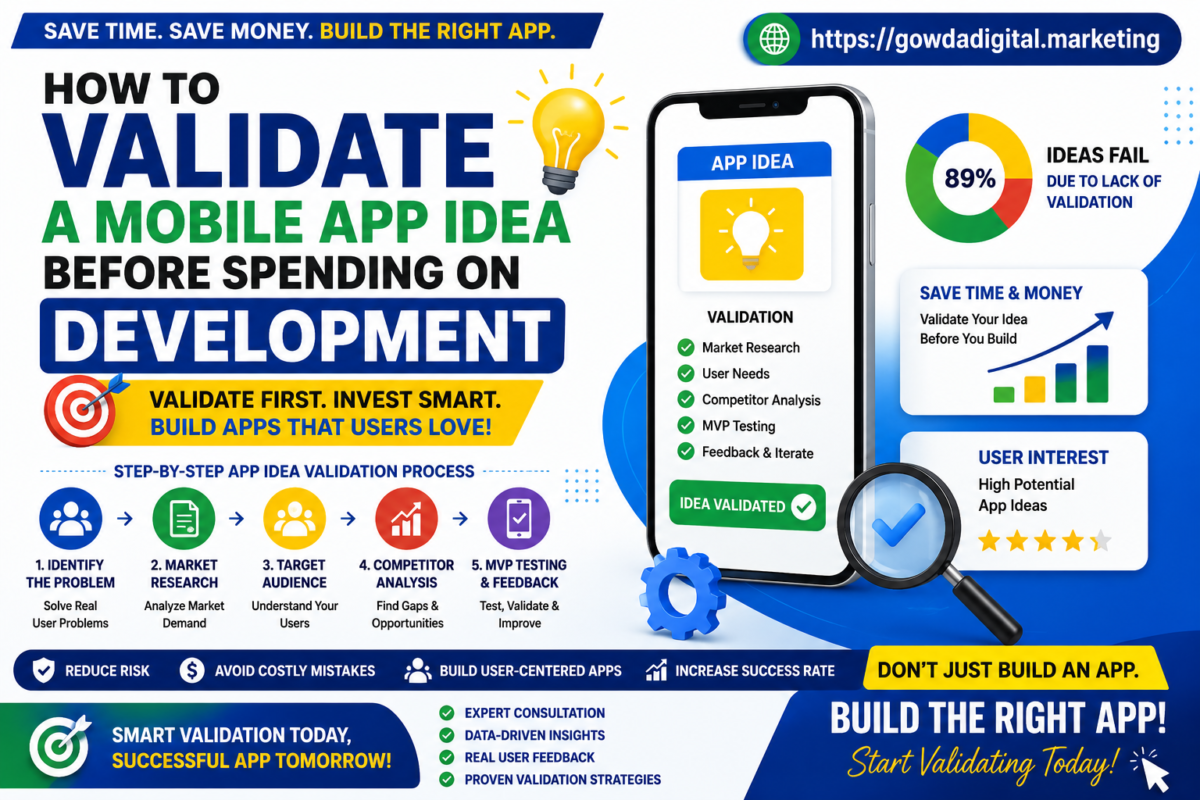
Validate Your Mobile App Idea Before Investing in Development
Why Mobile App Validation Matters
Launching an app without validation can lead to:
- Poor user adoption
- Low downloads
- Negative ROI
- Increased development costs
- Product-market mismatch
- Business failure
Validation helps you:
- Save development costs
- Understand customer needs
- Identify competitors
- Build the right features
- Increase launch success rates
Table of Contents
- What Is Mobile App Validation?
- Identify the Problem You Are Solving
- Research the Market
- Analyze Competitors
- Define Your Target Audience
- Create a Landing Page
- Run Customer Interviews
- Build a Minimum Viable Product (MVP)
- Test Paid Advertising
- Measure Validation Metrics
- Common Validation Mistakes
- Real-World Examples
- FAQs
- Conclusion
What Is Mobile App Validation?
Mobile app validation is the process of confirming that your app idea solves a genuine problem and that users are willing to use or pay for it.
Validation answers critical questions:
- Is there market demand?
- Who are the users?
- Will users pay?
- Are competitors already solving this problem?
- Can the idea scale?
Step 1: Identify the Problem You Are Solving
Why Problem Validation Comes First
Many founders focus on features instead of problems. Successful apps solve real pain points.
Ask Yourself:
- What problem does my app solve?
- How serious is the problem?
- Who experiences it?
- How often does it occur?
Example
Instead of saying:
❌ “I want to create a fitness app.”
Say:
✅ “I want to help busy professionals complete 15-minute daily workouts.”
The second statement identifies a specific problem and audience.
Step 2: Conduct Market Research
Validate Market Demand
Use tools such as:
- Google Trends
- Google Keyword Planner
- App Store Search
- Reddit Communities
- Quora
- Facebook Groups
Key Questions
- Are people searching for solutions?
- Is demand increasing?
- Are users discussing the problem online?
Key Statistics Box
📊 Important Market Facts
- More than 6.8 billion smartphone users worldwide.
- Average smartphone user spends over 4 hours daily on mobile apps.
- Over 255 billion app downloads occur annually.
- Most failed apps lack product-market fit.
Step 3: Analyze Competitors
Learn From Existing Apps
Competition is often a positive sign—it means demand already exists.
Analyze:
| Factor | What to Check |
| Downloads | Popularity |
| Reviews | User complaints |
| Pricing | Revenue potential |
| Features | Market expectations |
| Ratings | User satisfaction |
Tools to Use
- App Store
- Google Play Store
- Sensor Tower
- SimilarWeb
Step 4: Define Your Ideal User
Create User Personas
A user persona helps understand customer behavior.
Example Persona
- Name: Rahul
- Age: 29
- Profession: Software Engineer
- Challenge: Lack of time for fitness
- Goal: Quick daily workouts
Step 5: Create a Landing Page
Test Interest Before Building
Build a simple page explaining:
- Problem
- Solution
- Benefits
- Email signup form
Metrics to Track
- Visitor count
- Conversion rate
- Email signups
- Click-through rate
Validation Goal
A conversion rate above 10% often indicates strong interest.
Step 6: Conduct Customer Interviews
Talk to Real Users
Customer conversations provide insights impossible to obtain through surveys alone.
Ask Questions Like:
- How do you currently solve this problem?
- What frustrates you most?
- What would an ideal solution look like?
- Would you pay for a solution?
Target
Interview at least 20–50 potential users.
Expert Opinion
“Fall in love with the problem, not the solution.”
— Uri Levine, Co-Founder of Waze
Step 7: Build an MVP
What Is an MVP?
A Minimum Viable Product contains only essential features needed to test assumptions.
Benefits
- Faster launch
- Lower costs
- Real feedback
- Reduced risk
MVP Example
For a food delivery app:
Launch with:
- User registration
- Restaurant listings
- Order placement
Avoid advanced features initially.
Step 8: Run Paid Ads
Validate Demand Using Advertising
Before development, run small campaigns.
Platforms
- Google Ads
- Facebook Ads
- Instagram Ads
- LinkedIn Ads
Budget
Start with: ₹2,000–₹10,000
Track
- Click-through rate
- Cost per lead
- Signup conversions
Step 9: Measure Validation Metrics
Important KPIs
- Acquisition Metrics: Website traffic, signups, downloads
- Engagement Metrics: Session duration, feature usage, retention
- Revenue Metrics: Pre-orders, subscription interest, customer willingness to pay
Case Study: Dropbox Validation Success
Before building the product, Dropbox created a simple explainer video demonstrating how the software would work.
Results:
- Thousands of signups overnight
- Massive user interest validated
- Investors gained confidence
This simple validation saved enormous development costs.
Common Validation Mistakes
Avoid These Errors:
- Building Too Early – Many founders start coding without feedback.
- Ignoring User Feedback – Customers reveal critical improvements.
- Surveying Friends Only – Friends often provide biased opinions.
- Copying Competitors – Differentiation is essential.
- Overbuilding Features – Focus on solving one core problem first.
Comparison Table: Idea Validation vs No Validation
| Validation Approach | No Validation |
| Lower risk | Higher risk |
| User-focused | Assumption-based |
| Cost-effective | Expensive |
| Faster product-market fit | Delayed success |
| Better ROI | Uncertain ROI |
Step-by-Step Visual Process
Mobile App Validation Framework
Idea → Problem Research → Market Analysis → User Interviews → Landing Page → Ads Testing → MVP → User Feedback → Full Development
Pro Tip
If users are unwilling to provide an email address or pay a small amount for early access, they may not value the solution enough.
10 Frequently Asked Questions
- Why should I validate an app idea?
Validation reduces risks and confirms market demand.
- What is the cheapest way to validate an app idea?
Landing pages, surveys, and customer interviews.
- How many users should I interview?
At least 20–50 potential customers.
- What is an MVP?
A basic version of your app used to test demand.
- How long should validation take?
Typically 2–8 weeks.
- Can I validate without coding?
Yes. Landing pages and prototypes work effectively.
- Are competitors bad?
No. Competitors indicate existing demand.
- Should I spend money on ads?
Small campaigns can reveal market interest quickly.
- What metrics matter most?
Conversions, signups, engagement, and willingness to pay.
- What happens after validation?
Build an MVP and continue gathering feedback.
Summary / Key Takeaways
- Start with a real problem
- Research the market thoroughly
- Analyze competitors
- Define target users
- Conduct customer interviews
- Create a landing page
- Test demand using ads
- Launch an MVP
- Measure engagement metrics
- Build only after validation
Actionable To-Do List
Week 1
- Define app problem
- Research competitors
- Create user personas
Week 2
- Interview 20 users
- Launch landing page
Week 3
- Run paid advertisements
- Collect signups
Week 4
- Analyze results
- Build MVP if validation succeeds
Conclusion
Validating a mobile app idea before development is one of the smartest investments an entrepreneur can make. Instead of relying on assumptions, validation provides real-world evidence that users want your solution.
By conducting market research, speaking with customers, testing demand, and launching an MVP, you dramatically increase your chances of creating a successful app while minimizing risk and unnecessary expenses.
The most successful mobile applications are built on validated problems—not assumptions.
Call To Action
🚀 Planning to build a mobile app?
Subscribe to our newsletter for weekly startup growth strategies, app development insights, and product validation tips.
💬 Have an app idea? Share it in the comments below, and let’s discuss how you can validate it before investing in development.