
If you’re planning to invest ₹50,000 or ₹5 lakh in digital advertising, choosing the wrong platform could mean wasted budget and missed opportunities.
Digital advertising remains one of the most effective ways to generate leads, sales, and brand awareness in 2026.
However, one question continues to dominate marketing discussions:
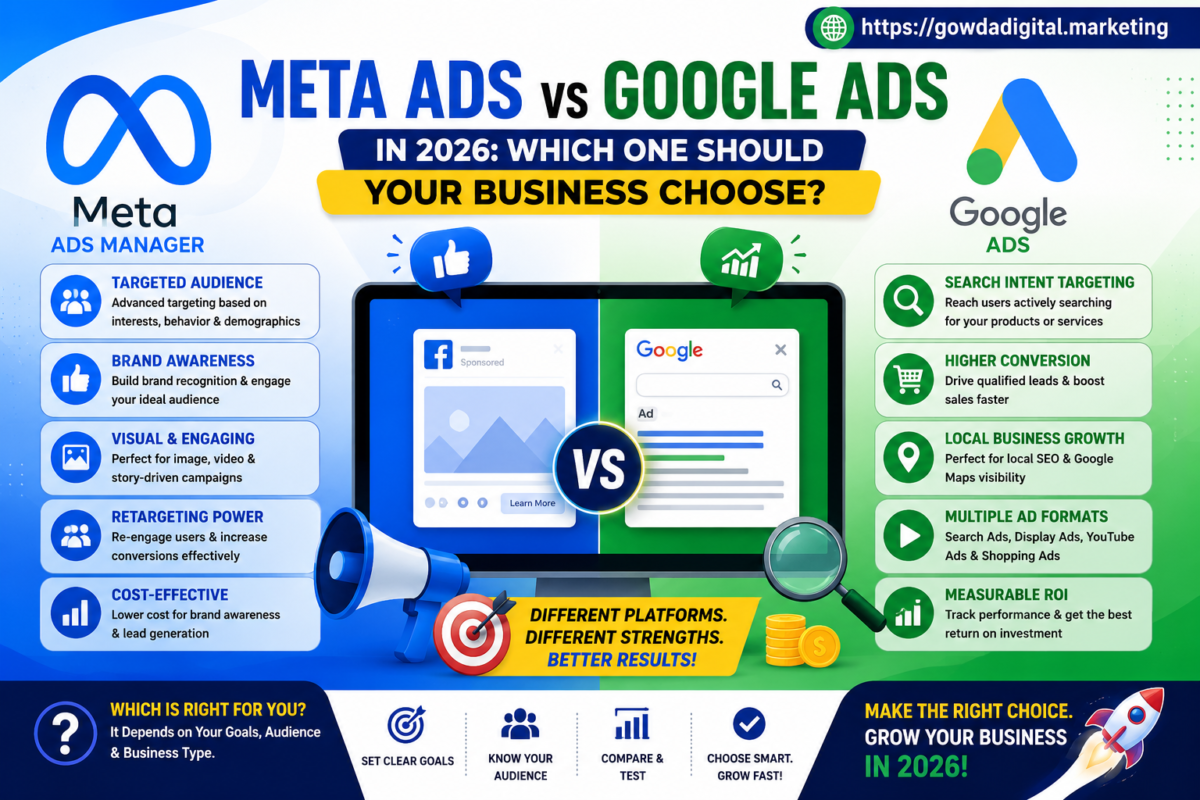
Should businesses choose Meta Ads or Google Ads?
While both platforms offer advanced AI-powered targeting, automation, and performance optimization, they operate differently and influence customers at different stages of the buying journey.
Understanding these differences can help businesses maximize advertising ROI while minimizing wasted spend.
This comprehensive guide compares Meta Ads and Google Ads across targeting, costs, lead generation, conversions, scalability, and business suitability.
Why It Matters: The Problem Statement
Many businesses make the mistake of:
- Running ads without a strategy
- Choosing platforms based on popularity
- Ignoring customer intent
- Spending money without tracking ROI
The result:
❌ High ad costs
❌ Poor conversions
❌ Low-quality leads
❌ Budget wastage
Choosing the right platform directly impacts profitability.
What You Will Learn
✅ Key differences between Meta Ads and Google Ads
✅ Which platform generates better leads
✅ Cost comparisons
✅ Industry-specific recommendations
✅ How to maximize advertising ROI in 2026
Table of Contents
- What Are Meta Ads?
- What Are Google Ads?
- Major Differences Between Meta Ads and Google Ads
- Audience Intent Comparison
- Cost Comparison
- Lead Generation Comparison
- E-commerce Advertising Performance
- B2B Advertising Performance
- Best Platform by Industry
- Real Business Case Studies
- Meta Ads vs Google Ads Comparison Table
- Frequently Asked Questions
- Conclusion
What Are Meta Ads?
Meta Ads include advertising across:
- Messenger
- Audience Network
- Threads (where available)
Meta focuses on:
- Interest-based targeting
- Behavioral targeting
- Visual storytelling
- Brand awareness
- Audience engagement
What Are Google Ads?
Google Ads allows businesses to advertise across:
- Google Search
- Google Display Network
- YouTube
- Google Shopping
- Gmail
- Discover Feed
Google focuses on:
- Search intent
- Keyword targeting
- Demand capture
- Purchase-ready users
Understanding User Intent
Meta Ads = Demand Generation
Users are scrolling social media and not actively searching. Businesses create demand through engaging content.
Example:
A fitness brand introduces a new workout program through Instagram Reels.
Google Ads = Demand Capture
Users actively search for solutions.
Example searches:
- “Best gym near me”
- “SEO agency in Bangalore”
- “Buy office printer online”
These users already have buying intent.
🚀 Pro Tip:
If your customer is searching for a solution today, Google Ads often wins. If your customer doesn’t know they need your solution yet, Meta Ads often performs better.
Cost Comparison in 2026
Meta Ads Costs
Advantages:
- Lower cost per impression
- Lower audience acquisition cost
- Excellent for awareness campaigns
Challenges:
- Lead quality may vary
- Longer customer journey
Google Ads Costs
Advantages:
- Higher intent traffic
- Faster conversions
Challenges:
- Higher CPC in competitive industries
- Greater competition
| Metric | Meta Ads | Google Ads |
| CPC | Lower | Higher |
| CPM | Lower | Higher |
| Brand Awareness | Excellent | Good |
| Search Intent | Limited | Excellent |
| Conversion Speed | Medium | High |
| Audience Discovery | Excellent | Limited |
Lead Generation Comparison
Meta Ads Lead Generation
Best for:
- Real Estate
- Coaching
- Education
- Fitness
- Lifestyle Brands
Popular formats:
- Lead Forms
- Video Ads
- Carousel Ads
Google Ads Lead Generation
Best for:
- Lawyers
- Doctors
- Local Services
- IT Services
- Digital Marketing Agencies
Popular formats:
- Search Ads
- Call Ads
- Local Service Ads
Case Study 1: Local Interior Design Company
Challenge: Generate high-quality leads.
Strategy: Google Search Ads with location targeting and service-specific keywords.
Result: Higher-quality inquiries, improved conversion rate, reduced sales cycle.
Case Study 2: Fashion E-commerce Brand
Challenge: Increase brand awareness and sales.
Strategy: Instagram Reels Ads, influencer content, retargeting campaigns.
Result: Increased reach, higher engagement, improved online sales.
E-commerce Advertising Performance
Meta Ads Advantages
- Visual storytelling
- Product discovery
- Remarketing
- Dynamic product ads
Best for: Fashion, Beauty, Home Decor, Electronics
Google Ads Advantages
- Shopping campaigns
- Product searches
- Purchase intent
Best for: Established online stores, high-demand products
B2B Advertising Performance
Meta Ads for B2B
Useful for awareness, retargeting, and content promotion.
Google Ads for B2B
Excellent for lead generation, consultation bookings, service inquiries.
Winner: Google Ads
“The most successful advertising strategies don’t choose between Meta Ads and Google Ads—they combine both to influence and convert customers throughout the entire buyer journey.”
Best Platform by Industry
| Industry | Recommended Platform |
| E-commerce | Meta + Google |
| Digital Marketing | |
| Real Estate | Meta + Google |
| Interior Design | Meta + Google |
| Education | Meta |
| Healthcare | |
| Local Services | |
| SaaS | Google + LinkedIn |
| Restaurants | Meta |
| Fashion | Meta |
Advertising Funnel Strategy
Awareness → Meta Video Ads → Website Visit → Retargeting Ads → Google Search Ad → Lead Form → Sales Call → Customer
When Should You Use Both Platforms?
The highest-performing businesses often combine both.
Meta Ads: Build awareness, generate engagement, create demand.
Google Ads: Capture search intent, convert ready buyers, drive leads and sales.
This creates a full-funnel marketing strategy.
10 Frequently Asked Questions
- Which platform is cheaper?
Meta Ads generally have lower CPC and CPM costs. - Which platform generates better leads?
Google Ads typically produces higher-intent leads. - Is Meta Ads good for B2B?
Supports awareness but less effective than Google for direct B2B leads. - Which platform works best for local businesses?
Google Ads often performs better due to search intent. - Can small businesses use Meta Ads?
Yes, highly effective for small businesses. - Is Google Ads worth the higher cost?
Often yes, due to stronger buyer intent. - Which platform is better for e-commerce?
A combination of both usually delivers best results. - Should I run ads on Instagram only?
Instagram works well, but integrated Meta campaigns perform better. - How much budget should I start with?
Many begin with ₹10,000–₹50,000 per month. - Should I use both platforms together?
For most businesses, yes.
Image Alt Text Suggestions
- Meta Ads vs Google Ads comparison infographic
- Digital marketing campaign performance dashboard
- Google Ads search advertising example
- Instagram and Facebook advertising strategy
- Marketing funnel using Meta and Google Ads
References & Sources
- Google Ads Help Center
- Meta Business Help Center
- Google Marketing Platform
- Think with Google
- Meta Business Resources
- HubSpot Digital Advertising Reports
Summary / Key Takeaways
- Google Ads captures high-intent customers
- Meta Ads excels at audience discovery
- Google often generates faster conversions
- Meta provides better awareness opportunities
- E-commerce businesses benefit from both
- Local service businesses often prefer Google Ads
- Combining platforms usually delivers the best ROI
Actionable To-Do List
- Define business goals.
- Identify customer buying behavior.
- Allocate advertising budget.
- Launch test campaigns.
- Track conversions.
- Optimize based on data.
Conclusion
The debate between Meta Ads and Google Ads in 2026 is not about which platform is universally better—it is about which platform best aligns with your business objectives.
Google Ads leads for intent-based marketing and immediate lead generation.
Meta Ads dominate brand awareness, audience engagement, and customer discovery.
For sustainable growth, businesses should integrate both platforms into a unified digital marketing strategy to maximize visibility, engagement, and conversions.
Call to Action
📧 Subscribe to our newsletter for weekly digital marketing insights, advertising strategies, and growth hacks.
💬 Have you tried Meta Ads or Google Ads? Share your experiences in the comments below.
Lead Magnet Ideas
- Google Ads Campaign Checklist
- Meta Ads Optimization Guide
- PPC Budget Calculator
- Digital Marketing ROI Spreadsheet
- Advertising Funnel Blueprint
Collaboration Ideas
- Partner with PPC experts
- Interview marketing agencies
- Guest post on advertising blogs
- Create YouTube ad strategy videos
- Host advertising webinars
Monetization Plan
Phase 1
Affiliate marketing for advertising tools.
Phase 2
Offer PPC audit services.
Phase 3
Sell advertising templates.
Phase 4
Launch advanced digital marketing courses.
Phase 5
Provide full-service ad management.