
A practical digital marketing framework for Bangalore SMBs to build visibility, trust, leads and long-term growth without trying to outspend bigger brands
You Do Not Need a Bigger Budget. You Need a Smarter System.
A small business in Bengaluru does not have to spend like a multinational company to get noticed.
It needs to be more relevant to the right customer, in the right place, at the right moment.
Imagine two businesses selling similar products.
One has a large advertising budget, a national marketing team and thousands of followers.
The other has a small team, a limited marketing budget and a strong understanding of its neighbourhood.
When someone searches:
“best dental clinic near Vijayanagar”
“digital marketing agency in Bangalore”
“best cafe in Indiranagar”
“interior designer near me”
“AC repair service in Bangalore”
or
“website development company in Bengaluru”
the customer is not necessarily looking for the biggest company in India.
They are looking for the business that appears relevant, trustworthy, accessible and capable of solving their specific problem.
That creates an important opportunity for small and medium businesses.
Why This Matters for Bangalore Businesses
Bengaluru is one of India’s most competitive business environments, with businesses ranging from neighbourhood retailers and restaurants to technology companies, professional services, manufacturers, healthcare providers, education businesses and startups.
Karnataka’s industrial policy describes Bengaluru as a major startup and technology hub, while noting the state’s strong entrepreneurial ecosystem.
The wider MSME opportunity is equally significant.
The Ministry of MSME’s current dashboard records millions of registered enterprises across India, demonstrating the enormous scale of India’s small-business economy.
For a Bangalore business, this creates both an opportunity and a problem.
There are more potential customers online.
But there are also more competitors.
That means simply “being online” is no longer enough.
Your business needs a system that helps customers:
Discover → Understand → Trust → Contact → Buy → Return → Recommend
That is what smart digital marketing should accomplish.
KEY IDEA
Big brands often compete through scale. Small businesses can compete through relevance, specialization, speed, local trust and customer relationships.
What Is Smart Digital Marketing?
Smart digital marketing is not simply posting on Instagram every day or running Google Ads whenever sales are slow.
It is the process of using digital channels strategically so that each activity supports a business objective.
A smart system connects:
- Search visibility
- Local SEO
- Website performance
- Content
- Social media
- Paid advertising
- Reviews and reputation
- Lead generation
- Customer follow-up
- Automation
- Measurement
Instead of asking:
“Which platform should we use?”
a better question is:
“Where does our ideal customer look for a solution, and what needs to happen before they become a customer?”
That change in thinking can dramatically improve how a small business approaches digital marketing.
The Small-Business Advantage Bigger Brands Cannot Easily Copy
Small businesses often look at large brands and immediately notice their advantages:
- Larger budgets
- Bigger teams
- More content
- More advertising
- More brand awareness
- More locations
- More resources
But scale creates limitations too.
Large organizations often have:
- Multiple approval layers
- Slower decision-making
- Broader messaging
- Less local personalization
- More complicated processes
- Greater distance from individual customers
A small business can sometimes respond in hours instead of weeks.
It can create highly local content.
It can build personal relationships.
It can become known for one specific problem.
And it can adapt its marketing quickly.
This leads to a useful principle:
Do Not Try to Be Bigger. Try to Be More Relevant.
For example, a small bakery does not need to compete with a national food chain for every search related to food.
It can dominate a much narrower opportunity:
Custom birthday cakes in JP Nagar
Eggless cakes in Vijayanagar
Corporate catering near Electronic City
Custom wedding cakes in South Bangalore
The narrower the problem, the easier it becomes to build relevant messaging.
The Smart Digital Marketing Framework for Bangalore SMBs
A practical framework can be divided into eight connected areas:
1. Positioning
Know exactly who you serve and why they should choose you.
2. Local Visibility
Make it easy for nearby customers to discover your business.
3. Search Visibility
Build organic visibility around problems, services and questions your customers search for.
4. Conversion
Turn website visitors and profile visitors into enquiries.
5. Trust
Use reviews, proof, expertise, examples and transparent information.
6. Distribution
Use social media, content, email, WhatsApp and advertising to reach potential customers.
7. Automation
Reduce repetitive work and improve follow-up.
8. Measurement
Track what actually contributes to enquiries and revenue.
Think of these as parts of one system rather than separate marketing services.
1. Start With a Narrow Positioning Strategy
One of the biggest mistakes small businesses make is trying to market everything to everyone.
A company might say:
“We provide quality products and services for everyone.”
That sounds safe.
But it gives the customer very little reason to remember the business.
Instead, define:
Who + Problem + Location + Outcome
For example:
Who: Small businesses
Problem: Difficulty generating qualified online leads
Location: Bangalore
Outcome: A predictable digital lead-generation system
This is much more specific.
Another example:
Who: Bangalore homeowners
Problem: Finding reliable interior designers
Location: South Bangalore
Outcome: End-to-end home interior solutions
Specificity makes marketing easier.
The Positioning Formula
Use this sentence:
We help [specific audience] solve [specific problem] through [specific solution] so they can achieve [specific outcome].
Then create supporting messages around it.
Example
“We help Bangalore-based small businesses generate more qualified enquiries through SEO, websites, paid advertising and marketing automation.”
The purpose is not to create a clever slogan.
The purpose is to make your business understandable.
THE 5-SECOND TEST
Open your website homepage.
Can a new visitor understand within five seconds:
- What you do?
- Who you help?
- Where you operate?
- What problem you solve?
- What they should do next?
If not, your first digital marketing project may be improving the message—not increasing the advertising budget.
2. Own Your Local Digital Presence
For many Bangalore SMBs, local visibility can be one of the most valuable digital assets.
Google states that local search results are primarily influenced by relevance, distance and prominence. Google also recommends maintaining complete and accurate Business Profile information.
This means local businesses should treat their Google Business Profile as more than an online address.
Think of it as a digital storefront.
A well-managed profile should communicate:
- Business name
- Correct category
- Services
- Location or service area
- Phone number
- Website
- Business hours
- Photos
- Products where applicable
- Reviews
- Updates
- Useful business information
Google describes Business Profiles as a way for businesses to manage how they appear across Google Search and Maps.
Build a Bangalore Local SEO Map
Instead of trying to rank for everything related to your industry, identify the areas and search intents that matter.
For example, a business might target:
- Bangalore
- Bengaluru
- Vijayanagar
- Rajajinagar
- Basaveshwaranagar
- Malleshwaram
- Jayanagar
- JP Nagar
- Indiranagar
- Koramangala
- HSR Layout
- Whitefield
- Electronic City
- Yeshwanthpur
But avoid creating low-value pages simply by replacing the neighbourhood name.
Every local page should provide genuinely useful local information.
For example:
“Digital Marketing Agency in Bangalore”
can explain:
- Industries served
- Local market challenges
- Service areas
- Examples
- Pricing considerations
- Lead-generation approaches
- Local SEO strategy
- Consultation process
A page titled:
“Digital Marketing Agency in X”
with almost identical text for 20 locations adds little value.
3. Build a Website That Works Like a Sales Assistant
A website should not simply look professional.
It should help visitors make decisions.
Your homepage should answer:
What do you offer?
Explain your core service or product clearly.
Who is it for?
Show the customer that the business understands their situation.
Why should they trust you?
Use:
- Reviews
- Testimonials
- Certifications
- Experience
- Portfolio
- Case studies
- Results
- FAQs
- Team information
What should they do next?
Give visitors a clear action.
Examples:
- Request a quote
- Book a consultation
- Call now
- WhatsApp us
- Get a free assessment
- Download a guide
- Request a demo
The Website Conversion Equation
A useful simplified model is:
Traffic × Relevance × Trust × Conversion = Leads
Increasing traffic alone is not enough.
Imagine:
1,000 visitors × poor conversion = few enquiries.
Meanwhile:
300 highly relevant visitors × strong conversion = potentially much better business results.
This is why SEO, website development and conversion optimization should work together.
4. Use SEO to Capture Existing Demand
SEO becomes especially valuable for small businesses because it can continue attracting relevant visitors after content has been published.
Google’s SEO guidance emphasizes useful, people-first content, clear organization and content that helps users accomplish their goals. Google also explicitly notes that there is no secret formula that guarantees first position in Search.
That makes evergreen SEO particularly useful.
Instead of creating content only around trends, build resources around questions customers repeatedly ask.
The Four-Layer SEO Strategy
Layer 1: Service Keywords
Examples:
- digital marketing agency Bangalore
- website development Bangalore
- SEO company Bangalore
- social media management Bangalore
- Google Ads agency Bangalore
Layer 2: Problem Keywords
Examples:
- how to generate leads for a small business
- why my website is not generating enquiries
- how to improve Google Maps visibility
- how to get more local customers
Layer 3: Comparison Keywords
Examples:
- SEO vs Google Ads
- website redesign vs new website
- social media vs paid advertising
- agency vs freelancer for digital marketing
Layer 4: Educational Keywords
Examples:
- local SEO checklist
- Google Business Profile guide
- digital marketing strategy for small businesses
- website conversion checklist
This creates a content ecosystem rather than a collection of disconnected blog posts.
5. Become the Specialist, Not the Generalist
A small business can use content to create authority in a narrow category.
Suppose you run a dental clinic.
Instead of publishing random posts such as:
- 10 motivational quotes
- Festival greetings
- Generic health tips
you could create a structured content library around:
- Dental implants
- Root canal treatment
- Braces
- Children’s dentistry
- Dental emergencies
- Oral hygiene
- Costs and treatment timelines
- Frequently asked questions
- Before-and-after education
- Local patient guides
Now your content supports your commercial services.
The same principle works for almost every industry.
Restaurant
Create content around:
- Menu education
- Local food guides
- Catering
- Events
- Private dining
- Signature dishes
- Customer questions
Real Estate Business
Create:
- Local area guides
- Buying checklists
- Rental guides
- Home loan explainers
- NRI property guides
- Property maintenance advice
B2B Company
Create:
- Industry guides
- Product comparisons
- Technical explainers
- Maintenance guides
- Procurement checklists
- ROI calculators
- Case studies
This is how content becomes a long-term marketing asset.
6. Use Social Media as a Trust-Building Channel
Many small businesses measure social media only through followers.
That can be misleading.
A business with 2,000 relevant followers may have more commercial value than one with 50,000 irrelevant followers.
For SMBs, social media should help answer:
“Can I trust this business?”
Show:
- People behind the business
- Product demonstrations
- Customer stories
- Frequently asked questions
- Process videos
- Before-and-after examples
- Behind-the-scenes content
- Educational tips
- Mistakes to avoid
- Local insights
- New products
- Client outcomes
The 70/20/10 Content Framework
A simple evergreen framework:
70% — Education
Teach something useful.
20% — Trust
Show people, processes, testimonials, work and proof.
10% — Promotion
Talk directly about offers, products, services or consultations.
The percentages do not need to be mathematically exact.
The principle is what matters:
Give people reasons to follow you before repeatedly asking them to buy.
7. Use Paid Advertising Strategically
Small businesses sometimes make one of two mistakes:
Mistake 1: Never use paid advertising.
Mistake 2: Spend money on ads without knowing what happens after the click.
Google provides advertising options that can connect businesses with people searching for products and services, including local businesses.
The important question is not:
“How much should I spend?”
It is:
“What economics make this campaign viable?”
Start With the Numbers
Suppose:
- Average sale = ₹10,000
- Gross contribution = ₹4,000
- Target cost per qualified lead = ₹500
- Lead-to-customer conversion = 20%
Then five qualified leads produce approximately one customer.
At ₹500 per lead:
5 × ₹500 = ₹2,500 acquisition cost
If the resulting customer contributes ₹4,000 before other costs, the campaign may have room to work.
These are illustrative numbers—not a universal benchmark.
Every business needs to calculate its own economics.
8. Build a Simple Lead Funnel
A smart digital marketing system should have a clear path from discovery to enquiry.
Example Funnel
Google Search / Maps / Social / Ads
↓
Landing Page or Business Profile
↓
Useful information
↓
Trust signals
↓
Call / WhatsApp / Form
↓
Lead captured
↓
Follow-up
↓
Sales conversation
↓
Customer
↓
Review / Referral / Repeat purchase
This is much more powerful than treating every digital channel as a separate project.
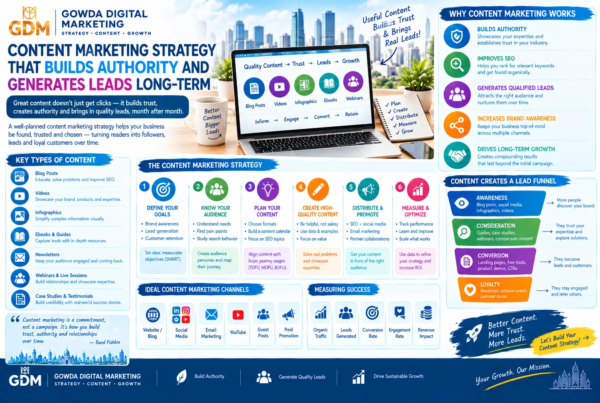
Step-by-Step Visual: The SMB Digital Growth Loop
STEP 1 — ATTRACT
SEO + Local SEO + Content + Ads
↓
STEP 2 — ENGAGE
Website + Social Media + Useful Resources
↓
STEP 3 — BUILD TRUST
Reviews + Proof + Case Studies + Expertise
↓
STEP 4 — CONVERT
Call + WhatsApp + Forms + Bookings
↓
STEP 5 — FOLLOW UP
CRM + Email + WhatsApp + Automation
↓
STEP 6 — RETAIN
Offers + Content + Customer Service
↓
STEP 7 — AMPLIFY
Reviews + Referrals + Testimonials
↓
BACK TO STEP 1
This creates a compounding system.
9. Turn Reviews Into a Marketing Asset
Reviews are not simply reputation management.
They are customer-generated proof.
Google says reviews and other information across the web can contribute to the prominence of a business in local search.
But businesses should not try to manufacture reviews.
Instead:
- Deliver a good customer experience.
- Ask satisfied customers for honest feedback.
- Make the process simple.
- Respond professionally.
- Learn from recurring complaints.
- Use genuine testimonials where appropriate.
A useful review is specific.
Compare:
“Great service.”
with:
“The team helped us redesign our website and improve our enquiry process. We especially appreciated the quick response and clear communication.”
The second provides much more context for a potential customer.
10. Use Content to Answer Customer Questions Before the Sales Call
One of the biggest advantages of content marketing is that it allows a business to educate customers before they contact the company.
Consider a customer looking for a website.
They may wonder:
- How much does a website cost?
- WordPress or custom development?
- How long does development take?
- What pages should a business website have?
- Do I need SEO?
- How do I generate leads?
- Should I redesign my existing website?
If your website already answers these questions, the eventual sales conversation can become much easier.
The customer has already learned about the problem.
Your team can focus on whether the solution is appropriate.
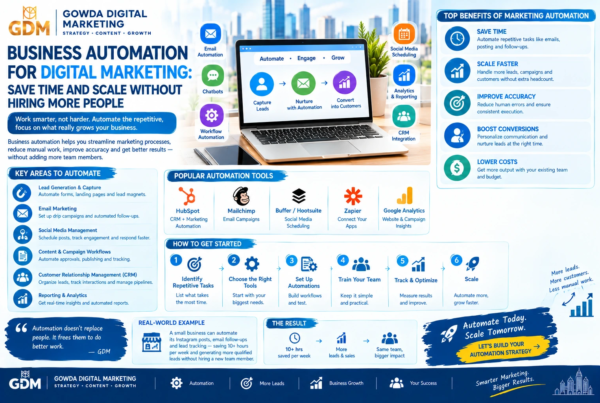
11. Automate Repetitive Marketing Tasks
Small businesses often lose opportunities not because they lack leads, but because they cannot follow up consistently.
Consider a typical enquiry.
A customer:
- Finds the company.
- Sends a WhatsApp message.
- Receives a reply.
- Asks for pricing.
- Gets busy.
- Stops responding.
Without a system, that lead may disappear.
With simple automation, the business can:
- Capture the enquiry
- Categorize the lead
- Send an acknowledgement
- Notify the sales team
- Schedule follow-ups
- Send relevant information
- Record the interaction
- Trigger reminders
- Ask for feedback after purchase
Automation does not have to mean replacing humans.
It means allowing humans to spend more time on high-value conversations.
AUTOMATION PRINCIPLE
Automate repetition, not relationships.
Let technology handle reminders, notifications, routing and repetitive communication while people handle trust, negotiation, complex questions and customer relationships.
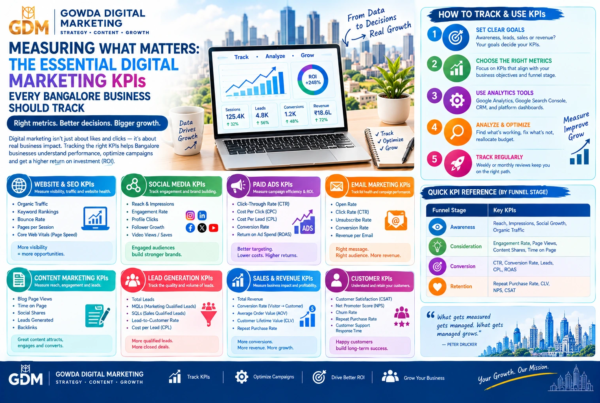
12. Measure Business Outcomes, Not Vanity Metrics
A dashboard showing 100,000 impressions can look impressive.
But impressions do not automatically mean revenue.
A small business should track metrics such as:
| Stage | Useful Metric |
| Awareness | Search impressions |
| Visibility | Website sessions |
| Local discovery | Google Business Profile interactions |
| Engagement | Relevant page engagement |
| Conversion | Calls/forms/WhatsApp enquiries |
| Lead quality | Qualified leads |
| Sales | Customers acquired |
| Economics | Customer acquisition cost |
| Retention | Repeat customers |
| Reputation | Reviews and response rate |
Google Business Profile performance data can show how people discover a profile through Search and Maps and what actions they take after finding it.
The principle is simple:
Track the journey from visibility to business outcome.
Big Brand vs Smart SMB: What Should You Actually Compete On?
| Area | Bigger Brand | Smart SMB Opportunity |
| Budget | Often higher | Focused spending |
| Geographic reach | Broad | Local specialization |
| Content | High volume | High relevance |
| Decision-making | Complex | Faster |
| Customer relationship | Often standardized | Personal |
| Positioning | Broad | Niche |
| Local knowledge | Variable | Strong |
| Testing | Larger scale | Faster experimentation |
| Customer feedback | More layers | Direct access |
| Automation | Advanced systems | Simple high-impact workflows |
| SEO | Large content footprint | Focused topical authority |
| Advertising | Large campaigns | High-intent targeting |
| Brand recognition | Established | Trust-building required |
The goal is not to imitate a multinational company.
The goal is to use the advantages available to your business.
Bangalore-Specific Digital Marketing Opportunities
Bangalore is not one uniform market.
Different areas have different audiences, purchasing behaviour and competitive environments.
For example:
Startup & Technology Businesses
Potential focus:
- B2B SEO
- Thought leadership
- Lead-generation landing pages
- Search campaigns
- Case studies
- Marketing automation
Restaurants & Cafes
Potential focus:
- Google Maps
- Reviews
- Local SEO
- Food photography
- Offers
- Event marketing
Clinics & Healthcare Businesses
Potential focus:
- Local SEO
- Service pages
- Educational content
- Reviews
- Appointment systems
- Google Business Profile
Education Businesses
Potential focus:
- Course pages
- Search campaigns
- Educational content
- Lead forms
- WhatsApp follow-up
- Testimonials
Professional Services
Potential focus:
- Expertise-driven content
- Local SEO
- Case studies
- Lead magnets
- Consultation funnels
Retail Businesses
Potential focus:
- Google Business Profile
- Local search
- Product pages
- Social media
- Offers
- Repeat-customer campaigns
The 30-Day Smart Digital Marketing Sprint
A small business does not need to rebuild everything simultaneously.
Use a staged approach.
Week 1: Audit
Review:
- Website
- Google Business Profile
- Search visibility
- Social profiles
- Competitors
- Reviews
- Existing content
- Conversion points
- Analytics
- Lead follow-up
Create a list of the top 10 problems.
Week 2: Fix the Foundation
Prioritize:
- Website messaging
- Contact information
- Calls to action
- Google Business Profile
- Service pages
- Mobile experience
- Basic technical SEO
- Tracking
Do not start with 50 social posts if the website cannot convert the visitors you already have.
Week 3: Build Visibility
Create:
- 2–4 high-value service pages or improvements
- 2–4 useful blog articles
- Google Business Profile updates
- Social content
- One downloadable resource
- Review-generation process
Week 4: Add Acquisition and Automation
Test:
- Google Ads
- Meta Ads where appropriate
- WhatsApp lead flows
- Email follow-up
- Lead forms
- CRM pipeline
- Retargeting where appropriate
Then measure the results.
A Practical Monthly Marketing Framework
For an SMB with limited resources, a simple monthly system might look like:
Every Week
SEO
- Monitor rankings and search performance
- Improve existing pages
- Build useful internal links
Content
- Publish one useful article or resource
- Repurpose it into social content
Local SEO
- Update Business Profile content
- Add relevant photos
- Monitor reviews
Social
- Educational posts
- Trust-building content
- Customer-focused content
Lead Generation
- Monitor enquiries
- Follow up with prospects
- Review lead quality
Analytics
- Check traffic
- Leads
- Conversion rate
- Campaign performance
The exact frequency should depend on the business.
Consistency matters more than creating an unrealistic schedule.
Example: How a Small Bangalore Business Could Apply the Framework
Consider a fictional Bangalore-based interior design company called UrbanNest Interiors.
It competes against large interior brands.
Instead of trying to rank nationally, UrbanNest chooses a narrower strategy.
Positioning
“Home interiors for Bangalore homeowners looking for transparent, end-to-end execution.”
Local Strategy
Create useful service and area content around relevant Bangalore locations.
SEO
Build pages for:
- 2BHK interiors
- 3BHK interiors
- Modular kitchens
- Bedroom interiors
- Living room interiors
- Interior design costs
- Interior design timelines
Content
Publish:
- “How Much Does a 2BHK Interior Cost in Bangalore?”
- “Interior Design Checklist for First-Time Homeowners”
- “How to Compare Interior Design Quotes”
- “Questions to Ask Before Hiring an Interior Designer”
Social Media
Show:
- Projects
- Design decisions
- Materials
- Before/after transformations
- Customer stories
Lead Magnet
Offer:
Bangalore Home Interior Planning Checklist
Lead Capture
Website visitors download the checklist in exchange for contact information.
Follow-Up
A simple automated sequence sends:
- Checklist
- Budget guide
- Project planning guide
- Consultation invitation
UrbanNest does not need to become a national brand overnight.
It needs to become highly relevant to the people it wants to serve.
Another Example: A Small B2B Company
Imagine a Bangalore industrial supplier competing with much larger companies.
Instead of competing purely on brand recognition, it can build authority around:
- Product education
- Technical specifications
- Application guides
- Maintenance information
- Troubleshooting
- Comparison articles
- Downloadable technical documents
- Search-focused service pages
A customer searching for a specific technical problem may discover the smaller company because its content directly answers the question.
That visitor may not care how many employees the company has.
They care whether the company understands the problem.
This is one of the most important opportunities created by search marketing.
What Small Businesses Should Avoid
1. Trying Every Platform
You do not need to be everywhere.
Choose channels based on customer behaviour.
2. Buying Followers
Follower numbers do not automatically produce customers.
3. Publishing Generic AI Content
AI can help with research, organization and production.
But generic content without original insight can make a business indistinguishable from competitors.
Google emphasizes helpful, reliable and people-first content rather than content created primarily to manipulate search rankings.
4. Keyword Stuffing
Use keywords naturally.
Google’s documentation recommends using words people search for in appropriate, descriptive locations while focusing on useful content.
5. Running Ads Without Tracking
If you cannot tell which campaign generated qualified enquiries, optimization becomes guesswork.
6. Ignoring Existing Customers
Acquiring a customer is only part of growth.
Repeat purchases, referrals and reviews can also become important growth channels.
7. Changing Strategy Every Week
Digital marketing requires experimentation, but not constant chaos.
Give meaningful tests enough time and define success before launching them.
The 80/20 Principle for SMB Digital Marketing
A small business rarely has unlimited time.
Therefore, identify the activities that have the greatest commercial impact.
For many businesses, that could mean prioritizing:
20% of channels → 80% of meaningful enquiries
For example:
- Google Search
- Google Maps
- One strong social channel
- Website
may be more valuable than maintaining seven social platforms.
Your 80/20 mix will be different.
Find it through data.
How to Build a Digital Marketing Budget
Instead of asking:
“What is the cheapest digital marketing package?”
ask:
“What level of investment can we support consistently while measuring return?”
A basic budget can be divided into:
| Area | Purpose |
| Website | Conversion foundation |
| SEO | Long-term visibility |
| Local SEO | Local discovery |
| Content | Authority and organic traffic |
| Social Media | Trust and distribution |
| Paid Ads | Demand capture |
| Automation | Efficiency and follow-up |
| Analytics | Measurement |
Do not automatically spend equally across every category.
Allocate according to business priorities.
For example, a new local clinic may prioritize:
Website + Local SEO + Reviews + Google Ads
while a B2B manufacturer may prioritize:
Technical SEO + Content + Website + LinkedIn + Lead Generation
A Simple Digital Marketing Decision Tree
Do people already search for your service?
Yes → Invest in SEO + local SEO + search advertising.
No / very low demand → Build awareness through content, social, partnerships and targeted advertising.
Are website visitors becoming leads?
No → Improve messaging, trust and conversion.
Are leads becoming customers?
No → Review lead quality, pricing, sales process and follow-up.
Are customers returning?
No → Improve retention, communication and customer experience.
Are you spending too much time on repetitive tasks?
Yes → Identify automation opportunities.
This prevents businesses from treating every problem as an SEO problem or an advertising problem.
How Can Small Businesses Compete With Big Brands Online?
Small businesses can compete with larger brands online by focusing on specific customer segments, local SEO, high-intent search terms, useful content, strong reviews, conversion-focused websites, targeted advertising and consistent follow-up. Instead of competing on advertising budget or brand size, SMBs can compete on relevance, specialization, local expertise, speed and customer relationships.
Key Facts & Statistics Box
📊 DIGITAL MARKETING & MSME FACTS
MSME scale: India’s MSME ecosystem represents a very large share of the country’s registered enterprise base. The Ministry of MSME dashboard recorded more than 96 million Udyam and Udyam Assist registrations as of September 2026.
Bengaluru’s business ecosystem: Karnataka’s industrial policy identifies Bengaluru as a major technology and startup hub, with the state reporting more than 18,000 active startups.
Local search: Google says local results are primarily based on relevance, distance and prominence.
Business Profiles: Verified businesses can manage how their business information appears on Google Search and Maps.
SEO: Google recommends helpful, reliable, people-first content rather than content created primarily to manipulate rankings.
Important: Statistics and platform guidance can change. Businesses should verify current figures and Google documentation when making strategic decisions.
Expert Perspective: What Google’s Guidance Means for SMBs
Google’s own SEO documentation repeatedly emphasizes a straightforward principle: build useful content for people and make it easier for search engines to understand that content.
Its SEO Starter Guide recommends well-organized, readable, unique and useful content, while its people-first content guidance emphasizes original value, expertise and satisfying the user’s goal.
For a small business, this is encouraging.
You do not need to publish hundreds of shallow pages simply because a competitor has hundreds.
One genuinely useful guide can be more valuable to your audience than dozens of generic posts.
10 FAQs
1. Can a small business in Bangalore really compete with a large brand online?
Yes. But “compete” does not mean beating a large company for every keyword, customer or market.
A small business can compete by focusing on specific locations, customer segments, services and search intents.
Local SEO, niche content, customer reviews, specialization and strong conversion systems can help a smaller business become highly visible to the customers that matter most to it.
2. How much does digital marketing cost for a small business in Bangalore?
There is no single correct price.
Costs depend on:
- Industry
- Competition
- Geographic target
- Services
- Website requirements
- Advertising budget
- Content requirements
- Lead value
- Business objectives
A better approach is to determine what the business can sustainably invest and then prioritize the activities with the strongest expected commercial impact.
3. Should a Bangalore SMB focus on SEO or Google Ads?
They serve different purposes.
SEO focuses on organic visibility and can become a long-term asset.
Google Ads can provide paid visibility when customers are actively searching for relevant services.
Many businesses can use both.
The right mix depends on search demand, competition, budget, sales cycle and customer lifetime value.
4. Is Google Business Profile important for local businesses?
For eligible local businesses, it can be an important part of their online presence.
Google says Business Profiles help businesses manage their information across Search and Maps and interact with customers through information, photos, videos and reviews.
For local businesses, accuracy and completeness are foundational.
5. How long does SEO take to produce results?
There is no universal timeline.
Results depend on:
- Competition
- Website quality
- Existing authority
- Technical issues
- Content quality
- Search demand
- Location
- Industry
- Consistency
SEO should generally be treated as a long-term marketing asset rather than a guaranteed quick-result channel.
6. Does social media help SEO?
Social media activity and Google organic rankings should not be treated as the same thing.
However, social media can support broader digital marketing by increasing awareness, distributing content, building trust and helping customers discover a business.
A useful social presence can also create content and brand signals that support the overall customer journey.
7. Should small businesses invest in a new website?
Not necessarily.
If the existing website is fast, usable, secure, clear and capable of generating enquiries, improvements may be enough.
A redesign or rebuild becomes more relevant when the website has fundamental problems such as poor mobile experience, confusing navigation, outdated information, weak conversion paths or technical limitations.
8. How can a small business generate more leads?
Start by identifying where existing customers come from.
Then improve the journey:
Discovery → Website/Profile → Trust → Enquiry → Follow-up → Sale
Potential channels include:
- SEO
- Local SEO
- Google Ads
- Social media
- Content marketing
- Referrals
- Partnerships
The best channel is the one that reaches relevant customers and produces sustainable economics.
9. Can AI replace digital marketing for small businesses?
AI can make marketing production and analysis more efficient.
It can help with:
- Research
- Brainstorming
- Drafting
- Data analysis
- Content repurposing
- Automation
- Customer-support workflows
But businesses still need strategy, original expertise, positioning, creative judgment, customer understanding and quality control.
AI is better viewed as a tool inside a marketing system rather than the entire system.
10. What should a Bangalore small business do first?
Start with a digital foundation audit.
Check:
- Google Business Profile
- Website
- Search visibility
- Reviews
- Conversion paths
- Social profiles
- Analytics
- Lead follow-up
- Existing customers
- Competitors
Then identify the three improvements most likely to affect business outcomes.
Do those first.
Quick Comparison: Which Digital Channel Should You Prioritize?
| Business Goal | Potentially Useful Channels |
| Get local customers | Local SEO + Google Business Profile |
| Capture existing search demand | SEO + Google Ads |
| Build brand awareness | Social Media + Content |
| Generate B2B leads | SEO + Content + LinkedIn + Ads |
| Increase enquiries | Website + Landing Pages + Ads |
| Improve lead follow-up | CRM + WhatsApp + Email Automation |
| Build authority | SEO + Educational Content |
| Increase repeat purchases | Email + WhatsApp + Customer Marketing |
| Improve trust | Reviews + Testimonials + Case Studies |
| Launch a new service | Content + Search + Paid Campaigns |
The correct combination depends on the business.
Your Next 7 Steps
If you run a small or medium business in Bangalore, start here:
Step 1
Write down your three most valuable customer segments.
Step 2
Identify the five problems those customers most frequently search for.
Step 3
Audit your Google Business Profile.
Step 4
Review your website from the perspective of a first-time customer.
Step 5
Create one genuinely useful piece of content around a high-value customer question.
Step 6
Set up a simple process for capturing and following up with leads.
Step 7
Measure what generates actual enquiries and sales—and invest more attention in those activities.
Do not attempt everything simultaneously.
Build the foundation first.
Then improve the system one layer at a time.
Summary: 6 Key Takeaways
- Small businesses do not need to outspend bigger brands to compete online. They can compete through specialization, relevance and local expertise.
- Local SEO is particularly important for Bangalore businesses serving specific locations. Google says local visibility is influenced primarily by relevance, distance and prominence.
- Your website should convert attention into action. Traffic without a clear path to enquiry, booking or purchase can waste marketing investment.
- Content should answer real customer questions. Useful, people-first content can support both customer education and organic search visibility.
- Automation should remove repetitive work, not remove human relationships. Lead routing, reminders, follow-ups and reporting are strong candidates for automation.
- Measure business outcomes rather than vanity metrics. Track the journey from discovery to enquiry, qualified lead, customer and repeat business.
Conclusion
The internet has changed the competitive equation for small businesses.
A company does not need to have the largest office, the biggest advertising budget or the most recognizable national brand to win the attention of a potential customer.
It needs to be visible when the customer searches, useful when the customer researches, credible when the customer compares and easy to contact when the customer is ready.
For Bangalore businesses, the opportunity is particularly interesting because the market contains an enormous variety of customers, neighbourhoods, industries and business categories.
A local restaurant can build authority around its neighbourhood.
A clinic can become known for a specific treatment.
A B2B company can dominate a technical niche.
A professional services firm can build authority through educational content.
A startup can use thought leadership and targeted search campaigns.
A retailer can combine Maps, reviews, social media and WhatsApp.
The strategy is different, but the underlying principle is the same:
Do not try to compete with bigger brands everywhere. Become exceptionally relevant somewhere that matters.
Smart digital marketing is ultimately not about doing more marketing.
It is about connecting the right customer with the right message through the right channel—and creating a system that keeps improving.
If you found this guide useful, subscribe to the Gowda Digital Marketing newsletter for practical insights on SEO, websites, Google Ads, social media, automation, lead generation and digital growth for businesses.
Have you used digital marketing to compete with a larger business?
Share your experience in the comments. Your lesson could help another Bangalore business owner make a smarter marketing decision.
If your business needs help identifying where its digital growth opportunities are, consider starting with a simple website, SEO, local visibility and lead-generation audit rather than trying to change everything at once.
References & Sources
- Google Search Central — SEO Starter Guide
Google Search Central SEO Starter Guide - Google Search Central — Creating Helpful, Reliable, People-First Content
Google Search Central Helpful Content Guidance - Google Business Profile Help — Tips to Improve Your Local Ranking
Google Local Ranking Guidance - Google Business Profile Help — Get Started With Google Business Profile
Google Business Profile Help - Google Business Profile Help — Business Profile Performance & Insights
Google Business Profile Performance Insights - Ministry of Micro, Small & Medium Enterprises — MSME Dashboard
MSME Dashboard - Ministry of MSME — MSME Connect
MSME Connect - Government of Karnataka / Invest Karnataka — Karnataka Industrial Policy
Karnataka Industrial Policy