
Build a Content Engine That Earns Trust, Attracts Search Traffic, and Converts Visitors Over Time
The Best Content Keeps Working After You Publish It
Imagine publishing a useful article today and still receiving relevant visitors, enquiries, brand searches, backlinks, and sales opportunities from it months or even years later.
That is the real promise of content marketing.
Content marketing is not simply about writing blog posts every week.
It is about building a library of useful information that answers customer questions, demonstrates expertise, earns trust, attracts search demand, and moves potential customers closer to taking action.
For a business in Bangalore, this can be particularly valuable.
A local company does not necessarily need millions of visitors.
It may need the right 500 visitors.
A dental clinic may need people searching for a specific treatment in Bangalore. A school may need parents researching admissions. A restaurant may need customers looking for a particular cuisine nearby. A software company may need decision-makers comparing solutions. A digital marketing agency may need business owners researching SEO, Google Ads, websites, automation, or lead generation.
The strategy is therefore not:
“How do we publish more content?”
It is:
“How do we consistently publish content that the right people find useful at the right stage of their decision?”
That distinction changes everything.
Why Long-Term Content Marketing Matters
Businesses often approach content with one of two expectations.
The first is immediate traffic.
The second is immediate sales.
Both can happen, but sustainable content marketing usually works differently.
A strong content asset can contribute to several stages of the customer journey:
Search → Discovery → Education → Trust → Consideration → Enquiry → Conversion → Retention
The first article someone reads may not generate a lead immediately.
But it can introduce the brand.
A second article can answer another question.
A comparison page can help them evaluate options.
A case study can reduce uncertainty.
A service page can explain the solution.
A strong call to action can finally turn interest into an enquiry.
This is why content should be treated as a system rather than a collection of articles.
Most Businesses Create Content Without a Strategy
Publishing content is relatively easy.
Building content that compounds is much harder.
Common problems include:
- Writing whatever topic appears in the news
- Targeting keywords without understanding search intent
- Creating articles that are too similar to competitors
- Publishing without internal links
- Ignoring older content
- Creating traffic-focused content with no conversion path
- Writing for search engines instead of humans
- Focusing only on high-volume keywords
- Not creating content for different buying stages
- Publishing inconsistently
- Measuring page views instead of business outcomes
- Using AI to produce generic articles without original expertise
- Creating content without connecting it to actual services
The result can be hundreds of pages but very little business value.
A better approach is to create a content ecosystem.
What Is a Content Marketing Strategy?
A content marketing strategy is a structured plan for creating, distributing, optimizing, and measuring content that supports specific business objectives.
Those objectives may include:
- Increasing organic search visibility
- Building brand authority
- Generating qualified leads
- Supporting sales teams
- Educating customers
- Increasing branded searches
- Building an email audience
- Improving customer retention
- Creating backlinks
- Supporting local SEO
- Reducing repetitive sales questions
- Establishing expertise in a niche
A complete strategy connects:
Business Goals + Audience + Search Demand + Content + Distribution + Conversion + Measurement
If one of these elements is missing, the strategy becomes weaker.
The Evergreen Content Marketing Framework
A practical long-term framework can be built around eight stages:
1. Define the business objective
What should content accomplish?
2. Understand the audience
Who are you trying to attract?
3. Map customer problems
What questions and frustrations exist?
4. Build content pillars
Which major subjects represent your expertise?
5. Create topic clusters
Which supporting topics surround each pillar?
6. Match content with search intent
What does the searcher actually want?
7. Connect content to conversion
What should the reader do next?
8. Measure and improve
Which content creates meaningful business outcomes?
Visual: The Content Authority Flywheel
Business Expertise
↓
Useful Content
↓
Search Visibility
↓
Qualified Visitors
↓
Trust & Authority
↓
Leads & Enquiries
↓
Customer Insights
↓
Better Content
The cycle repeats.
Over time, the website becomes a growing knowledge asset rather than a static brochure.
1. Start With Business Goals, Not Keywords
One of the biggest strategic mistakes is starting content planning with a keyword tool.
Keywords are important.
But business goals should come first.
Suppose a company wants to generate more enquiries for website development.
Instead of producing random articles about “web design,” it could create content around:
- Website development costs
- Website redesign
- Business website mistakes
- Website speed
- Mobile usability
- Conversion optimization
- Website security
- WordPress vs custom development
- Ecommerce website requirements
- Website maintenance
- Website development process
Each topic supports the broader commercial objective.
A simple planning question
Ask:
“If this article performs well, what business outcome could it influence?”
Possible answers:
- More relevant traffic
- More enquiries
- More brand searches
- More email subscribers
- More consultation requests
- More product sales
- More qualified leads
- Better customer education
If you cannot identify a useful business connection, reconsider the topic.
2. Define Your Ideal Audience
Content becomes much stronger when it is written for a clearly defined audience.
You do not need an elaborate persona document.
Start with five questions:
- Who buys from us?
- What problem are they trying to solve?
- What are they afraid of?
- What alternatives are they considering?
- What information do they need before taking action?
For a Bangalore-focused digital marketing company, audiences might include:
- Local small-business owners
- Startups
- Professional service providers
- Restaurants and cafes
- Clinics
- Educational institutions
- Real estate businesses
- Automotive businesses
- Ecommerce brands
- B2B companies
Each audience has different search behaviour.
A restaurant owner may search:
“How to get more customers for my restaurant in Bangalore?”
A B2B company may search:
“How much does SEO cost in Bangalore?”
A startup may search:
“SEO vs Google Ads for a new business.”
The business objective may be similar.
The questions are different.
3. Build Content Pillars
Content pillars are the major themes your business wants to become known for.
For example, a digital marketing company could build pillars around:
Pillar 1: SEO
Supporting topics:
- Technical SEO
- Local SEO
- On-page SEO
- Off-page SEO
- Keyword research
- SEO audits
- Internal linking
- SEO reporting
- International SEO
Pillar 2: Paid Advertising
Supporting topics:
- Google Ads
- Search campaigns
- Display advertising
- Remarketing
- Lead generation
- Call campaigns
- WhatsApp campaigns
- Landing pages
- Ad copywriting
Pillar 3: Social Media
Supporting topics:
- Instagram marketing
- Content calendars
- Reels
- LinkedIn marketing
- Community management
- Social media analytics
- Founder-led content
Pillar 4: Websites
Supporting topics:
- Website development
- Website redesign
- Conversion optimization
- Core Web Vitals
- WordPress
- Ecommerce
- Website security
- Website maintenance
Pillar 5: Business Automation
Supporting topics:
- CRM automation
- Email automation
- WhatsApp automation
- Chatbots
- Lead routing
- Appointment automation
- Social scheduling
This creates a clear topical structure.
4. Use Topic Clusters Instead of Isolated Blog Posts
A topic cluster connects multiple pieces of content around one central subject.
For example:
Pillar Page:
Complete Guide to SEO for Small Businesses
Supporting articles:
- What Is Local SEO?
- How Google Business Profile Works
- On-Page SEO Checklist
- Technical SEO Checklist
- How to Find SEO Keywords
- SEO vs Google Ads
- How Long Does SEO Take?
- Common SEO Mistakes
- How Much Does SEO Cost?
- How to Measure SEO Results
Each supporting article can link back to the pillar.
The pillar can link to relevant supporting articles.
This creates a connected information architecture.
Why this matters
Readers get deeper information.
Search engines can better understand topical relationships.
Older content gets more internal links.
Visitors have more opportunities to move toward commercial pages.
5. Understand Search Intent
A keyword is not enough.
You need to understand why someone searched for it.
Four broad search-intent categories are useful:
| Search Intent | Typical Question | Suitable Content |
| Informational | What is SEO? | Guide |
| Commercial investigation | SEO vs Google Ads | Comparison |
| Transactional | SEO agency Bangalore | Service page |
| Navigational | GDM SEO services | Brand/service page |
There can also be mixed intent.
For example:
“Best website development company in Bangalore”
may indicate commercial investigation.
Someone searching:
“How much does a business website cost?”
may be researching before contacting providers.
The content should match that stage.
6. Create Content for the Entire Customer Journey
A long-term content strategy should not consist entirely of educational articles.
Create content for different stages.
Top of Funnel: Awareness
The reader is identifying a problem.
Examples:
- Why Is My Website Not Getting Leads?
- How Does Local SEO Work?
- What Is Content Marketing?
- Why Businesses Need Google Business Profiles
Middle of Funnel: Consideration
The reader is evaluating solutions.
Examples:
- SEO vs Google Ads
- WordPress vs Custom Website
- In-House Marketing vs Agency
- Organic Social vs Paid Social
Bottom of Funnel: Decision
The reader is close to taking action.
Examples:
- SEO Services in Bangalore
- Website Development Packages
- Digital Marketing Consultation
- Local SEO Services
Post-Purchase Content
Content can also support existing customers.
Examples:
- Website maintenance checklist
- Google Business Profile management guide
- Social media reporting guide
- SEO reporting explained
- Marketing dashboard checklist
This creates a full-funnel content system.
7. Build Evergreen Content First
Evergreen content remains useful for an extended period.
Examples include:
- How-to guides
- Checklists
- Frameworks
- Definitions
- Tutorials
- Resource pages
- Comparisons
- Templates
- Glossaries
- Beginner guides
- Process explanations
For example:
“How to Create a Social Media Content Calendar”
can remain useful for years.
By contrast:
“Instagram Algorithm Update This Week”
has a much shorter lifespan.
That does not mean timely content is bad.
It means your content portfolio should balance both.
Recommended mix
Evergreen: 60–70%
Timely/trend-based: 20–30%
Experimental: 10%
The exact ratio can change by industry.
8. Add Original Experience to Every Article
One of the biggest challenges in modern content marketing is producing information that feels interchangeable.
If ten websites publish the same AI-generated summary, readers have little reason to choose one.
Originality can come from:
- First-hand experience
- Client patterns
- Internal data
- Original research
- Expert interviews
- Screenshots
- Examples
- Templates
- Calculators
- Checklists
- Case studies
- Local observations
- Mistakes learned from experience
A simple principle:
Do not only explain what is true. Explain what you have learned about applying it.
That is where expertise becomes visible.
Key Facts & Statistics Box
Content marketing works best as a compounding system rather than a short-term traffic tactic.
- Search engines remain a major discovery channel for businesses.
- High-quality content can target multiple related search intents.
- Evergreen pages can continue attracting organic visitors long after publication.
- Internal linking helps users discover deeper resources.
- Conversion-focused content gives organic traffic a path toward business outcomes.
- Updating existing content can be more efficient than continually producing new pages.
Important: Statistics vary by industry, market, platform, and measurement methodology. Avoid using generic benchmark numbers as guarantees for business results.
9. Create a Content Brief Before Writing
A content brief prevents articles from becoming unfocused.
A useful brief should contain:
Primary keyword
The main search phrase.
Search intent
What the user expects to find.
Audience
Who is reading?
Primary question
What problem must the article solve?
Secondary topics
Related questions and subtopics.
Recommended structure
H2/H3 sections.
Internal links
Existing pages that should be linked.
External references
Authoritative sources where appropriate.
Conversion goal
What should the reader do next?
Original value
What unique insight will your article provide?
This makes content production more systematic.
10. Write for Humans First, Search Engines Second
SEO should improve discoverability.
It should not make content robotic.
Avoid:
- Keyword stuffing
- Repetitive headings
- Awkward exact-match phrases
- Excessive jargon
- Extremely long introductions
- Generic filler
- Repeating the same conclusion
Instead:
- Answer questions directly
- Use descriptive headings
- Keep paragraphs short
- Use examples
- Add tables
- Explain complicated ideas simply
- Use natural language
- Link to deeper resources
A reader should never feel that the article was written primarily to satisfy an algorithm.
11. Build a Strong Internal Linking System
Internal links are one of the most underused content assets.
Suppose you publish:
“How Much Does SEO Cost in Bangalore?”
It could link to:
- Local SEO guide
- Technical SEO guide
- SEO services page
- SEO audit guide
- Google Business Profile guide
- SEO reporting guide
The goal is not to add links randomly.
The goal is to help readers continue their research.
Simple rule
Whenever a sentence introduces a topic that has a useful deeper page, consider linking to it.
12. Connect Content to Lead Generation
Traffic alone is not the end goal.
A visitor needs a logical next step.
Depending on the article, that could be:
- Download a checklist
- Subscribe to a newsletter
- Request a consultation
- View a related service
- Use a calculator
- Download a template
- Book a discovery call
- Read a case study
- Contact the business
Example
An article about:
“Website Redesign Checklist”
could offer:
Free Website Redesign Audit Checklist
The visitor receives something genuinely useful.
The business receives an opportunity to continue the relationship.
That is a natural content-to-lead transition.
Lead Magnet Ideas for a Content Marketing Strategy
Businesses can turn existing expertise into downloadable resources.
1. SEO Audit Checklist
A practical checklist for business owners.
2. 30-Day Content Calendar
A ready-to-use planning template.
3. Website Conversion Checklist
A self-assessment resource.
4. Local SEO Checklist
Useful for Bangalore and other local businesses.
5. Google Business Profile Checklist
A simple optimization worksheet.
6. Content Brief Template
Useful for marketers and business owners.
7. Lead Generation Funnel Planner
Map traffic, content, conversion points, and follow-up.
8. Digital Marketing Budget Planner
Help businesses allocate budgets across channels.
13. Use Bangalore-Specific Content Strategically
Local SEO should not mean adding “Bangalore” to every sentence.
That creates unnatural content.
Instead, develop genuinely local resources.
Examples:
- Digital Marketing Strategy for Bangalore Small Businesses
- Local SEO Checklist for Bangalore Businesses
- How Bangalore Businesses Can Generate Leads Online
- SEO vs Google Ads for Bangalore Startups
- Website Development Cost in Bangalore
- Social Media Marketing for Bangalore Restaurants
- Digital Marketing for Clinics in Bangalore
- Local SEO for Service Businesses in Bangalore
Local content becomes stronger when it includes genuine local context.
Consider:
- Customer behaviour
- Competition
- Local search patterns
- Neighbourhood targeting
- Service areas
- Bangalore-specific examples
- Local business categories
The objective is relevance, not keyword repetition.
14. Build a Content Funnel
A simple content funnel might look like this:
Educational Blog
↓
Related Guide
↓
Case Study
↓
Service Page
↓
Lead Magnet
↓
Enquiry / Consultation
For example:
Blog:
How to Improve Local SEO
↓
Guide:
Local SEO Checklist
↓
Case Study:
How a Local Business Improved Search Visibility
↓
Service:
Local SEO Services
↓
CTA:
Request an SEO Consultation
This is much more natural than placing “Contact Us” after every paragraph.
15. Repurpose One Strong Article Into Multiple Assets
A single high-quality article can become an entire content campaign.
For example:
Original Article
Content Marketing Strategy That Builds Authority and Generates Leads Long-Term
Can become:
- LinkedIn post
- Instagram carousel
- Short video
- YouTube video
- Email newsletter
- Infographic
- Quote graphic
- Checklist
- PDF guide
- Short-form video scripts
- Sales enablement resource
- FAQ page
This increases the return on content production.
Repurposing Visual
1 Pillar Article
↓
5–10 Social Posts
↓
2–3 Short Videos
↓
1 Newsletter
↓
1 Lead Magnet
↓
1 Sales Resource
The key is not copying the same content everywhere.
Adapt the idea to each platform.
16. Create a Sustainable Publishing System
Consistency matters more than publishing an unrealistic number of articles.
A small business might begin with:
2 high-quality articles per month
A larger marketing team might produce:
4–8 strategic articles per month
The important factor is quality and strategic coverage.
Example Monthly Calendar
| Week | Content | Purpose |
| Week 1 | Evergreen guide | Organic discovery |
| Week 2 | Commercial comparison | Consideration |
| Week 3 | Case study | Trust |
| Week 4 | Service-support article | Conversion |
Over six months, that becomes approximately 24 strategic assets.
Over two years, the library can become substantial.
17. Measure Content Beyond Page Views
Page views are useful.
But they are not enough.
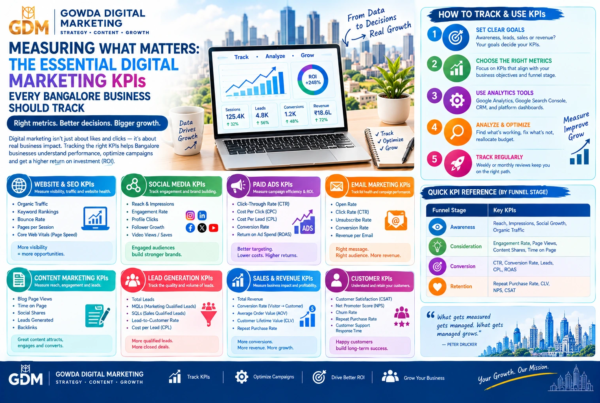
Track:
Visibility
- Organic impressions
- Search clicks
- Rankings
- Branded searches
Engagement
- Engagement rate
- Scroll depth
- Time on page
- Returning visitors
Authority
- Backlinks
- Referring domains
- Brand mentions
- Expert citations
Business impact
- Form submissions
- Calls
- WhatsApp enquiries
- Newsletter signups
- Consultation requests
- Assisted conversions
- Qualified leads
The final question should be:
“Is our content helping the business?”
Not simply:
“How much traffic did we receive?”
18. Update Content Instead of Always Starting From Zero
A mature content strategy has two engines:
Creation + Optimization
Every few months, review important pages.
Look for:
- Outdated statistics
- Broken links
- Missing sections
- New search queries
- Better examples
- New internal links
- Weak introductions
- Poor conversion paths
- Declining traffic
- Ranking opportunities
A page ranking around positions 5–15 may have significant optimization potential.
Instead of immediately publishing another article targeting the same topic, improve the existing page where appropriate.
19. Build Content Around Customer Questions
Your customers are one of your best content research sources.
Collect questions from:
- Sales calls
- WhatsApp conversations
- Emails
- Customer support
- Reviews
- Consultation calls
- Search suggestions
- Competitor FAQs
- Community discussions
- Internal teams
If customers repeatedly ask the same question, that question may deserve a page.
This creates a powerful loop:
Customer Question → Content → Search Visibility → Education → Better Lead
20. Use AI as an Assistant, Not a Substitute for Expertise
AI can make content operations faster.
It can help with:
- Topic brainstorming
- Outlining
- Content briefs
- Keyword grouping
- FAQ generation
- Repurposing
- Summarization
- Editing
- Content gap analysis
But generic AI output can easily become repetitive.
Human expertise should provide:
- Original examples
- Business context
- Experience
- Opinions where appropriate
- Case studies
- Data interpretation
- Local knowledge
- Practical recommendations
- Quality control
The strongest workflow is often:
Human Strategy → AI Assistance → Human Expertise → Editorial Review → Publication
Authority Comes From Demonstrated Knowledge
A useful content principle is:
Authority is not created by repeatedly claiming expertise. It is demonstrated by consistently helping people solve meaningful problems.
A company that publishes detailed, accurate, useful resources over time gives potential customers more evidence to evaluate its expertise.
That is especially valuable for services where customers cannot easily judge quality before buying.
Content Marketing vs Traditional Advertising
Content and advertising solve different problems.
| Factor | Content Marketing | Paid Advertising |
| Traffic source | Organic/distributed | Paid |
| Immediate visibility | Usually slower | Usually faster |
| Long-term asset | Yes | Campaign-dependent |
| Cost model | Production + distribution | Media spend + production |
| Trust building | Strong potential | Depends on execution |
| Evergreen potential | High | Usually limited |
| Control | Moderate | Higher during campaign |
| Best use | Education, authority, discovery | Reach, demand capture, campaigns |
These approaches do not have to compete.
A business can use paid campaigns to accelerate traffic while building an organic content library for long-term visibility.
Content Marketing vs Social Media Marketing
Social media is excellent for distribution and relationship-building.
A website is useful as a durable owned content asset.
| Content on Website | Social Media |
| Searchable over time | Often feed-driven |
| Strong SEO potential | Strong discovery potential |
| Owned platform | Platform-dependent |
| Detailed education | Shorter-form communication |
| Evergreen potential | Faster content decay |
| Strong internal linking | Strong engagement/distribution |
A mature strategy often connects both.
Publish the comprehensive resource on the website.
Then distribute useful ideas through social platforms.
Case Study Example: A Local Service Business
Consider a hypothetical Bangalore-based home improvement company.
The company initially publishes:
- “Our Services”
- “Contact Us”
- “About Our Company”
The website has limited educational content.
A stronger strategy could create a content cluster around:
Home Renovation Planning
Supporting articles:
- Home Renovation Checklist
- Renovation Budget Planning
- Common Renovation Mistakes
- Kitchen Renovation Guide
- Bathroom Renovation Guide
- How Long Does Renovation Take?
- Renovation Material Checklist
- Questions to Ask a Contractor
Each article links to relevant services.
A downloadable checklist provides another conversion opportunity.
The result is not simply more content.
It is a structured knowledge ecosystem around the customer’s decision process.
Case Study Example: A Bangalore Digital Marketing Agency
Consider a hypothetical digital marketing agency targeting small and medium-sized businesses.
Instead of publishing only generic marketing news, the agency develops content clusters such as:
SEO
- Local SEO
- Technical SEO
- SEO audits
- Keyword research
- SEO reporting
Websites
- Website development
- Website redesign
- Website speed
- Conversion optimization
Paid Ads
- Google Ads
- Lead generation
- Landing pages
- Remarketing
Automation
- CRM automation
- WhatsApp automation
- Email automation
- Lead follow-up
Each topic supports the broader positioning of the company.
The content demonstrates capability before a prospect ever speaks to the sales team.
The 90-Day Content Authority Plan
You do not need to wait years to build a structured content system.
Days 1–30: Foundation
Week 1
- Define target audience
- Define business goals
- Identify core services
- Select 4–6 content pillars
Week 2
- Research customer questions
- Research search intent
- Build keyword groups
- Identify content gaps
Week 3
- Create pillar page outlines
- Create supporting topic clusters
- Map internal links
Week 4
- Publish first strategic articles
- Improve core service pages
- Add conversion paths
Days 31–60: Expansion
Publish:
- Supporting guides
- Comparisons
- FAQs
- Case studies
- Checklists
Start repurposing content for:
- YouTube
Build relationships for:
- Expert quotes
- Guest contributions
- Interviews
- Relevant backlinks
Days 61–90: Optimization
Review:
- Search impressions
- Search clicks
- Rankings
- Engagement
- Leads
- Conversion paths
Then:
- Update promising articles
- Strengthen internal links
- Improve titles
- Improve introductions
- Add FAQs
- Add original examples
- Strengthen CTAs
At the end of 90 days, you should have the beginning of a repeatable content system.
A Practical Content Strategy Template
Use this template for every major topic.
Business Goal
What business outcome does this content support?
Audience
Who needs this information?
Problem
What problem are they experiencing?
Search Intent
What are they actually trying to accomplish?
Primary Keyword
What is the main search phrase?
Secondary Topics
What related questions should be answered?
Content Format
Guide, comparison, checklist, case study, tutorial, etc.
Internal Links
Which existing pages should be connected?
Conversion
What is the most useful next step?
Distribution
Where will the content be promoted?
Measurement
Which metrics determine success?
This simple framework can turn content production into a repeatable process.
Common Content Marketing Mistakes
Mistake 1: Publishing for the sake of publishing
More articles do not automatically create more authority.
Mistake 2: Targeting only high-volume keywords
Low-volume keywords can sometimes attract highly relevant audiences.
Mistake 3: Ignoring commercial intent
A site can attract thousands of informational visitors and generate few enquiries.
Mistake 4: Creating disconnected content
Topic clusters usually create stronger relationships between pages than isolated articles.
Mistake 5: Never updating old content
Information becomes outdated.
Mistake 6: Using generic AI content
Similarity makes differentiation difficult.
Mistake 7: Forgetting conversion paths
Traffic needs somewhere useful to go.
Mistake 8: Overusing keywords
Natural language and helpfulness should come first.
Mistake 9: Measuring only rankings
Business outcomes matter too.
Mistake 10: Expecting immediate results
Content is often a compounding channel.
What Is the Best Content Marketing Strategy for Long-Term Lead Generation?
A strong long-term content marketing strategy combines evergreen educational content, topic clusters, SEO optimization, internal linking, content distribution, conversion-focused calls to action, and continuous content updates. Businesses should create content around real customer problems and search intent, connect educational articles to relevant commercial pages, and measure both organic visibility and lead-generation outcomes.
Step-by-Step Visual: From Idea to Lead
1. Identify Customer Problem
↓
2. Research Search Intent
↓
3. Choose Topic & Keyword
↓
4. Create Useful Content
↓
5. Add Original Expertise
↓
6. Optimize for Search
↓
7. Add Internal Links
↓
8. Add Relevant CTA
↓
9. Distribute Content
↓
10. Measure Results
↓
11. Update & Improve
10 FAQs
1. What is content marketing?
Content marketing is the process of creating and distributing useful, relevant content to attract, educate, engage, and retain a target audience.
For businesses, content can include blog articles, guides, videos, case studies, newsletters, checklists, social posts, webinars, and other educational resources.
The goal is not simply publishing content. The goal is to create useful information that supports customer relationships and business objectives.
2. How does content marketing generate leads?
Content can attract people who are researching problems related to your products or services.
Once visitors arrive, relevant internal links, service pages, lead magnets, newsletters, consultation offers, or other calls to action can move them toward conversion.
The process may look like:
Search → Article → Trust → Related Resource → Service Page → Enquiry
Not every article needs to sell directly.
Some articles build awareness while others support consideration and conversion.
3. How long does content marketing take to produce results?
There is no universal timeline.
Results depend on factors such as:
- Website authority
- Competition
- Search demand
- Content quality
- Technical SEO
- Industry
- Distribution
- Publishing consistency
- Existing brand recognition
Some content can attract traffic relatively quickly, while competitive topics may require sustained effort.
It is better to evaluate content as a long-term channel rather than expect every article to produce immediate leads.
4. How often should a business publish blog posts?
There is no universal ideal frequency.
For a small business, publishing two genuinely useful articles per month may be more sustainable than publishing several low-quality articles every week.
Consistency, relevance, originality, and strategic coverage matter more than an arbitrary publishing number.
5. Is blogging still useful for SEO?
Yes, useful and well-structured content can support organic search visibility.
However, blogging should not mean publishing repetitive articles simply to increase page count.
The stronger approach is to create comprehensive resources around topics your audience actually searches for and connect them through a logical website structure.
6. Should businesses focus on evergreen or trending content?
Both can have a role.
Evergreen content creates a durable foundation.
Trending content can capture temporary interest and help brands participate in timely conversations.
For long-term authority, evergreen content should generally form the foundation, while timely content can complement it.
7. Can small businesses compete with larger companies through content?
Yes, although competition varies substantially by industry and topic.
Smaller businesses can differentiate through:
- Local expertise
- Specific niches
- First-hand experience
- Detailed examples
- Customer questions
- Original insights
- Specialized topics
Instead of competing for every broad keyword, a small business can build authority around a focused subject area.
8. Should AI be used for content marketing?
AI can assist with research, outlining, editing, repurposing, brainstorming, and workflow automation.
However, businesses should add human expertise, factual verification, original examples, experience, and editorial judgment.
The objective should be better content production—not simply more content.
9. What should a content marketing KPI be?
Useful KPIs depend on the business objective.
They may include:
- Organic clicks
- Search impressions
- Qualified traffic
- Rankings
- Backlinks
- Newsletter signups
- Lead submissions
- Calls
- WhatsApp enquiries
- Consultation requests
- Assisted conversions
A business should connect content metrics to its actual objectives.
10. How can a Bangalore business use content marketing for local SEO?
A Bangalore business can create useful local resources based on its customers, service areas, problems, and search intent.
Examples include:
- Bangalore-specific guides
- Local service pages
- Neighbourhood/service-area content
- Local case studies
- Industry-specific Bangalore guides
- Google Business Profile resources
- Local customer FAQs
The content should provide genuine local value rather than simply repeating the city name.
The Content Compounding Principle
A strong article should not have only one job.
Ideally, it should:
- Answer a real customer question.
- Attract relevant search traffic.
- Demonstrate expertise.
- Connect readers with related resources.
- Support a business objective.
- Remain useful long enough to justify its production cost.
Actionable Content Marketing To-Do List
Use this checklist to start building your own strategy.
Strategy
- Define your main business objective
- Identify your primary audience
- List your main customer problems
- Select 4–6 content pillars
- Identify commercial topics
SEO
- Research search intent
- Group related keywords
- Build topic clusters
- Create pillar pages
- Plan internal links
- Optimize titles and descriptions
Content
- Create detailed content briefs
- Add original examples
- Use short paragraphs
- Add tables and checklists
- Include relevant FAQs
- Review factual claims
Conversion
- Add relevant CTAs
- Create a lead magnet
- Link to service pages
- Add newsletter signup
- Track enquiries
Optimization
- Monitor organic traffic
- Track search impressions
- Monitor rankings
- Review conversions
- Update older content
- Strengthen internal links
6 Key Takeaways
- Content marketing is a system, not simply a publishing schedule.
- Start with business objectives and customer problems before choosing keywords.
- Use content pillars and topic clusters to build topical authority.
- Create different content for awareness, consideration, decision, and retention stages.
- Connect useful content to relevant conversion opportunities without making every article overly promotional.
- Treat your content library as a long-term business asset that should be measured, updated, and improved.
Conclusion
Content marketing becomes powerful when a business stops treating content as something it needs to publish and starts treating it as something it can build.
One article may answer one question.
Ten connected articles can establish a topic.
A well-structured content library can become a discovery engine.
Add internal linking, useful lead magnets, conversion paths, distribution, email nurturing, and regular optimization, and that library can become an important part of the company’s long-term marketing infrastructure.
For businesses in Bangalore, the opportunity is not simply to create more content about digital marketing, websites, SEO, social media, advertising, or automation.
The opportunity is to become genuinely useful to the people searching for those solutions.
That means answering real questions.
Explaining complicated subjects clearly.
Sharing practical experience.
Creating resources people want to save.
Building content around customer journeys.
And continuously improving what has already been created.
The goal is simple:
Create content that earns attention today, builds trust tomorrow, and continues creating opportunities long after publication.
If you found this guide useful, subscribe to our newsletter for practical digital marketing, SEO, content, website, automation, and lead-generation insights.
Have a question about building a long-term content strategy for your business?
Leave a comment and tell us what type of business you run and what marketing challenge you are currently facing.
For Bangalore businesses looking to improve their online visibility, website performance, lead generation, social media presence, or marketing automation, exploring the right combination of strategies can be the next step toward building a more sustainable digital presence.
References & Sources
- Google Search Central — Creating helpful, reliable, people-first content
https://developers.google.com/search/docs/fundamentals/creating-helpful-content - Google Search Central — SEO Starter Guide
https://developers.google.com/search/docs/fundamentals/seo-starter-guide - Google Search Central — Search Essentials
https://developers.google.com/search/docs/essentials - Google Analytics — Analytics documentation
https://developers.google.com/analytics - Google Business Profile — Official business profile resources
https://www.google.com/business/ - Content Marketing Institute — Content marketing resources
https://contentmarketinginstitute.com/ - HubSpot — Marketing resources
https://www.hubspot.com/marketing-statistics
Note: Industry benchmarks and marketing statistics can vary by methodology, industry, geography, and measurement period. Business decisions should use current first-party analytics wherever possible.