
Can Your Business Be Found by Both Google and AI?
Imagine spending months creating high-quality blog posts, optimizing keywords, and building backlinks—only to discover that users are now getting answers directly from AI platforms like ChatGPT, Gemini, Perplexity, and Google AI Overviews instead of clicking on websites.
This is the biggest shift in search since Google was launched.
Traditional Search Engine Optimization (SEO) is still essential, but in 2026 it’s no longer enough. Businesses also need Generative Engine Optimization (GEO)—a strategy designed to help AI-powered search engines discover, understand, and recommend your content.
The brands that combine SEO and GEO will dominate both traditional search results and AI-generated answers.
In this complete guide, you’ll learn the key differences between SEO and GEO, why both matter, and how to optimize your content for the future of search.
Why SEO Alone Is No Longer Enough
Search behavior has changed dramatically.
Today, people search by asking complete questions such as:
- “Which digital marketing agency is best for small businesses?”
- “How do I improve local SEO?”
- “Best AI marketing tools for startups”
- “How do I rank in Google AI Overview?”
Instead of showing ten blue links, AI platforms generate direct answers by combining information from multiple trusted sources.
If your content isn’t optimized for AI, your competitors may be mentioned instead—even if your website ranks well on Google.
Businesses that ignore GEO risk losing valuable visibility, traffic, and leads.
What You Will Learn
By the end of this guide, you’ll understand:
- What SEO and GEO are
- Key differences between SEO and GEO
- How Google AI Overviews work
- How ChatGPT, Gemini, and Perplexity find information
- GEO ranking factors in 2026
- How to optimize your content for AI search
- The future of search marketing
Table of Contents
- What Is SEO?
- What Is GEO?
- SEO vs GEO: What’s the Difference?
- Why AI Search Is Changing Everything
- How AI Search Engines Find Content
- SEO Ranking Factors
- GEO Ranking Factors
- SEO and GEO Best Practices
- Common Optimization Mistakes
- Case Study
- SEO vs GEO Comparison Table
- Frequently Asked Questions
- Conclusion
What Is SEO?
SEO (Search Engine Optimization) is the process of improving your website so it ranks higher in traditional search engines like Google and Bing.
SEO focuses on:
- Keyword research
- On-page optimization
- Technical SEO
- Website speed
- Backlinks
- User experience
- Content quality
The primary goal is to increase organic traffic from search engine results pages (SERPs).
What Is GEO?
GEO (Generative Engine Optimization) is the practice of optimizing your content so AI-powered search engines can understand, trust, and reference it in their responses.
Unlike traditional SEO, GEO focuses on becoming a trusted source that AI systems use when generating answers.
GEO helps your content appear in:
- Google AI Overviews
- ChatGPT Search
- Gemini
- Perplexity AI
- Claude
- Future AI search assistants
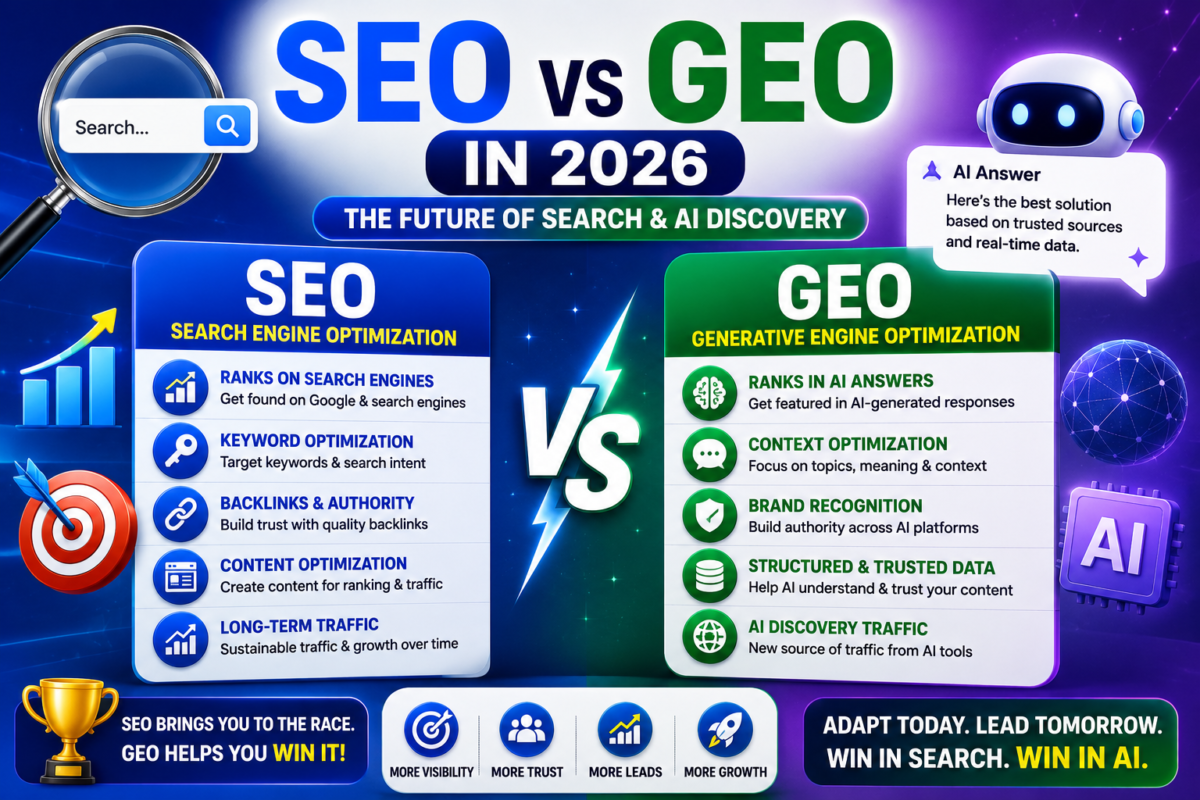
SEO vs GEO: The Biggest Differences
| Feature | SEO | GEO |
| Primary Goal | Rank on Google | Be cited by AI |
| Focus | Keywords | Context and authority |
| User Journey | Search → Click | Question → AI Answer |
| Ranking Method | SERPs | AI-generated responses |
| Success Metric | Organic traffic | Mentions and citations |
| Optimization | Pages | Knowledge and expertise |
| Importance | Essential | Growing rapidly |
SEO drives clicks.
GEO drives visibility inside AI-generated answers.
Businesses need both.
Why AI Search Is Growing So Fast
Consumers want answers instantly.
Instead of reading multiple articles, users prefer asking AI:
“What’s the best CRM for a small business?”
AI delivers one complete response in seconds.
Benefits of AI search include:
- Faster answers
- Personalized responses
- Better context
- Natural conversations
- Multi-source information
As AI adoption increases, businesses must ensure their content is optimized for both humans and machines.
How AI Search Engines Work
Unlike traditional search engines, AI platforms analyze information differently.
A simplified process looks like this:
User Question
↓
AI Understands Intent
↓
Finds Trusted Sources
↓
Verifies Information
↓
Combines Multiple Sources
↓
Generates a Complete Answer
↓
May Cite or Reference Your Brand
The more authoritative and well-structured your content is, the greater the chance of being included.
Traditional SEO Ranking Factors
Google still considers many classic SEO signals, including:
High-Quality Content
Helpful, original, and relevant content performs best.
Keyword Optimization
Use keywords naturally in titles, headings, and body content.
Backlinks
Links from trusted websites increase authority.
Technical SEO
Fast loading speed, mobile responsiveness, HTTPS, and proper indexing remain critical.
User Experience
Google rewards websites that provide a positive browsing experience.
GEO Ranking Factors in 2026
AI search engines prioritize different signals.
Entity Authority
AI trusts recognized brands and experts.
Build authority through consistent publishing and brand mentions.
Expertise
Demonstrate real experience and knowledge.
Include author information, credentials, and case studies.
Structured Content
Organize content using:
- H2 and H3 headings
- Bullet points
- Tables
- FAQs
- Step-by-step guides
Structured content is easier for AI to understand.
Trustworthiness
Support your claims with:
- Research
- Statistics
- Industry reports
- Credible references
Comprehensive Coverage
Cover topics thoroughly instead of creating thin articles.
How to Optimize Content for AI Search
Write for Questions
Create content that answers real user questions.
Examples:
- What is GEO?
- How does AI search work?
- Is SEO still important?
Question-based content performs well in AI systems.
Create Topic Clusters
Instead of writing isolated posts, build comprehensive content around one topic.
Example:
Main Topic:
SEO
Supporting Articles:
- Technical SEO
- Local SEO
- AI SEO
- GEO
- Schema Markup
This strengthens topical authority.
Add Schema Markup
Structured data helps search engines understand your content.
Recommended schema types:
- Article
- FAQ
- Organization
- Local Business
- Product
- Review
Include Original Research
AI platforms prefer unique insights over copied information.
Publish:
- Surveys
- Case studies
- Industry reports
- Customer data
- Performance benchmarks
Build Brand Authority
Strong brands are more likely to be referenced by AI.
Improve authority through:
- Thought leadership
- Guest blogging
- Digital PR
- Podcasts
- Webinars
- Consistent publishing
Google AI Overviews and SEO
Google AI Overviews summarize information directly in search results.
To improve your chances of appearing:
- Answer questions clearly.
- Use short paragraphs.
- Add FAQ sections.
- Include tables and lists.
- Support claims with facts.
- Publish comprehensive content.
Optimizing for ChatGPT, Gemini, and Perplexity
Although each AI system works differently, they generally favor content that is:
- Accurate
- Well-organized
- Helpful
- Expert-written
- Frequently updated
- Comprehensive
Content that demonstrates real-world expertise has a better chance of being referenced.
Common SEO and GEO Mistakes
Avoid these common issues:
❌ Keyword stuffing
❌ Thin AI-generated articles
❌ No author information
❌ Missing schema markup
❌ Poor website experience
❌ No citations or supporting evidence
❌ Publishing outdated content
❌ Ignoring user intent
Case Study
Digital Marketing Agency
Challenge
The agency ranked well on Google but rarely appeared in AI-generated search results.
Strategy
- Improved content depth
- Added FAQ sections
- Implemented schema markup
- Published original case studies
- Updated existing content
Results
- Increased organic traffic
- More branded searches
- Higher engagement
- Improved visibility in AI-powered search experiences
SEO + GEO Content Strategy
Keyword Research
↓
Search Intent Analysis
↓
Comprehensive Content Creation
↓
Schema Markup
↓
Expert Review
↓
Publishing
↓
Content Updates
↓
Google Rankings + AI Visibility
When Should Businesses Use SEO and GEO Together?
The answer is simple:
Always.
SEO helps people discover your website through search engines.
GEO helps AI systems recommend your brand during conversations.
Together, they create a future-proof digital marketing strategy.
Frequently Asked Questions
Is SEO still important in 2026?
Yes. SEO remains the foundation of organic visibility.
What is GEO?
Generative Engine Optimization helps content appear in AI-generated answers.
Can GEO replace SEO?
No. GEO complements SEO rather than replacing it.
Does ChatGPT rank websites?
Not in the traditional sense. It references trusted and authoritative information.
What is Google AI Overview?
Google AI Overview is an AI-generated summary displayed for certain search queries.
How do I optimize for AI search?
Publish expert content, use structured formatting, answer user questions, and build authority.
Do backlinks still matter?
Yes. They continue to strengthen authority for both SEO and GEO.
Is AI-generated content enough?
No. Human expertise and originality remain critical.
Should small businesses care about GEO?
Absolutely. Early adoption provides a competitive advantage.
What’s the future of search?
Search will increasingly combine traditional rankings with AI-generated answers.
Key Takeaways
- SEO remains essential for Google rankings.
- GEO helps your content appear in AI-generated responses.
- AI search is changing how users discover information.
- Authority, trust, and expertise matter more than ever.
- Structured content improves AI understanding.
- Topic clusters strengthen visibility.
- Schema markup supports both SEO and GEO.
- Original research increases citation opportunities.
- Combining SEO and GEO creates long-term competitive advantages.
- Businesses that adapt early will dominate future search.
Final Thoughts
Search is no longer just about ranking on Google’s first page.
In 2026, success means being visible wherever people search—whether that’s Google Search, Google AI Overviews, ChatGPT, Gemini, Perplexity, or future AI assistants.
Traditional SEO builds the foundation, while GEO prepares your content for the next generation of search.
Businesses that invest in both strategies today will be better positioned to earn trust, attract qualified visitors, and remain discoverable as search continues to evolve.
If your goal is sustainable organic growth, don’t choose between SEO and GEO. Build a strategy that leverages both—and make your brand easy to find, whether the answer comes from a search engine or an AI assistant.