
Don’t Build the Perfect App—Build the Right App First
Many startups fail before they even launch—not because their idea is bad, but because they spend too much time and money building features that customers never use.
Entrepreneurs often believe that an app needs dozens of features to succeed. In reality, some of the world’s biggest technology companies, including Airbnb, Uber, and Instagram, started with simple versions of their products.
This approach is known as Minimum Viable Product (MVP) development.
An MVP focuses on solving one core problem with only the essential features needed to validate an idea. Instead of investing heavily upfront, businesses launch quickly, gather user feedback, and improve the product over time.
In 2026, India’s startup ecosystem is growing rapidly, making MVP development one of the smartest ways to reduce risk, save costs, and accelerate time to market.
This guide explains what an MVP is, which features you should build first, what to avoid, and how to launch a successful app in India.
Why It Matters
Many startups make costly development mistakes.
Common problems include:
❌ Building too many features before launch
❌ Spending large budgets without market validation
❌ Ignoring customer feedback
❌ Delaying product launches
❌ Choosing the wrong technology stack
❌ Developing features users don’t actually need
The result?
Higher development costs.
Longer timelines.
Poor user adoption.
Difficulty attracting investors.
A well-planned MVP minimizes these risks.
What You Will Learn
By the end of this guide, you’ll understand:
✅ What an MVP is
✅ Why startups should build an MVP first
✅ Essential features to include
✅ Features to avoid in the first version
✅ Typical MVP development process
✅ Estimated development costs in India
✅ Best practices for launching successfully
Table of Contents
- What Is an MVP?
- Why Start with an MVP?
- Benefits of MVP Development
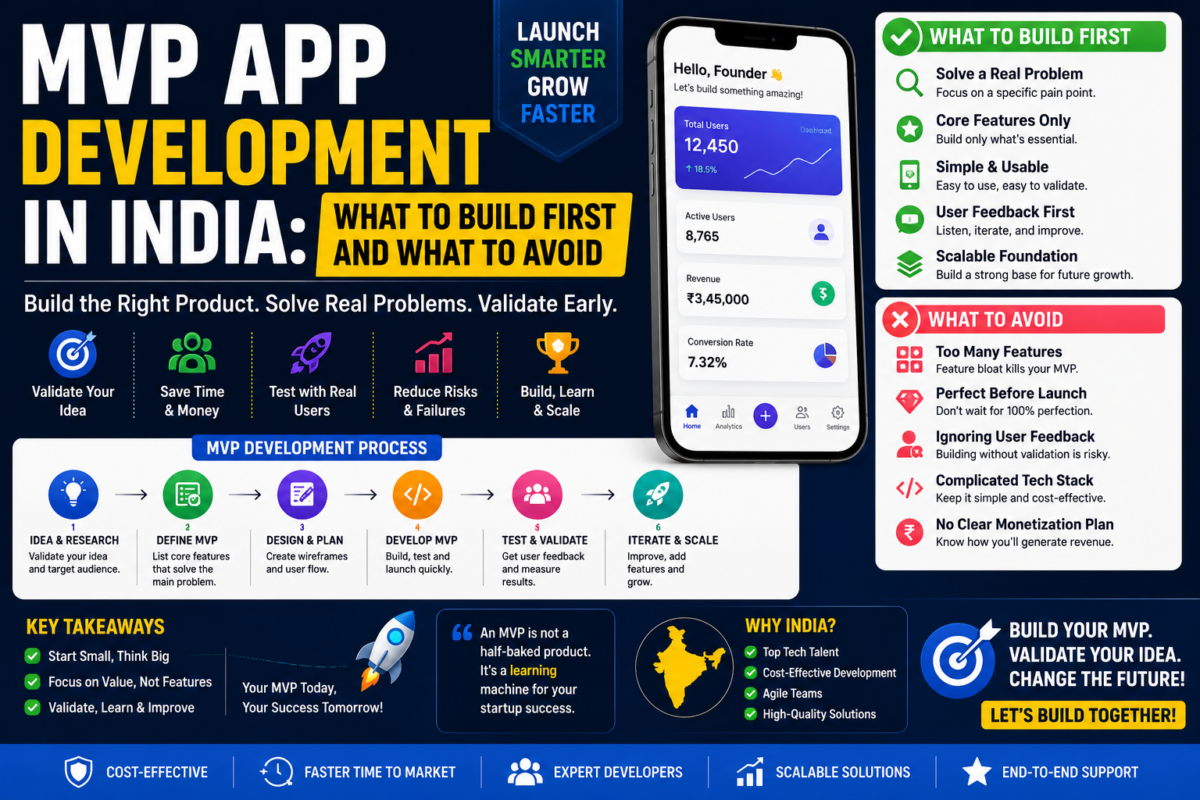
- Features to Build First
- Features to Avoid Initially
- Choosing the Right Technology
- MVP Development Process
- MVP Development Cost in India
- Common Startup Mistakes
- Case Study
- Frequently Asked Questions
- Conclusion
What Is an MVP?
An MVP (Minimum Viable Product) is the simplest version of an app that solves a specific problem for users.
Instead of building every possible feature, an MVP focuses on delivering one core value.
Examples:
A food delivery MVP may include:
- User registration
- Restaurant listings
- Food ordering
- Online payment
- Order tracking
Features like loyalty programs, AI recommendations, and advanced analytics can be added later.
Why Start with an MVP?
Launching quickly provides valuable insights.
An MVP allows businesses to:
Validate ideas
Reduce development costs
Launch faster
Collect customer feedback
Improve products based on real users
Reduce business risk
Attract investors
Rather than guessing what customers want, businesses learn directly from user behavior.
Benefits of MVP Development
Building an MVP offers several advantages:
Lower investment
Faster development
Early customer feedback
Reduced business risk
Improved product-market fit
Higher investor confidence
Scalable product development
For startups, these benefits are critical during the early stages.
What Features Should You Build First?
Focus only on features essential to solving the primary problem.
Typical MVP features include:
User Registration
Login and Authentication
Core Service Functionality
Search
Basic Dashboard
Notifications
Payment Gateway
Profile Management
Customer Support
Feedback Collection
Every feature should contribute directly to the user’s primary goal.
Features to Avoid in the First Version
Avoid adding features that increase complexity without validating demand.
Examples include:
Advanced AI features
Gamification
Complex reporting dashboards
Multi-language support (unless essential)
Referral programs
Loyalty systems
Advanced personalization
Offline functionality
Social networking features
Build these only after validating your core product.
Prioritize User Experience
A simple, intuitive interface is more valuable than a feature-rich but confusing app.
Focus on:
Easy navigation
Fast loading
Clear buttons
Simple onboarding
Responsive design
Accessible layouts
A positive first impression encourages users to return.
Choose the Right Technology Stack
Selecting the right technology helps reduce future development costs.
Common choices include:
Frontend:
React
React Native
Flutter
Backend:
Node.js
Python
Java
Database:
MongoDB
PostgreSQL
MySQL
Cloud Platforms:
AWS
Google Cloud
Microsoft Azure
Choose technologies that support future scalability.
MVP Development Process
A structured process increases the chances of success.
Step 1: Validate the Idea
Research the market.
Identify competitors.
Understand customer pain points.
Step 2: Define the Core Problem
Focus on solving one primary challenge.
Avoid trying to solve everything at once.
Step 3: Prioritize Features
Create two lists:
Must-have features
Future features
Launch with only the essentials.
Step 4: Design the User Experience
Create:
User flows
Wireframes
Clickable prototypes
Simple UI designs
Step 5: Develop the MVP
Build the core functionality.
Keep development focused and efficient.
Step 6: Launch Quickly
Release the MVP to real users.
Collect feedback.
Monitor usage.
Step 7: Improve Continuously
Analyze:
Customer feedback
Analytics
Feature requests
Performance
Iterate based on real data.
Estimated MVP Development Cost in India
Costs vary depending on complexity.
Approximate ranges:
Basic MVP:
₹3–6 Lakhs
Medium Complexity MVP:
₹6–12 Lakhs
Advanced MVP:
₹12–25 Lakhs
Factors affecting cost include:
Features
Design
Technology stack
Third-party integrations
Development timeline
Testing requirements
Common MVP Development Mistakes
Avoid these mistakes:
❌ Building unnecessary features
❌ Ignoring customer validation
❌ Choosing technology without planning
❌ Poor UI/UX
❌ Skipping testing
❌ Launching too late
❌ Ignoring analytics
❌ Failing to collect user feedback
Case Study
Food Delivery Startup
Challenge
The founders wanted to build a feature-rich food delivery app with over 40 planned features.
Strategy
The development team recommended launching an MVP with:
User registration
Restaurant listings
Online ordering
Payments
Order tracking
Everything else was postponed.
Results
Launched in four months
Collected customer feedback
Identified the most requested features
Reduced development costs
Secured additional funding
Expanded successfully
MVP Development Workflow
Business Idea
↓
Market Research
↓
Problem Validation
↓
Feature Prioritization
↓
UI/UX Design
↓
MVP Development
↓
Testing
↓
Launch
↓
User Feedback
↓
Product Improvement
Frequently Asked Questions
What does MVP mean?
Minimum Viable Product.
Why should startups build an MVP?
It reduces risk and validates ideas before large investments.
How long does MVP development take?
Typically between 2 and 6 months, depending on complexity.
How much does an MVP cost in India?
Costs generally range from ₹3 Lakhs to ₹25 Lakhs based on features and scope.
Should I include every feature in my MVP?
No. Focus only on essential features.
Can investors fund an MVP?
Yes. Many investors prefer startups that have validated products and real user feedback.
What technologies are best for MVPs?
React, Flutter, Node.js, Python, and cloud-based infrastructure are popular choices.
How do I know if my MVP is successful?
Measure user engagement, retention, feedback, and product-market fit.
Can I improve the MVP after launch?
Yes. Continuous improvement is a core principle of MVP development.
Is an MVP only for startups?
No. Established businesses also use MVPs to test new products and services.
Key Takeaways
- Build only essential features first.
- Validate your idea before investing heavily.
- Launch quickly and gather user feedback.
- Keep the user experience simple.
- Choose scalable technologies.
- Avoid unnecessary complexity.
- Measure real customer behavior.
- Improve continuously after launch.
- Reduce risk through iterative development.
- Focus on solving one core problem exceptionally well.
Final Thoughts
Building a successful app in 2026 isn’t about launching the most feature-rich product—it’s about solving the right problem for the right audience.
An MVP allows startups and businesses to validate ideas, minimize development costs, and make informed decisions based on real customer feedback rather than assumptions.
India’s thriving startup ecosystem offers tremendous opportunities, but competition is increasing every year. Businesses that launch quickly, learn continuously, and improve strategically will have a significant advantage over those that delay launch in pursuit of perfection.
Start simple, solve one problem exceptionally well, listen to your users, and evolve your product based on data. That’s the foundation of building an app that customers love and investors trust.