
In 2026, Indian customers are not simply scrolling past brands—they are discovering, evaluating, trusting and sometimes buying from businesses through the content they see every day.
Introduction
Social media has changed from being a place where businesses occasionally publish promotional posts into a major discovery, communication and sales channel.
For Indian businesses, that shift is particularly important.
Customers now consume content across Instagram Reels, YouTube Shorts, Facebook, LinkedIn, WhatsApp and other digital platforms. They expect brands to be useful, entertaining, authentic and easy to understand.
At the same time, India’s digital audience is becoming increasingly diverse. A content strategy that works for an urban English-speaking audience may not work equally well for customers in Tier 2, Tier 3 or rural markets.
In 2026, the winning strategy is therefore not simply “post more.”
It is:
Post the right format, for the right audience, in the right language, with the right business objective.
Recent Meta research indicates that video consumption has become deeply embedded across Indian audiences, with daily video engagement reported at 98% in urban areas and 94% in rural areas. Meta also reports that 89% of Gen Z respondents in its study engage with Reels daily.
This creates a major opportunity for Indian startups, local businesses, D2C brands, service companies and established enterprises.
Why Social Media Content Trends Matter for Indian Businesses in 2026
The biggest mistake businesses make is treating social media as a digital poster board.
Posting a product photo with a price and phone number every day is unlikely to build a strong modern content strategy.
Customers increasingly want:
- Demonstrations
- Reviews
- Stories
- Educational content
- Entertainment
- Behind-the-scenes content
- Expert opinions
- Creator recommendations
- Regional-language explanations
- Quick answers to questions
Meta’s 2026 research describes India’s shopping journey as increasingly “scroll-led”, with AI, short-form video, creators and conversational messaging influencing discovery and conversion.
The Problem
Many Indian businesses still struggle with questions such as:
- What should we post today?
- Should we focus on Reels or images?
- Should we use English or regional languages?
- Do we need influencers?
- Can AI create our content?
- How often should we post?
- How do we turn views into customers?
- What content actually generates leads?
The Promise of This Guide
By the end of this article, you will have a practical 2026 content framework covering:
- What content formats to prioritize.
- Which trends Indian businesses should adopt.
- What to post on different platforms.
- How to use AI without losing authenticity.
- How to use regional content.
- How to work with creators.
- How to turn content into leads and sales.
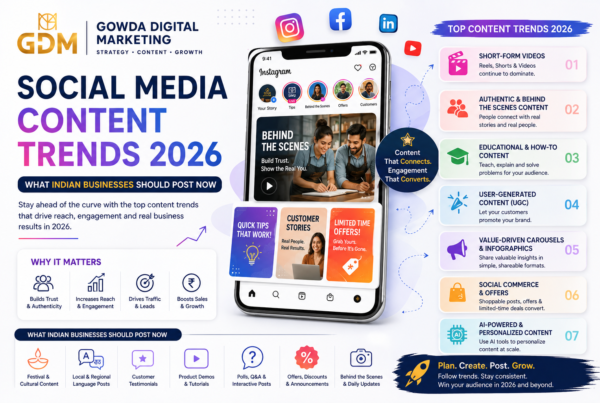
1. Short-Form Video Becomes the Core Content Format
If your business is still treating video as optional, 2026 is the year to reconsider that strategy.
Short-form videos such as Instagram Reels and YouTube Shorts are highly effective for:
- Product demonstrations
- Before-and-after transformations
- Tutorials
- Customer testimonials
- Quick tips
- FAQs
- Founder stories
- Local business tours
- Product comparisons
- Industry insights
Meta’s 2026 India research reports that 97% of surveyed users watch video on its platforms daily, while Reels is particularly strong among Gen Z.
What Indian Businesses Should Post
A local salon could create:
“3 hair mistakes that damage your hair.”
A restaurant could create:
“How we prepare our signature biryani.”
A digital marketing agency could create:
“3 Instagram mistakes small businesses make.”
A real estate company could create:
“What ₹50 lakh can buy in this area.”
The objective is to make the first few seconds useful enough to stop the scroll.
Content rule: Don’t start with your company introduction. Start with the customer’s problem.
2. Regional-Language and Hyperlocal Content
India is not one audience.
It is a collection of markets with different languages, cultures, purchasing habits and preferences.
In 2026, businesses should experiment with content in languages relevant to their customers.
For example:
- Hindi
- Kannada
- Tamil
- Telugu
- Marathi
- Bengali
- Malayalam
- Gujarati
- Punjabi
Meta has expanded AI-powered Reel translation capabilities to additional Indian languages including Bengali, Tamil, Telugu, Kannada and Marathi, reflecting the increasing importance of multilingual content.
A Better Regional Strategy
Instead of simply translating an English post word-for-word, adapt it to the audience.
For example:
English:
“5 ways to improve your home’s security.”
Kannada:
A short Reel explaining practical security tips in conversational Kannada.
The second approach feels more native.
Hyperlocal Content Ideas
- Local customer stories
- Festival-related content
- City-specific offers
- Local business collaborations
- Regional jokes and references
- Local-language FAQs
- Community events
- Area-specific recommendations
3. Authentic UGC and Customer Stories
UGC means User-Generated Content.
It can include:
- Customer reviews
- Unboxing videos
- Testimonials
- Customer photographs
- Product demonstrations
- Video reviews
- Before-and-after results
Consumers often trust experiences from other people more than polished advertisements.
UGC Formula
Customer → Problem → Product/Service → Experience → Result
For example:
“I was struggling to find a reliable home cleaning service. I booked through the app, received confirmation immediately and the service was completed the same day.”
This type of content communicates benefits without sounding like a traditional advertisement.
How to Collect UGC
After a purchase or service:
- Ask for feedback.
- Request permission to use it.
- Offer a simple incentive where appropriate.
- Turn the testimonial into a Reel.
- Create a quote graphic.
- Publish it on your website.
- Repurpose it into Stories and ads.
4. Creator-Led Content and Micro-Influencers
Influencer marketing is evolving.
Businesses do not always need celebrities with millions of followers.
For many Indian businesses, micro and niche creators can be more practical.
Consider:
- Local food creators
- Fitness creators
- Beauty creators
- Finance educators
- Parenting creators
- Technology reviewers
- Regional-language creators
- City-based lifestyle creators
Meta’s India research highlights creators as an important part of product discovery, while its 2026 retail research reports that creator-led and Reels-focused campaigns can influence brand intent and acquisition performance.
What to Ask a Creator to Make
Instead of:
“Please post about our product.”
Try:
- “Show how you use our product.”
- “Compare our solution with a common alternative.”
- “Answer three customer questions.”
- “Document your experience.”
- “Create a tutorial.”
- “Tell a real customer-style story.”
Authenticity should be the priority.
5. Educational Content That Solves Problems
One of the most sustainable social media strategies is teaching.
Educational content positions your business as a useful resource rather than another company asking customers to buy something.
Examples
Accountant
- “3 tax mistakes small businesses make.”
- “Difference between GST registration and filing.”
Dentist
- “How often should you replace your toothbrush?”
Digital Marketing Agency
- “Why your Instagram posts aren’t generating enquiries.”
Interior Designer
- “5 mistakes to avoid when designing a small bedroom.”
App Development Company
- “How much does it cost to build an app in India?”
The 70/20/10 Content Model
A simple starting framework:
| Content Type | Suggested Share |
| Educational / Valuable | 50–60% |
| Engagement / Community | 20–25% |
| Promotional | 15–20% |
| Experimental | 5–10% |
These percentages are a planning framework, not a platform rule. Adjust them according to your audience and business objectives.
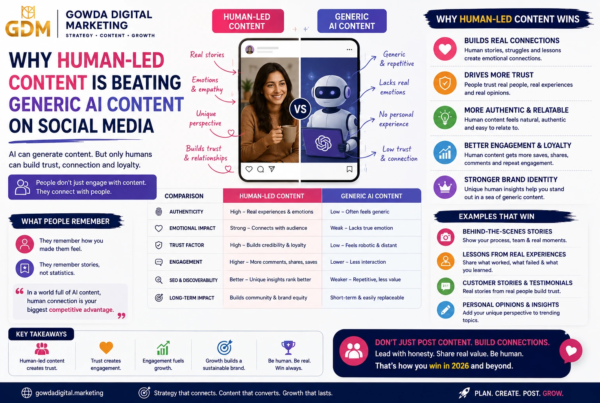
6. AI-Assisted Content Creation
AI is becoming part of the content production workflow.
But businesses should avoid turning their entire social media feed into generic AI-generated posts.
Use AI for:
- Brainstorming
- Content calendars
- First drafts
- Caption variations
- Hook ideas
- Video scripts
- Translation
- Repurposing
- Research organization
- A/B testing concepts
Meta itself continues to introduce AI tools for creators and businesses, including creative assistance and multilingual capabilities.
The Best AI Workflow
AI generates → Human reviews → Brand adds expertise → Customer sees authentic content
Do not publish AI output without checking:
- Facts
- Tone
- Local context
- Claims
- Grammar
- Cultural sensitivity
- Brand accuracy
Callout: AI should increase your team’s creative capacity—not remove the human voice from your brand.
7. Behind-the-Scenes and Human Content
Customers want to know the people behind businesses.
Behind-the-scenes content can make a company more relatable.
Content Ideas
- Meet the founder
- Meet the team
- Office tour
- Product manufacturing
- Packaging process
- Client preparation
- Day in the life
- Mistakes and lessons
- New product development
- Company celebrations
For a small Indian business, this can be particularly powerful because customers often value relationships and trust.
A simple phone-recorded video can sometimes communicate more personality than a highly produced advertisement.
8. Social Commerce and Conversational Content
Social media is increasingly becoming part of the buying journey.
Meta’s 2026 India research describes the movement from scroll to chat to cart, with social discovery, short-form video and messaging increasingly connected to commerce.
This means your content should not stop at awareness.
It should provide a clear next step.
Examples
Instagram Reel → DM
“Send us ‘PRICE’ and we’ll share the details.”
Instagram → WhatsApp
“Message us on WhatsApp for today’s availability.”
Product video → Product page
“See all specifications through the link in our profile.”
Educational Reel → Consultation
“Book a free 15-minute consultation.”
Content-to-Conversion Funnel
Attention → Interest → Trust → Conversation → Purchase → Repeat Customer
Your social media strategy should support every stage.
9. Community-Driven Content
2026 social media is not only about accumulating followers.
It is about building communities.
Try:
- Polls
- Questions
- Quizzes
- “Choose A or B”
- Customer challenges
- Live sessions
- Q&A sessions
- Community stories
- Comment-based content
Example
A clothing brand could ask:
“Which colour should we launch next?”
Then turn the results into another Reel.
The audience becomes part of the product story.
10. Search-Friendly Social Media Content
People increasingly use social platforms to discover information.
That means social content should also be understandable to search systems.
Use keywords naturally in:
- Video titles
- Captions
- On-screen text
- Descriptions
- YouTube titles
- Instagram captions
- LinkedIn posts
- Hashtags where relevant
For example, instead of:
“Our latest project 🚀”
Try:
“Mobile App Development Cost in India 2026: What Businesses Should Budget”
The second version communicates the topic immediately.
11. Platform-Specific Content Strategy
Don’t copy the exact same post everywhere.
Adapt the idea to the platform.
| Platform | Best Content Direction | Example |
| Reels, Stories, carousels, UGC | Product tips | |
| YouTube | Shorts + long-form education | Tutorials |
| Community + video + local content | Customer stories | |
| Expertise + case studies | Business insights | |
| Offers, updates, conversations | Product enquiries | |
| Visual inspiration | Design/product ideas |
Focus heavily on:
- Reels
- Stories
- Carousels
- UGC
- Creator collaborations
YouTube
Use:
- Shorts for discovery
- Long videos for authority
- Tutorials
- Product reviews
- Interviews
Focus on:
- Industry insights
- Founder perspectives
- Case studies
- Company milestones
- Data-driven posts
- Employee stories
Use it for:
- Enquiries
- Offers
- Customer support
- Order updates
- Product discovery
- Follow-ups
12. 2026 Content Trends at a Glance
| Trend | Why It Matters | What to Post |
| Short-form video | High attention and discovery | Reels, Shorts |
| Regional content | Reaches wider Indian audiences | Local-language videos |
| UGC | Builds trust | Reviews and testimonials |
| Creator marketing | Adds credibility | Creator tutorials |
| AI-assisted content | Speeds production | Scripts and variations |
| Educational content | Builds authority | Tips and explainers |
| Behind-the-scenes | Humanizes brands | Team videos |
| Social commerce | Connects content to sales | Product demos |
| Community content | Encourages interaction | Polls and Q&As |
| Search-friendly content | Improves discoverability | Keyword-led videos |
13. Step-by-Step Visual: Build a Social Media Post
The 7-Step Content Workflow
Step 1: Identify customer problem
↓
Step 2: Choose content format
↓
Step 3: Write a strong hook
↓
Step 4: Deliver useful information
↓
Step 5: Add proof or example
↓
Step 6: Add a simple CTA
↓
Step 7: Measure the result
Example
Problem: Small businesses don’t know what to post.
Hook:
“Posting every day but getting zero enquiries?”
Value:
Explain three content types that generate conversations.
Proof:
Show a real example or case study.
CTA:
“Save this post for your next content planning session.”
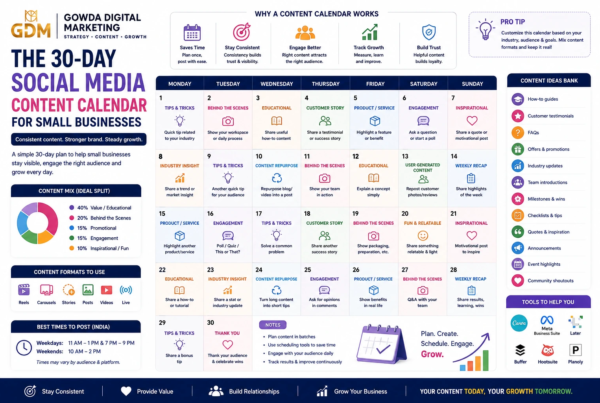
14. A 30-Day Social Media Content Framework
Businesses often struggle because they start each day by asking:
“What should we post today?”
Create the content calendar first.
Week 1 — Authority
- Industry tip
- Common mistake
- Educational Reel
- FAQ
- Industry statistic
- Founder opinion
- Weekly recap
Week 2 — Trust
- Customer testimonial
- Behind-the-scenes Reel
- Team introduction
- Case study
- Customer question
- UGC
- Story Q&A
Week 3 — Engagement
- Poll
- Quiz
- “This or that”
- Myth vs fact
- Customer challenge
- Trending-topic discussion
- Live Q&A
Week 4 — Conversion
- Product demonstration
- Service explanation
- Offer
- Comparison
- Case study
- FAQ about pricing
- Customer success story
- Direct CTA
- Month-end results / community post
15. Key Facts & Statistics Box
📊 India Social Media Content Snapshot
- Meta reported 97% daily video usage among surveyed Indian users in its 2026 study.
- 89% of Gen Z respondents in the same study reported daily Reels engagement.
- Meta’s 2026 India retail research reports that social media influences 77% of retail purchase decisions.
- Meta reported that 80% of Indians in its study discover new brands on its platforms.
- Meta’s India research also highlights the growing role of creators, short-form video and messaging in product discovery.
Important: These figures come from Meta-commissioned studies and describe the specific methodologies and populations in those studies. They should not automatically be interpreted as statistics for every Indian social-media user.
16. Case Studies and Examples
Case Study 1: AJIO — Making Product Content More Video-Friendly
Meta reported that AJIO’s catalog-product-video strategy generated approximately 20% higher efficiency according to a statement from the company’s CMO.
Lesson for Small Businesses
You don’t necessarily need expensive productions.
Turn existing products into:
- Short demonstrations
- Product comparisons
- Styling videos
- How-to videos
- Customer-use scenarios
Case Study 2: Reliance Digital — Regional Creator Strategy
Meta reported that Reliance Digital uses regional creators on Meta platforms to connect with diverse communities and support brand awareness and business outcomes.
Lesson
For Indian businesses, the best creator may not be the person with the largest follower count.
The better creator may be the one who has:
Relevant audience + local credibility + strong engagement + content quality.
17. Expert Opinion
Meta’s Saugato Bhowmik described the Indian shift as a convergence of “creators, culture and commerce.”
That idea is important for businesses.
Content should not exist separately from the business.
Your content should connect:
Culture → Attention → Trust → Conversation → Commerce
18. What Indian Businesses Should Post More of in 2026
Post More:
- Short-form educational videos
- Customer stories
- Regional-language content
- Founder videos
- Product demonstrations
- UGC
- Creator collaborations
- Behind-the-scenes content
- FAQs
- Case studies
- Comparisons
- Local community content
- Problem-solving posts
- Interactive Stories
Post Less:
- Repetitive promotional graphics
- Generic motivational quotes
- Unedited AI-generated captions
- Stock-photo-heavy content
- Corporate announcements with no customer value
- Excessively sales-focused posts
- Copying competitors
19. Common Social Media Mistakes to Avoid
Mistake 1: Chasing Every Trend
Not every viral sound or meme fits your brand.
Use trends only when they support your message.
Mistake 2: Focusing Only on Followers
10,000 irrelevant followers may be less valuable than 1,000 potential customers.
Track:
- Leads
- Enquiries
- Saves
- Shares
- Website visits
- Sales
- Repeat customers
Mistake 3: Using One Content Format
Don’t make every post a sales graphic.
Create a content mix.
Mistake 4: Ignoring Regional Audiences
If your target customers speak Kannada, Tamil, Telugu or another local language, test content in that language.
Mistake 5: No CTA
Tell people what to do next.
Examples:
- Save this post.
- Share this with a business owner.
- Comment your question.
- Send us a DM.
- Visit our website.
- Book a consultation.
- Subscribe to our newsletter.
What Are the Biggest Social Media Content Trends in India in 2026?
The biggest social media content trends in India in 2026 include short-form video, regional-language content, user-generated content, creator collaborations, AI-assisted content creation, educational videos, behind-the-scenes storytelling, social commerce, community-driven content and search-friendly social posts.
Businesses should combine these trends instead of relying on a single format.
For example:
Regional-language Reel + Customer Story + Creator + WhatsApp CTA
can become a complete discovery-to-conversion content asset.
10 FAQs
1. What is the biggest social media trend for Indian businesses in 2026?
Short-form video remains one of the most important formats, particularly Reels and Shorts. Indian businesses should also pay close attention to regional content, creators, UGC and conversational commerce.
2. Should Indian businesses focus on Instagram Reels?
Yes, especially businesses targeting consumers. Reels are useful for discovery, education, demonstrations and creator collaborations.
3. Is regional-language content important in India?
Yes. Businesses targeting audiences outside English-dominant segments should test relevant regional languages and culturally localized content.
4. Is AI-generated social media content effective?
AI can accelerate content creation, but businesses should add human expertise, brand personality, fact-checking and local context before publishing.
5. Should small businesses work with influencers?
Yes, but follower count should not be the only selection criterion. Relevance, trust, engagement and audience location are often more important.
6. How often should a business post on social media?
There is no universal number. A practical starting point is 3–5 quality posts or videos per week, supported by regular Stories and community interaction.
7. What type of content generates leads?
Educational content, product demonstrations, customer testimonials, case studies, FAQs and clear conversion-focused posts can help generate qualified enquiries.
8. Should businesses post the same content on every platform?
No. Repurpose the idea, but adapt the format, length, tone and CTA for each platform.
9. How can local businesses use social media?
Local businesses can use location-specific Reels, customer stories, regional-language content, local creator collaborations, reviews, offers and WhatsApp conversations.
10. What should businesses measure?
Track metrics connected to your goal, including reach, engagement, saves, shares, enquiries, website traffic, leads, conversions and revenue.
22. Actionable Social Media To-Do List
- Define your primary target audience.
- Identify the three biggest customer problems.
- Choose 3–5 content pillars.
- Create a 30-day content calendar.
- Produce at least one short-form video series.
- Test regional-language content.
- Collect customer testimonials.
- Contact 3 relevant micro-creators.
- Create educational content every week.
- Add clear CTAs to conversion-focused posts.
- Test WhatsApp as a conversation channel.
- Use AI for brainstorming and repurposing.
- Review analytics every week.
- Double down on the formats generating meaningful business results.
26. Recommended Content Strategy for Indian Businesses
A simple 2026 framework is:
40% — Educate
Teach customers something useful.
20% — Entertain
Use relatable stories, humour, trends and culture.
20% — Build Trust
Show customers, employees, reviews and behind-the-scenes content.
20% — Convert
Promote products, services, offers and consultations.
Think of your content as a portfolio rather than a collection of advertisements.
The 2026 Content Formula
STOP → TEACH → PROVE → CONNECT → CONVERT
STOP: Use a strong hook.
TEACH: Give the audience something useful.
PROVE: Use reviews, examples or data.
CONNECT: Make the content human and relatable.
CONVERT: Give the viewer a clear next step.
30. Summary: Key Takeaways
The social media landscape in India is becoming more video-first, creator-driven, multilingual and commerce-oriented.
The biggest opportunities for Indian businesses in 2026 are:
- Prioritize short-form video.
- Experiment with regional-language content.
- Use real customer stories and UGC.
- Work with relevant micro-creators.
- Publish educational content consistently.
- Use AI to improve productivity, not replace authenticity.
- Show the humans behind your business.
- Connect social content with WhatsApp and other conversion channels.
- Build communities instead of chasing followers.
- Measure business outcomes, not vanity metrics alone.
31. Conclusion
Social media marketing in 2026 is moving beyond the traditional idea of “posting regularly.”
Indian customers are discovering brands through videos, creators, communities, regional content, recommendations and conversations.
That means businesses need to think like publishers, educators and community builders—not just advertisers.
The winning strategy is not to blindly copy every trend.
It is to identify the trends that fit your audience and turn them into useful, authentic and commercially relevant content.
Whether you are a local retailer, startup, D2C brand, professional service provider or established company, start small.
Create one useful Reel.
Publish one customer story.
Test one regional-language post.
Collaborate with one relevant creator.
Then measure what happens.
The businesses that consistently learn from their audience will have a major advantage in India’s social-first market.
27. References & Sources
- Meta — Reels Is Shaping India’s Video-First Future Across Gen Z, Women & Bharat — 2026 India video and Reels research. Meta India: Reels and India’s video-first future
- Meta — From Scroll to Chat to Cart: Trends Reshaping How India Shops — 2026 research on AI, creators, video and conversational commerce. Meta: Scroll to Chat to Cart
- Meta — AI Fuels India’s Omnichannel Shopping Surge — Research with the Retailers Association of India on social discovery, creators and omnichannel commerce. Meta & RAI: India’s omnichannel shopping trends
- DataReportal — Digital in India — Digital, internet, mobile and social-media market data for India. DataReportal: Digital in India
- Meta — Five Years On, Reels Reigns as India’s Top Short-Form Video Platform — India-specific Reels and short-form video findings. Meta: Reels in India
Want More Practical Digital Marketing Insights?
Subscribe to the Gowda Digital Marketing newsletter for practical articles, content ideas, SEO strategies, social media tips, AI marketing updates and digital growth strategies for Indian businesses.
Have a social media trend that is working for your business in 2026?
Leave a comment and share your experience. Your example could help another Indian business improve its content strategy.