
Introduction
Marketing dashboards often celebrate low Cost Per Lead (CPL).
Businesses proudly announce:
- “We reduced our CPL by 40%.”
- “We generated 5,000 leads this month.”
But there’s an important question many overlook:
How many of those leads actually became paying customers?
Generating leads is only the first step.
The true measure of marketing success is generating leads that convert into revenue.
A campaign with a higher CPL but better-quality leads can produce significantly greater profits than a campaign generating inexpensive but unqualified prospects.
In 2026, businesses are shifting their focus from lead quantity to lead quality.
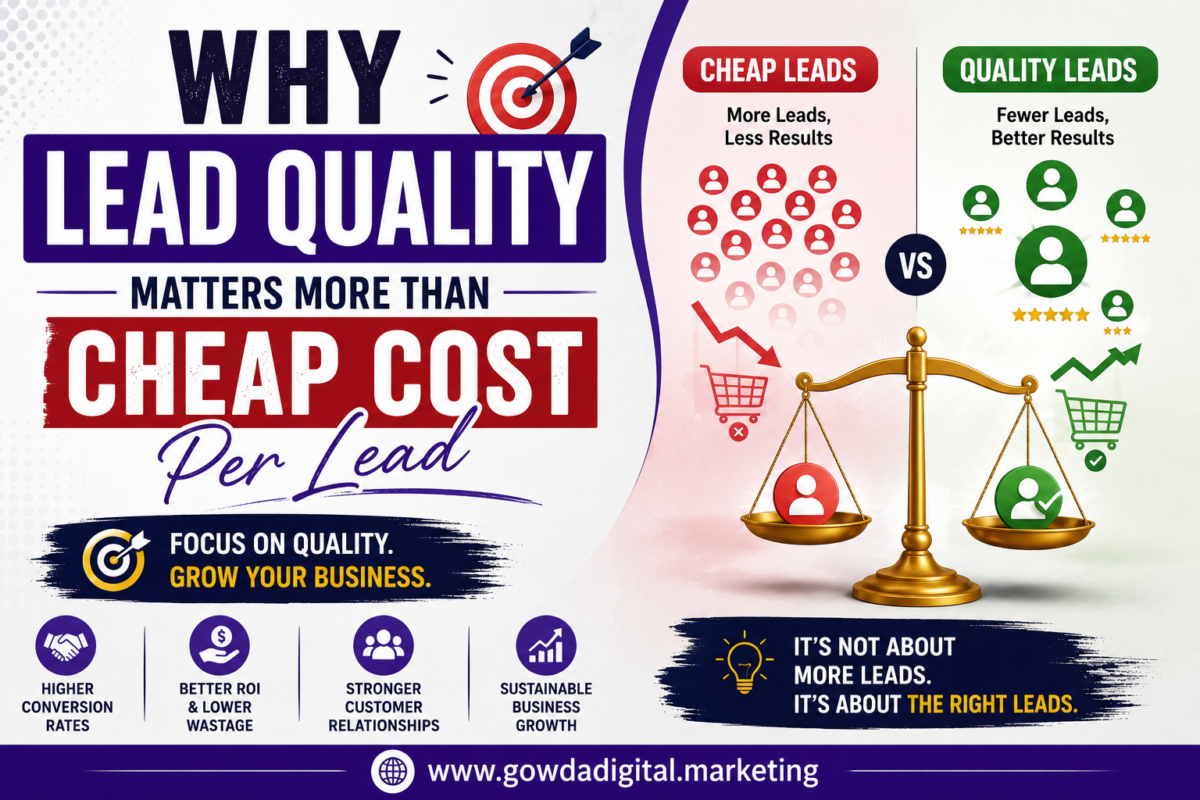
Quality leads generate better ROI, stronger customer relationships, and sustainable business growth.
Problem Statement: Why It Matters
Many companies optimize only for:
- Lower CPL
- More leads
- Higher click volume
While ignoring:
- Buyer intent
- Lead qualification
- Sales readiness
- Customer lifetime value
- Conversion rates
Consequences include:
❌ Wasted advertising budgets
❌ Sales team frustration
❌ Low conversion rates
❌ Poor ROI
❌ Slow business growth
Promise of Value
By the end of this guide, you’ll learn:
✅ What lead quality means
✅ Why cheap leads often cost more
✅ How to qualify leads effectively
✅ Metrics that matter beyond CPL
✅ Strategies for generating better leads
Table of Contents
- What Is Lead Quality?
- Why Cost Per Lead Can Be Misleading
- Characteristics of High-Quality Leads
- Marketing Metrics That Matter
- Improving Lead Quality
- Sales and Marketing Alignment
- Real Business Examples
- Common Mistakes
- FAQs
- Conclusion
Featured Snippet Section
Why Is Lead Quality More Important Than Cost Per Lead?
Lead quality is more important than cost per lead because qualified leads are more likely to convert into paying customers, generate higher lifetime value, and produce better return on investment. A lower CPL may deliver more leads, but if those prospects are not genuinely interested or ready to buy, businesses often waste marketing budgets and sales resources.
Key Facts & Statistics Box
📊 Lead Generation Insights
- High-quality leads generally convert at much higher rates than unqualified leads.
- Sales teams spend less time on prospects who are unlikely to purchase when effective lead qualification is in place.
- Customer lifetime value often has a greater impact on profitability than acquisition cost alone.
- Strong alignment between marketing and sales typically improves lead conversion performance.
- Measuring revenue instead of lead volume provides a more accurate picture of campaign success.
What Is Lead Quality?
Lead quality refers to how likely a prospect is to become a paying customer.
A high-quality lead typically:
- Needs your product or service
- Has purchasing intent
- Fits your target audience
- Has the appropriate budget
- Is ready to make a buying decision
Lead quality matters because it directly influences revenue.
Highlight Box
🚀 Pro Tip:
A lead costing ₹1,500 that converts into a ₹5,00,000 customer is often far more valuable than ten ₹150 leads that never buy.
Why Cost Per Lead Can Be Misleading
A low CPL looks attractive.
However, it doesn’t tell you:
- Whether leads are qualified
- Whether they become customers
- Whether they generate profit
Marketing should be evaluated on business outcomes—not just acquisition cost.
Cheap Leads vs Quality Leads
| Cheap Leads | High-Quality Leads |
| Low Intent | High Buying Intent |
| Low Conversion Rate | Higher Conversion Rate |
| Time-Consuming Follow-Up | Faster Sales Cycle |
| Lower Revenue | Higher Revenue Potential |
| Poor ROI | Strong ROI |
| High Sales Effort | Efficient Sales Process |
Characteristics of High-Quality Leads
Strong Purchase Intent
They are actively searching for solutions.
Clear Business Need
Your offering solves a real problem.
Decision-Making Authority
They influence or control purchasing decisions.
Budget Availability
They can realistically invest in your solution.
Good Customer Fit
They match your ideal customer profile.
Metrics That Matter More Than CPL
Instead of focusing only on Cost Per Lead, monitor:
Lead-to-Customer Conversion Rate
How many leads become customers?
Customer Acquisition Cost (CAC)
What is the total cost to acquire a customer?
Customer Lifetime Value (CLV)
How much revenue does each customer generate over time?
Return on Ad Spend (ROAS)
How much revenue does advertising produce?
Marketing ROI
Overall profitability of marketing campaigns.
Expert Opinion
“The cheapest lead isn’t always the best lead. Businesses that optimize for customer value instead of acquisition cost usually achieve stronger long-term growth.”
How to Improve Lead Quality
Define Your Ideal Customer Profile (ICP)
Identify:
- Industry
- Business size
- Budget
- Location
- Challenges
- Goals
Targeting the right audience improves lead quality.
Improve Targeting
Refine advertising audiences using:
- Demographics
- Interests
- Purchase intent
- Geographic location
- Behavioral data
Create Better Landing Pages
Clearly explain:
- Your offer
- Benefits
- Social proof
- Call to action
A focused landing page attracts more qualified prospects.
Use Lead Qualification Forms
Ask questions such as:
- Company size
- Budget range
- Timeline
- Business goals
This helps prioritize serious inquiries.
Marketing and Sales Alignment
Marketing should generate qualified leads.
Sales should provide feedback about:
- Lead quality
- Common objections
- Customer needs
Continuous collaboration improves future campaigns.
Step-by-Step Visual Workflow
Target Audience
↓
Marketing Campaign
↓
Landing Page
↓
Lead Capture
↓
Lead Qualification
↓
Sales Review
↓
Customer Conversion
↓
Retention
↓
Repeat Business
Case Study 1
B2B Software Company
Challenge:
Thousands of low-quality leads.
Solution:
- Narrowed audience targeting
- Added qualification questions
- Improved landing page messaging
Results:
- Fewer leads
- Higher conversion rate
- Better revenue growth
Case Study 2
Local Service Business
Challenge:
Many inquiries but few sales.
Solution:
- Optimized Google Ads targeting
- Improved website content
- Introduced consultation forms
Results:
- Better-qualified leads
- Increased appointment bookings
- Higher marketing ROI
Common Lead Generation Mistakes
❌ Optimizing only for low CPL
❌ Ignoring lead quality
❌ Poor audience targeting
❌ Weak landing pages
❌ No sales feedback
❌ Lack of lead qualification
❌ Measuring success by lead count alone
Comparison Table
Lead Quantity vs Lead Quality
| Lead Quantity Focus | Lead Quality Focus |
| More Leads | Better Leads |
| Lower CPL | Higher ROI |
| Higher Sales Effort | Efficient Sales Process |
| Lower Conversion Rate | Higher Conversion Rate |
| Short-Term Metrics | Long-Term Growth |
| Vanity Metrics | Business Results |
10 Frequently Asked Questions
1. What is lead quality?
Lead quality measures how likely a prospect is to become a paying customer.
2. Is a low Cost Per Lead always good?
No. A low CPL is valuable only if the leads convert.
3. How do I improve lead quality?
Improve targeting, qualification, messaging, and landing pages.
4. What metrics matter besides CPL?
Conversion rate, CAC, CLV, ROAS, and ROI.
5. What is an ideal customer profile?
A detailed description of your best-fit customer.
6. Should marketing and sales work together?
Yes. Alignment improves lead quality and conversions.
7. Are expensive leads always better?
Not necessarily. The focus should be on profitability, not acquisition cost.
8. Why do sales teams reject leads?
Because many leads don’t meet qualification criteria.
9. How often should I review lead quality?
Regularly—at least monthly or after major campaigns.
10. What is the best lead generation strategy?
Attract qualified prospects through targeted marketing, valuable content, and strong qualification processes.
Image Alt Text Suggestions
- Lead quality vs cost per lead comparison infographic
- Lead qualification workflow diagram
- Marketing funnel showing qualified leads
- Customer acquisition process illustration
- Marketing ROI vs Cost Per Lead chart
Summary / Key Takeaways
✅ Lead quality is more valuable than low CPL
✅ Focus on revenue—not vanity metrics
✅ Qualify leads before passing them to sales
✅ Improve audience targeting
✅ Optimize landing pages
✅ Measure CAC, CLV, ROAS, and ROI
✅ Align marketing and sales teams
✅ Build long-term customer value
Actionable Steps / To-Do List
Week 1
- Define your Ideal Customer Profile
- Review current lead quality
Week 2
- Improve targeting
- Update landing pages
Week 3
- Add qualification questions
- Meet with your sales team for feedback
Week 4
- Measure conversion rates
- Optimize campaigns based on revenue instead of CPL
Conclusion
Cost Per Lead is an important metric—but it should never be the only one guiding your marketing decisions.
A campaign that generates fewer, highly qualified leads can outperform one that delivers thousands of inexpensive but unqualified prospects.
Businesses that prioritize lead quality, customer fit, and long-term value consistently achieve stronger sales performance, better marketing ROI, and sustainable growth.
In 2026, the smartest marketers aren’t asking, “How can we get cheaper leads?” They’re asking, “How can we attract customers who are most likely to buy and stay with us?”
That shift in thinking is what separates high-growth businesses from the rest.
Call to Action
📩 Subscribe to our newsletter for weekly lead generation, digital marketing, and sales growth strategies.
💬 Which matters more to your business today—lower CPL or higher-quality leads? Share your perspective in the comments below.
Lead Magnet Ideas
- Lead Qualification Checklist (PDF)
- Marketing KPI Dashboard Template
- Ideal Customer Profile Workbook
- High-Converting Landing Page Checklist
- Sales & Marketing Alignment Guide
Ideas to Collaborate with Other Creators/Blogs
- Interview B2B sales leaders
- Publish lead generation case studies
- Partner with CRM providers
- Host webinars on lead qualification
- Collaborate with marketing automation experts
Monetization Idea with Plan
Phase 1
Affiliate partnerships with CRM and marketing automation platforms.
Phase 2
Offer lead generation audits.
Phase 3
Sell lead qualification templates and dashboards.
Phase 4
Launch an advanced lead generation training program.
Phase 5
Provide end-to-end lead generation and conversion consulting for businesses.