
Introduction
WhatsApp has evolved far beyond a simple messaging app.
Today, businesses use it to:
- Generate leads
- Answer customer questions
- Schedule appointments
- Share product catalogs
- Send invoices
- Process support requests
- Build long-term customer relationships
With automation tools and AI assistants becoming more accessible, many businesses are trying to automate every conversation.
But that’s a mistake.
Automation improves speed and efficiency, while human interaction builds trust, empathy, and long-term loyalty.
The most successful businesses combine both.
This guide explains exactly what to automate, what to keep human, and how to build a WhatsApp communication strategy that improves customer satisfaction and business growth.
Problem Statement: Why It Matters
Many businesses struggle with:
- Slow response times
- Repetitive customer questions
- Missed inquiries outside business hours
- Poor lead follow-up
- Overloaded support teams
At the same time, excessive automation can lead to:
❌ Frustrated customers
❌ Generic conversations
❌ Poor customer experiences
❌ Lost trust
Finding the right balance is essential.
Promise of Value
By the end of this guide, you’ll learn:
✅ What WhatsApp automation is
✅ Which business tasks should be automated
✅ Which conversations require human support
✅ Best automation tools and workflows
✅ Common mistakes to avoid
Table of Contents
- What Is WhatsApp Automation?
- Benefits of WhatsApp Automation
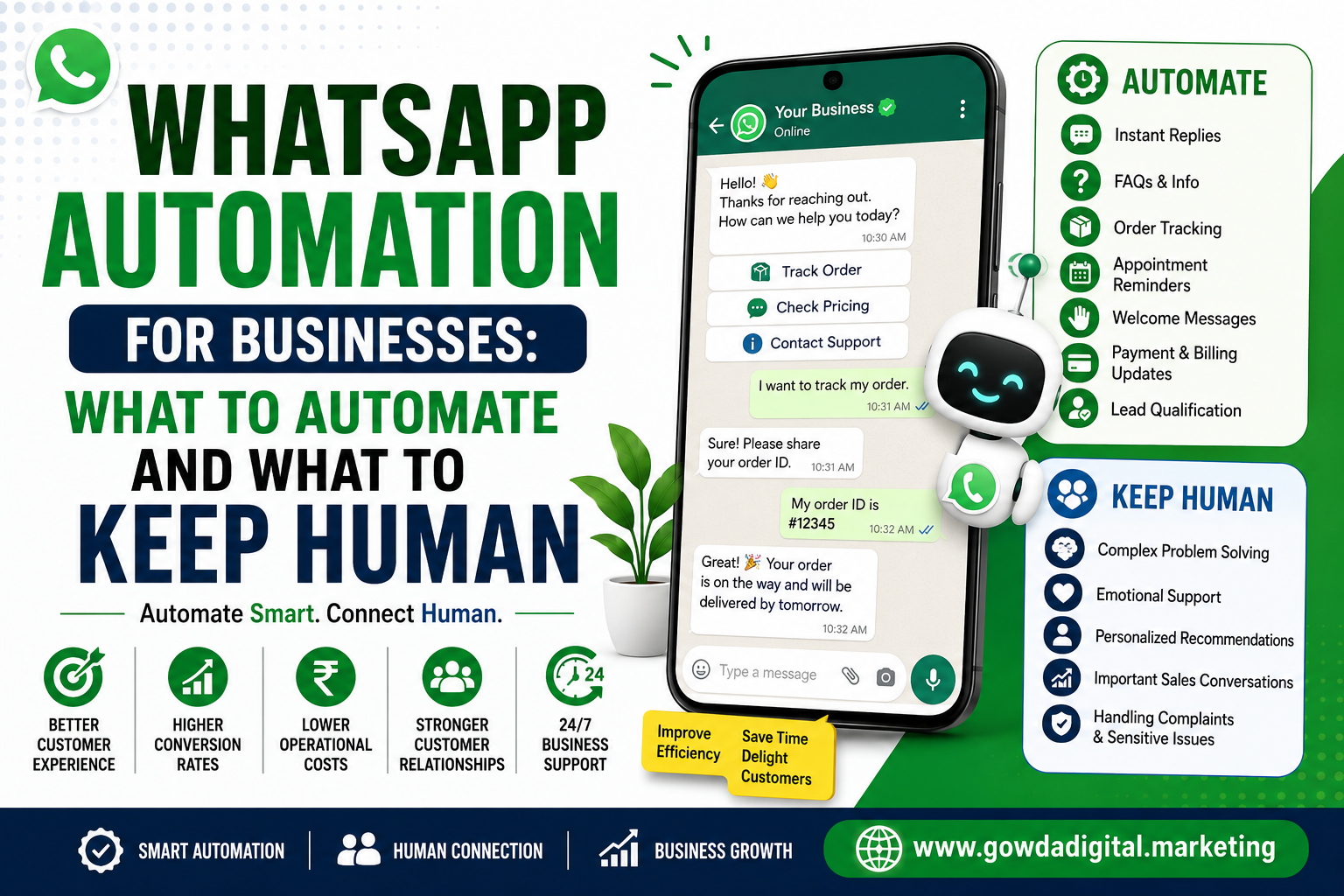
- What Businesses Should Automate
- What Should Always Stay Human
- AI Chatbots vs Human Support
- Automation Workflows
- Industry Examples
- Best Practices
- Common Mistakes
- FAQs
- Conclusion
Featured Snippet Section
What Should Businesses Automate on WhatsApp?
Businesses should automate repetitive tasks such as welcome messages, FAQs, lead qualification, appointment scheduling, order confirmations, payment reminders, shipping updates, and customer feedback requests. However, complex customer issues, complaints, negotiations, sales consultations, and relationship-building conversations should remain human to provide empathy, trust, and personalized support.
Key Facts & Statistics Box
📊 WhatsApp Business Trends 2026
- WhatsApp remains one of the world’s most-used messaging platforms.
- Customers increasingly prefer messaging businesses over calling.
- Fast response times improve customer satisfaction.
- Automated workflows reduce repetitive support tasks.
- Personalized conversations increase customer loyalty.
What Is WhatsApp Automation?
WhatsApp automation uses software, chatbots, AI agents, and workflow tools to automate customer communication.
It can:
- Reply instantly
- Route inquiries
- Capture leads
- Send notifications
- Trigger follow-up messages
- Integrate with CRM systems
The goal isn’t replacing people—it’s helping teams work more efficiently.
Benefits of WhatsApp Automation
Businesses using automation can achieve:
- Faster response times
- Better customer experiences
- Reduced manual work
- Improved lead management
- Increased productivity
- Consistent communication
- Better scalability
Highlight Box
🚀 Pro Tip:
Automate repetitive tasks—not relationships. Customers remember how your business makes them feel, not how quickly a chatbot answered a basic question.
What You Should Automate
Welcome Messages
Automatically greet new customers.
Example:
“Hi! 👋 Thanks for contacting ABC Solutions. How can we help you today?”
Frequently Asked Questions
Automate answers for:
- Business hours
- Pricing
- Services
- Product availability
- Delivery information
Lead Qualification
Collect:
- Name
- Phone number
- Business type
- Requirements
- Budget
Before transferring to a salesperson.
Appointment Booking
Allow customers to:
- Select dates
- Choose time slots
- Receive confirmations
- Get reminders
Order Updates
Automatically send:
- Order confirmation
- Payment confirmation
- Shipping updates
- Delivery notifications
Payment Reminders
Notify customers about:
- Pending invoices
- Due dates
- Successful payments
Customer Feedback
Automatically request reviews after:
- Deliveries
- Completed services
- Consultations
H2: What Should Stay Human
Sales Consultations
Customers making important purchasing decisions often need expert advice.
Complaint Resolution
Angry customers require empathy.
Avoid automated responses.
Negotiations
Pricing discussions and custom quotations should be handled personally.
High-Value Clients
VIP customers appreciate direct communication.
Emotional Conversations
Human interaction builds trust during:
- Complaints
- Refund requests
- Service failures
- Sensitive discussions
Comparison Table
Automation vs Human Interaction
| Best Automated | Best Handled by Humans |
| Welcome Messages | Sales Consultations |
| FAQs | Complaint Resolution |
| Order Updates | Negotiations |
| Appointment Booking | Custom Solutions |
| Payment Reminders | Relationship Building |
| Review Requests | Customer Retention Calls |
AI Chatbots vs Human Support
| AI Chatbot | Human Support |
| Instant Replies | Emotional Intelligence |
| Available 24/7 | Complex Decision Making |
| Handles Repetitive Tasks | Personalized Conversations |
| Scalable | Relationship Building |
| Cost Effective | Trust Building |
The best businesses combine both.
Expert Opinion
“Customers appreciate fast automation for simple questions, but they expect human understanding when the conversation becomes important.”
Sample WhatsApp Automation Workflow
Customer Sends Message
↓
Instant Welcome Message
↓
Menu Options
↓
Lead Qualification
↓
FAQ Response (if applicable)
↓
Appointment Booking
↓
Transfer to Human Agent (if required)
↓
Follow-Up
↓
Feedback Request
Industry Examples
Healthcare
Automate:
- Appointment reminders
- Prescription reminders
- Clinic timings
Keep Human:
- Medical consultations
Real Estate
Automate:
- Property listings
- Appointment scheduling
Keep Human:
- Site visits
- Price discussions
Restaurants
Automate:
- Menu sharing
- Reservations
- Delivery updates
Keep Human:
- Special requests
- Complaint handling
E-commerce
Automate:
- Order tracking
- Product recommendations
- Return requests
Keep Human:
- Complex product advice
- Escalated support
Case Study 1
Local Interior Design Company
Challenge:
Too many repetitive inquiries.
Solution:
Automated:
- FAQs
- Consultation booking
- Service information
Human team handled:
- Design discussions
- Quotations
- Client meetings
Results:
- Faster response times
- Increased consultation bookings
- Higher customer satisfaction
Case Study 2
Online Electronics Store
Challenge:
Support team overwhelmed.
Solution:
Automated:
- Order tracking
- Shipping updates
- Payment confirmations
Results:
- Reduced support workload
- Faster customer responses
- Improved efficiency
Common WhatsApp Automation Mistakes
❌ Automating every conversation
❌ Making chatbots difficult to navigate
❌ Hiding human support options
❌ Sending excessive promotional messages
❌ Ignoring customer preferences
❌ Failing to update automated workflows
Step-by-Step Visual Workflow
Customer Message
↓
AI Welcome
↓
Intent Detection
↓
Automated Response
↓
Human Escalation (If Needed)
↓
Resolution
↓
Follow-Up
↓
Customer Feedback
Best Practices Checklist
✅ Keep messages conversational
✅ Respond quickly
✅ Offer a human handoff
✅ Personalize responses
✅ Review automation regularly
✅ Measure customer satisfaction
10 Frequently Asked Questions
1. What is WhatsApp automation?
Automating repetitive customer communication using workflows, chatbots, or AI.
2. Is WhatsApp automation suitable for small businesses?
Yes. It helps save time and improve customer service.
3. Can AI replace customer support agents?
AI assists with routine tasks but should not replace human support for complex interactions.
4. What tasks should I automate first?
Welcome messages, FAQs, appointment booking, and order updates.
5. Is WhatsApp automation expensive?
Costs vary depending on the platform and business requirements.
6. Can WhatsApp integrate with CRM software?
Yes, many business solutions support CRM integrations.
7. Does automation improve response time?
Yes. Automated replies can respond instantly.
8. Should I automate sales conversations?
Only the initial qualification stage. Personalized sales discussions should remain human.
9. How do I know when to transfer to a human?
When the customer has a complex issue, complaint, or requires personalized advice.
10. Is WhatsApp automation the future of customer service?
It will continue to play a major role, especially when combined with skilled human support.
Image Alt Text Suggestions
- WhatsApp automation workflow infographic
- AI chatbot vs human customer support comparison
- WhatsApp Business automation dashboard
- Lead generation automation flow using WhatsApp
- Customer communication journey diagram
References & Sources
- WhatsApp Business Platform Documentation
- Meta Business Resources
- HubSpot Marketing Blog
- Salesforce Customer Service Resources
- Twilio WhatsApp Resources
Summary / Key Takeaways
✅ Automate repetitive conversations
✅ Keep important conversations human
✅ Use AI to improve—not replace—customer service
✅ Respond instantly to common questions
✅ Personalize communication whenever possible
✅ Integrate WhatsApp with your CRM
✅ Monitor customer satisfaction regularly
✅ Balance efficiency with empathy
Actionable Steps / To-Do List
Week 1
- Identify repetitive customer questions
- Create FAQ responses
Week 2
- Set up welcome messages
- Automate appointment booking
Week 3
- Integrate CRM and WhatsApp
- Build escalation workflows
Week 4
- Monitor conversations
- Optimize automation based on customer feedback
Conclusion
WhatsApp automation is one of the most valuable tools available to businesses in 2026—but only when implemented thoughtfully.
The goal is not to automate every interaction. Instead, automate repetitive, predictable tasks while preserving human conversations where empathy, expertise, and trust matter most.
Businesses that strike this balance will provide faster service, stronger customer relationships, and better long-term growth.
In the age of AI, customers still value genuine human connection—and that’s what will continue to differentiate successful brands.
Call to Action
📩 Subscribe to our newsletter for weekly insights on AI, WhatsApp marketing, business automation, and digital growth strategies.
💬 What part of your customer communication would you automate first? Share your thoughts in the comments below.