
Introduction
When starting a business, one of the first questions entrepreneurs ask is:
“Can you design my logo?”
While a logo is essential, it’s only one small part of your brand.
Think of it this way:
A logo is your business’s signature.
A brand identity is its personality.
Your brand identity influences how customers feel every time they interact with your business—from your website and social media to your customer service and packaging.
Businesses with a strong, consistent brand identity are often easier to recognize, easier to trust, and more likely to build loyal customer relationships.
This guide explores the differences between logos and brand identity and helps you determine what your business truly needs.
Problem Statement: Why It Matters
Many businesses:
- Spend weeks perfecting a logo.
- Ignore brand consistency.
- Use different colors across platforms.
- Change messaging frequently.
- Lack a recognizable personality.
The result?
❌ Weak brand recognition
❌ Low customer trust
❌ Confusing customer experience
❌ Poor differentiation
❌ Lost business opportunities
Promise of Value
By the end of this guide, you’ll learn:
✅ What a logo actually is
✅ What brand identity includes
✅ Key differences between the two
✅ Why businesses need both
✅ How to create a memorable brand
Table of Contents
- What Is a Logo?
- What Is Brand Identity?
- Logo vs Brand Identity Comparison
- Why Businesses Need More Than a Logo
- Elements of a Strong Brand Identity
- Building Your Brand Identity
- Real Business Examples
- Common Branding Mistakes
- FAQs
- Conclusion
Featured Snippet Section
What Is the Difference Between a Logo and Brand Identity?
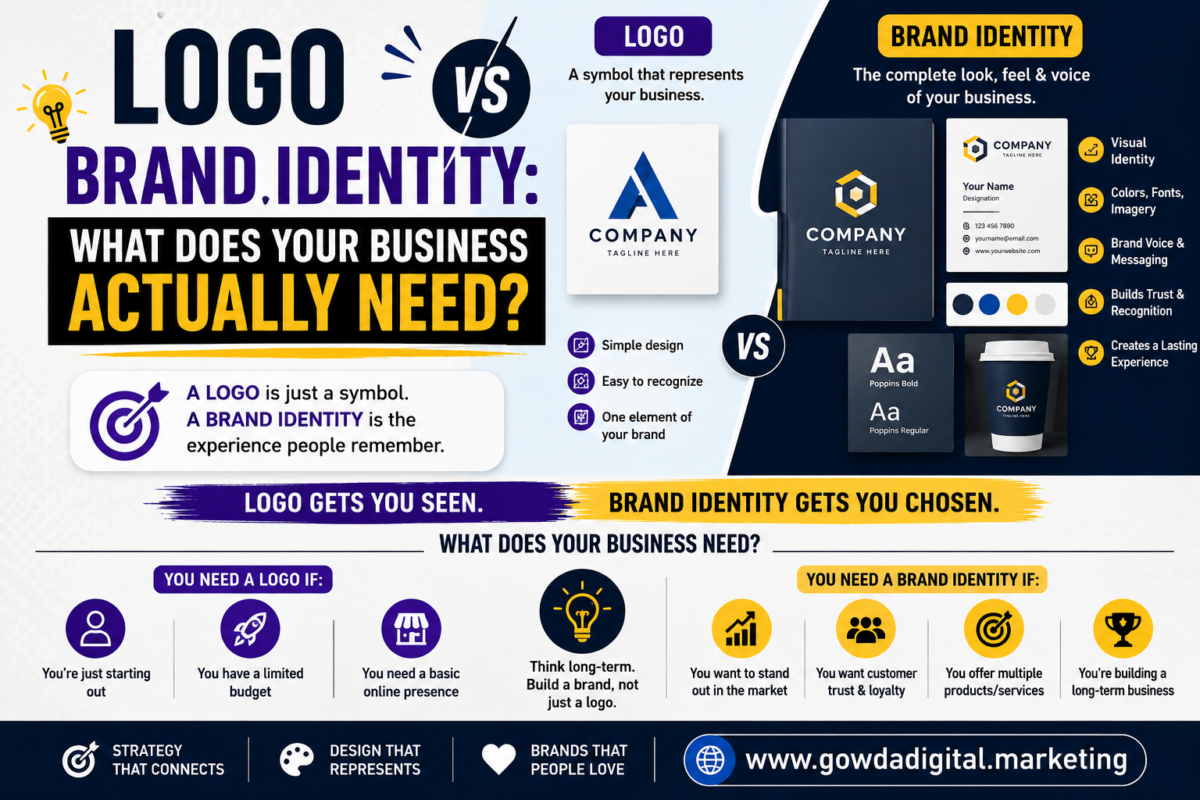
A logo is a visual symbol that represents a business, while a brand identity is the complete visual, verbal, and emotional experience customers associate with that business. Brand identity includes the logo, colors, typography, messaging, tone of voice, imagery, customer experience, and overall brand personality. A logo helps people recognize a business, but a strong brand identity helps them trust and remember it.
Key Facts & Statistics Box
📊 Branding Insights
- Consistent branding improves customer recognition.
- Customers are more likely to trust businesses with a professional visual identity.
- Strong branding supports customer loyalty and referrals.
- Visual consistency helps businesses stand out in competitive markets.
- Brand identity influences purchasing decisions beyond product features alone.
What Is a Logo?
A logo is a graphic symbol used to identify your business.
It can be:
- A wordmark
- A lettermark
- An icon
- A symbol
- A combination mark
Examples include:
- Company name
- Initials
- Abstract symbols
- Icons
A logo helps customers recognize your business.
However, recognition alone doesn’t create trust.
What Is Brand Identity?
Brand identity is everything customers experience about your business.
It includes:
- Logo
- Brand colors
- Typography
- Photography style
- Icons
- Illustrations
- Tone of voice
- Messaging
- Website design
- Social media appearance
- Packaging
- Customer experience
It defines how your business looks, sounds, and feels.
Highlight Box
Pro Tip:
Your logo introduces your business. Your brand identity tells customers what your business stands for and why they should choose you.
Logo vs Brand Identity
| Logo | Brand Identity |
| Symbol | Complete Brand Experience |
| Recognition | Trust & Recognition |
| One Design Element | Multiple Brand Elements |
| Static | Dynamic Across Platforms |
| Visual Only | Visual + Verbal + Emotional |
| Easy to Create | Requires Strategic Planning |
Why a Logo Alone Isn’t Enough
Imagine two coffee shops.
Both have attractive logos.
One has:
- Consistent colors
- Friendly messaging
- Beautiful packaging
- Helpful staff
- Memorable social media
The other has:
- Random colors
- Different fonts everywhere
- Confusing website
- Inconsistent customer experience
Which one feels more trustworthy?
Customers notice consistency—even if they don’t consciously realize it.
Elements of a Strong Brand Identity
Logo
Your visual signature.
Brand Colors
Choose colors that reflect your personality.
Examples:
Blue → Trust
Green → Growth
Orange → Energy
Black → Premium
Typography
Use consistent fonts across all platforms.
Brand Voice
Examples:
Professional
Friendly
Luxury
Innovative
Playful
Educational
Photography Style
Maintain consistency in:
- Lighting
- Editing
- Composition
- Visual mood
Messaging
Communicate:
- Mission
- Values
- Benefits
- Unique selling proposition
Expert Opinion
“People don’t build relationships with logos—they build relationships with brands that consistently deliver meaningful experiences.”
Build Your Brand Identity Step by Step
Step 1
Define your mission.
↓
Step 2
Understand your target audience.
↓
Step 3
Choose your brand personality.
↓
Step 4
Design your visual identity.
↓
Step 5
Create brand guidelines.
↓
Step 6
Apply branding consistently across every customer touchpoint.
Brand Identity Checklist
✔ Professional logo
✔ Color palette
✔ Typography system
✔ Icon style
✔ Photography guidelines
✔ Brand voice
✔ Messaging framework
✔ Social media templates
✔ Website consistency
✔ Email signature
✔ Business cards
✔ Presentation templates
Comparison Table
Business With Brand Identity vs Logo Only
| Brand Identity | Logo Only |
| High Trust | Limited Recognition |
| Consistent Messaging | Mixed Communication |
| Strong Customer Experience | Inconsistent Experience |
| Memorable Brand | Forgettable Business |
| Premium Perception | Generic Appearance |
| Higher Customer Loyalty | Lower Retention |
Step-by-Step Visual Framework
Business Vision
↓
Brand Strategy
↓
Logo Design
↓
Color Palette
↓
Typography
↓
Messaging
↓
Brand Guidelines
↓
Consistent Customer Experience
↓
Brand Recognition
Case Study 1
Local Bakery
Challenge:
Customers remembered the logo but not the business.
Solution:
- Redesigned packaging
- Created brand colors
- Developed friendly messaging
- Improved store experience
Results:
- Higher customer recognition
- More repeat customers
- Better word-of-mouth referrals
Case Study 2
Technology Startup
Challenge:
Professional logo but inconsistent branding.
Solution:
- Developed brand guidelines
- Unified website and social media
- Standardized communication
Results:
- Increased trust
- Improved lead generation
- Stronger online presence
Common Branding Mistakes
❌ Believing a logo is the entire brand
❌ Using inconsistent colors
❌ Frequently changing designs
❌ Ignoring brand voice
❌ Copying competitors
❌ Creating different styles across platforms
10 Frequently Asked Questions
1. Is a logo the same as branding?
No. A logo is one element of a brand.
2. Do small businesses need brand identity?
Yes. Consistent branding helps businesses compete effectively.
3. Can I start with only a logo?
Yes, but developing a complete brand identity should be a priority as your business grows.
4. Why is brand consistency important?
Consistency improves recognition and trust.
5. How often should I update my brand?
Only when necessary. Frequent changes may confuse customers.
6. What is a brand style guide?
A document explaining how to use brand elements consistently.
7. Does branding affect sales?
Yes. Strong branding often influences customer decisions.
8. Should my website match my branding?
Absolutely.
9. Can AI create a brand identity?
AI can assist with ideas, but strategy and customer understanding remain essential.