
In the Age of AI, People Trust People More Than Ever
Artificial Intelligence has transformed the way businesses create content, run advertising campaigns, and interact with customers.
Today, brands can generate websites, advertisements, videos, social media posts, and even customer support conversations within minutes.
While this has made marketing faster and more efficient, it has also created a major challenge.
Consumers are surrounded by similar-looking brands, repetitive AI-generated content, and generic marketing messages.
In 2026, customers are no longer choosing businesses simply because they have the best products or the biggest advertising budgets.
Instead, they are choosing brands they trust.
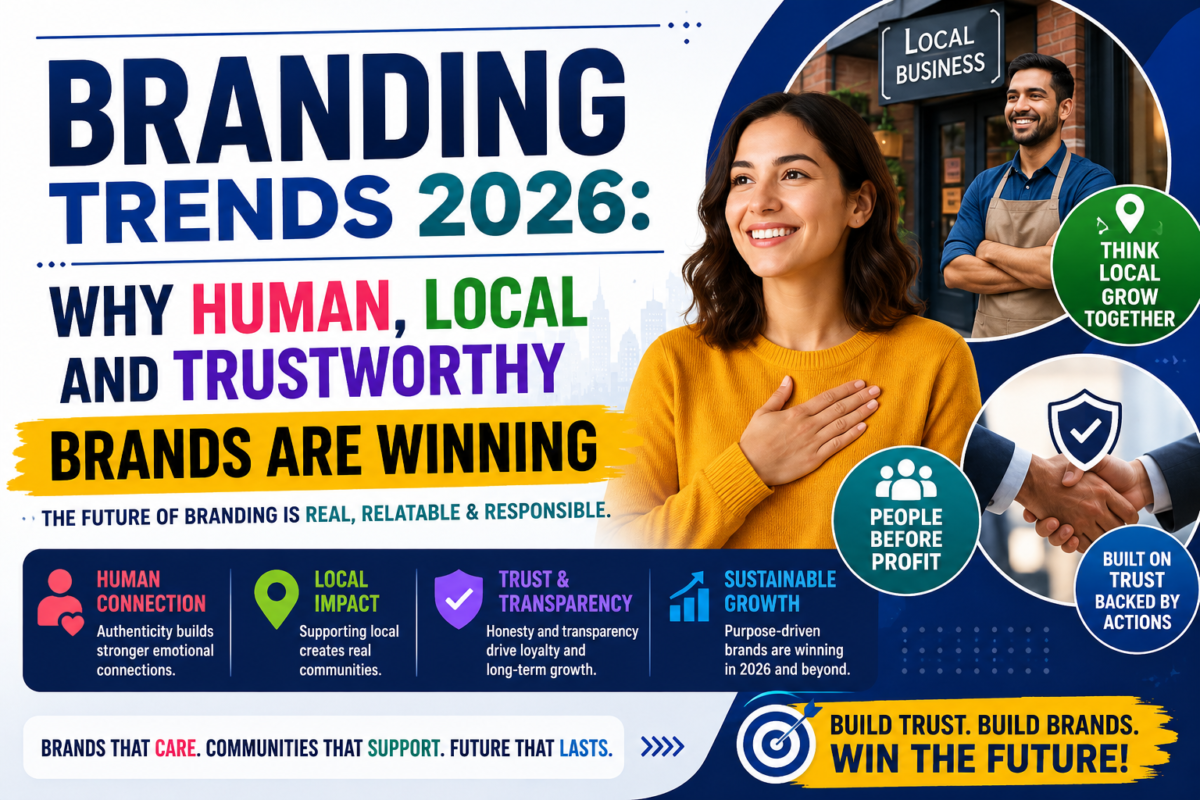
Human, local, and authentic brands are outperforming businesses that rely solely on automation because customers value genuine experiences, transparency, and meaningful relationships.
This guide explores the biggest branding trends shaping 2026 and explains why trust has become the most valuable business asset.
Why It Matters
Many businesses believe branding is only about logos and colors.
In reality, branding is about perception.
Businesses often make these mistakes:
❌ Relying entirely on AI-generated content
❌ Ignoring customer relationships
❌ Copying competitors
❌ Having inconsistent messaging
❌ Prioritizing sales over trust
❌ Failing to communicate their values
The result?
Customers struggle to remember the brand.
Engagement declines.
Loyalty decreases.
Competitors become difficult to differentiate.
What You Will Learn
By the end of this guide, you’ll discover:
✅ The biggest branding trends of 2026
✅ Why human-first brands outperform AI-only brands
✅ How local businesses build stronger customer loyalty
✅ Why trust has become the new marketing currency
✅ Strategies for building an authentic brand
✅ Future branding predictions
Table of Contents
- What Is Branding in 2026?
- Why Human Brands Are Winning
- The Rise of Local Branding
- Trust as a Competitive Advantage
- AI and Human Branding
- Community-Driven Marketing
- Personal Branding Growth
- Customer Experience as Branding
- Future Branding Trends
- Case Study
- Branding Comparison
- Frequently Asked Questions
- Conclusion
What Is Branding in 2026?
Branding is no longer limited to a company logo or tagline.
Modern branding includes every interaction customers have with your business.
This includes:
- Website experience
- Social media presence
- Customer service
- Reviews
- Content quality
- Advertising
- Brand voice
- Employee interactions
- Community involvement
Every customer experience contributes to your brand reputation.
Why Human Brands Are Winning
Consumers want genuine connections.
People trust businesses that show:
Real people
Real stories
Real customer experiences
Transparent communication
Behind-the-scenes content
Founder stories
Employee highlights
Human-centered brands create emotional connections that AI-generated marketing cannot replicate.
The Rise of Local Branding
Customers increasingly prefer supporting businesses within their communities.
Local brands often provide:
Personalized service
Faster communication
Better accountability
Community involvement
Local expertise
Businesses that emphasize their local presence build stronger customer trust and long-term loyalty.
Examples include:
Local digital marketing agencies
Interior design studios
Restaurants
Retail stores
Healthcare providers
Professional service firms
Trust Is the New Competitive Advantage
Trust has become one of the strongest purchasing factors.
Customers evaluate businesses based on:
Google reviews
Testimonials
Case studies
Industry expertise
Online reputation
Transparency
Social proof
Businesses with strong trust signals consistently outperform competitors.
AI Is Changing Branding—Not Replacing It
Artificial Intelligence helps businesses:
Generate ideas
Create content
Analyze customer behavior
Automate marketing
Improve personalization
However, AI cannot replace:
Human empathy
Creative storytelling
Brand purpose
Authentic relationships
Strategic thinking
The strongest brands combine AI efficiency with human creativity.
Community Is the New Marketing Channel
Modern customers want to belong to communities rather than simply buy products.
Successful brands build communities through:
Facebook Groups
LinkedIn Communities
WhatsApp Groups
Email newsletters
Local events
Webinars
Online discussions
Community-driven marketing creates stronger loyalty than traditional advertising.
Personal Branding Matters More Than Ever
People increasingly trust individuals more than corporate logos.
Business owners who build personal brands often experience:
Higher engagement
Greater credibility
More speaking opportunities
Better networking
Increased customer trust
Founders who actively share knowledge become valuable brand ambassadors.
Customer Experience Defines Your Brand
Every interaction shapes customer perception.
Great branding includes:
Quick responses
Friendly support
Easy navigation
Professional communication
Helpful content
Fast problem resolution
Consistent service
A positive customer experience leads to referrals and repeat business.
Storytelling Builds Emotional Connections
Customers remember stories more than advertisements.
Instead of promoting products, successful brands share:
Customer success stories
Business journey
Challenges overcome
Mission and values
Community impact
Stories make brands memorable.
Brand Consistency Creates Recognition
Consistency strengthens trust.
Maintain consistent:
Colors
Fonts
Tone of voice
Messaging
Photography
Logo usage
Social media style
Website design
Customers recognize brands that appear consistent across every platform.
Sustainability and Purpose Matter
Consumers increasingly support businesses with meaningful values.
Examples include:
Environmental responsibility
Ethical business practices
Community support
Diversity and inclusion
Employee well-being
Businesses with genuine purpose often build stronger emotional connections.
Common Branding Mistakes
Avoid these common mistakes:
❌ Copying competitors
❌ Inconsistent messaging
❌ Ignoring customer feedback
❌ Poor customer service
❌ Generic AI-generated content
❌ Lack of authenticity
❌ Weak online presence
❌ Inconsistent visual identity
Case Study
Local Interior Design Studio
Challenge
The business struggled to compete with larger national brands.
Strategy
Shared founder story
Posted project walkthrough videos
Highlighted local clients
Collected customer testimonials
Published educational blogs
Showcased team members
Maintained consistent branding
Results
Higher local visibility
Increased customer trust
More referrals
Improved engagement
Better brand recognition
Traditional Branding vs Modern Branding
| Traditional Branding | Modern Branding |
| Logo-focused | Experience-focused |
| Mass marketing | Personalized communication |
| Corporate messaging | Human storytelling |
| One-way communication | Community engagement |
| Product promotion | Value creation |
| Advertising | Relationship building |
| Brand awareness | Brand trust |
Human-Centered Branding Framework
Brand Purpose
↓
Customer Understanding
↓
Authentic Storytelling
↓
Community Engagement
↓
Consistent Experiences
↓
Customer Trust
↓
Brand Loyalty
↓
Business Growth
Future Branding Trends for 2026
The strongest brands will focus on:
Human-first marketing
AI-assisted creativity
Hyper-personalization
Community building
Local storytelling
Video-first communication
Employee advocacy
Transparent business practices
Trust-based marketing
Customer education
Frequently Asked Questions
What is the biggest branding trend in 2026?
Building trust through authentic human connections.
Does branding still matter?
More than ever.
Can AI replace branding?
No. AI supports branding but cannot replace authentic relationships.
Why are local brands growing?
Customers increasingly value personalized service and community connections.
What builds customer trust?
Transparency, expertise, reviews, and consistent experiences.
Is storytelling important?
Yes. Stories create emotional connections with customers.
Does branding affect SEO?
Yes. Strong brands improve engagement, trust, and search visibility.
What role does customer experience play?
Customer experience has become one of the most important branding factors.
Should founders build personal brands?
Yes. Personal branding strengthens credibility and customer trust.
What is the future of branding?
Human-centered, trustworthy, and community-driven brands will continue to outperform generic competitors.
Key Takeaways
- Human brands create stronger emotional connections.
- Local businesses build greater customer loyalty.
- Trust has become a competitive advantage.
- AI enhances branding but cannot replace authenticity.
- Storytelling improves engagement.
- Customer experience defines brand perception.
- Community marketing strengthens relationships.
- Consistent branding builds recognition.
- Personal branding supports business growth.
- Authentic brands will dominate the future.
Final Thoughts
Branding in 2026 is no longer about having the most polished logo or the biggest advertising budget.
Customers have become more informed, more selective, and more skeptical of generic marketing messages.
The brands that win are those that consistently demonstrate authenticity, transparency, and genuine care for their customers.
Artificial Intelligence will continue transforming marketing, but technology alone cannot create trust.
Businesses that combine AI-powered efficiency with human creativity, local engagement, exceptional customer experiences, and meaningful storytelling will build brands that customers remember, recommend, and remain loyal to for years.
In the future, the strongest competitive advantage will not simply be better marketing—it will be becoming a brand people genuinely trust.