
A business does not need to be everywhere online—it needs to be discoverable, credible and easy to choose when the right customer is ready to act.
Introduction
Bangalore is one of India’s most competitive business markets.
From technology startups and SaaS companies to restaurants, dental clinics, educational institutions, real estate firms, automobile businesses, professional services, retailers and D2C brands, businesses across the city compete for attention every day.
A potential customer might discover a business through Google Search in the morning, see its Instagram profile later, visit its website in the evening and finally contact it through WhatsApp.
That means digital marketing is no longer a collection of disconnected activities.
SEO, paid advertising, websites, social media, content, reviews, lead generation and automation need to work together.
This is where many growing businesses struggle.
They may have a website but little organic traffic.
They may run advertisements but fail to follow up with leads.
They may post regularly on Instagram but receive very few enquiries.
They may have a Google Business Profile but rarely optimize it.
Or they may invest in several marketing channels without knowing which activity is actually generating customers.
A complete digital marketing strategy solves this problem by connecting the entire customer journey.
Google’s current Search Essentials emphasize helpful, reliable, people-first content rather than content created primarily to manipulate search rankings.
For local businesses, Google also states that local results are primarily influenced by relevance, distance and prominence.
So the objective should not simply be:
“How do I get more followers?”
The better question is:
“How do I build a predictable digital system that turns the right online attention into measurable business results?”
This guide provides a framework for doing exactly that.
Why a Complete Digital Marketing Strategy Matters
Digital marketing becomes expensive and inefficient when every channel operates independently.
Imagine a Bangalore dental clinic doing the following:
- Instagram posts three times a week
- Google Ads occasionally
- Has a basic website
- Has a Google Business Profile
- Publishes a blog once every few months
- Receives enquiries through WhatsApp
- Stores customer information manually
Each activity can potentially generate value.
But without a strategy, there is no clear connection between them.
A better system could look like:
Google Search → Website / Google Business Profile → Service information → Trust signals → WhatsApp / Call → CRM → Follow-up → Appointment → Review → Repeat/referral
That is a marketing system rather than a collection of marketing tasks.
Key Facts & Statistics Box
DIGITAL MARKETING STRATEGY FACTS
1. Google says local search visibility is primarily influenced by relevance, distance and prominence.
2. Google recommends creating helpful, reliable, people-first content rather than content designed primarily to manipulate rankings.
3. Google states that meeting Search Essentials does not guarantee that a page will be crawled, indexed or shown in search results.
4. Google’s SEO guidance recommends thinking about the different words audiences may use when searching for the same information.
5. A complete marketing strategy therefore needs to focus on both discoverability and the experience that follows the click.
1. Understand the Business Before Choosing Marketing Channels
One of the biggest digital marketing mistakes is choosing channels before understanding the business.
A business owner may say:
“We need Instagram marketing.”
Another might say:
“We need Google Ads.”
A third might say:
“We need SEO.”
But these are solutions, not objectives.
Start with the business.
Define the Business Goal
Your primary goal could be:
- Generate more enquiries
- Increase online sales
- Generate phone calls
- Increase appointments
- Increase store visits
- Build brand awareness
- Generate qualified B2B leads
- Improve repeat purchases
- Enter a new Bangalore locality
- Expand across Karnataka
- Build a national customer base
The marketing strategy should be designed around the goal.
Example
A local dental clinic might prioritize:
Visibility → Calls → WhatsApp enquiries → Appointments → Reviews → Referrals
A B2B software company might prioritize:
Search → Landing page → Demo request → Sales qualification → Demo → Proposal → Conversion
A restaurant might prioritize:
Local discovery → Menu → Directions → Calls → Reservations → Reviews → Repeat visits
The channels can be different even though all three businesses use digital marketing.
2. Define Your Ideal Customer
A strategy becomes much easier when you know exactly who you want to attract.
Create an ideal customer profile.
Customer Profile Framework
| Question | Example |
| Who are they? | Working professionals |
| Location | Vijayanagar, Rajajinagar, Malleshwaram |
| Age group | 25–45 |
| Need | Convenient dental treatment |
| Problem | Limited time |
| Search behavior | “dentist near me” |
| Decision factor | Reviews, location, expertise |
| Contact preference | WhatsApp/call |
| Buying trigger | Pain or scheduled treatment |
| Objection | Price/trust |
You do not need an elaborate 50-page customer persona.
You need enough information to understand:
Who → Problem → Search → Decision → Action
3. Research the Bangalore Market
Bangalore should not be treated as one homogeneous market.
Customer behavior can vary significantly between areas.
For example, a business targeting:
- Indiranagar
- Koramangala
- Whitefield
- HSR Layout
- Jayanagar
- Vijayanagar
- Rajajinagar
- Yelahanka
- Electronic City
- Marathahalli
may need different messaging, service pages and campaign structures.
Create a Local Market Map
Start with three levels.
Level 1: Core Area
The immediate area surrounding the business.
Example:
Vijayanagar + surrounding neighborhoods
Level 2: Bangalore Expansion
Areas where customers can reasonably travel.
Example:
West Bangalore
Level 3: Wider Market
Depending on the business:
Bangalore → Karnataka → India → International
This prevents the common mistake of trying to target the entire city immediately.
4. Create a Clear Positioning Strategy
Before spending money on advertising, answer:
Why should someone choose this business instead of another option?
Your positioning should communicate:
Audience + Problem + Solution + Differentiator
For example:
Digital marketing support for Bangalore small businesses that want practical SEO, lead generation and automation without managing multiple disconnected vendors.
This is clearer than:
We provide innovative digital marketing solutions.
The second statement sounds professional but says little.
5. Build the Digital Foundation
Before driving traffic, make sure your digital infrastructure can handle it.
Your foundation should normally include:
- Website
- Google Business Profile
- Analytics
- Search Console
- Conversion tracking
- Social profiles
- Business email
- WhatsApp/contact system
- CRM or lead database
- Review management process
Think of your website as the central property you control.
Social platforms and advertising platforms can send traffic toward it, but your website should clearly explain:
- What you offer
- Who you help
- Where you operate
- Why customers should trust you
- What makes you different
- How to contact you
6. Build a Website That Converts
A website is not simply an online brochure.
It should help visitors move from:
Interest → Understanding → Trust → Action
Essential Website Pages
Depending on the business:
- Home
- About
- Services
- Individual service pages
- Location pages
- Industries
- Portfolio/case studies
- Testimonials
- Blog/resources
- Contact
- FAQ
Service Pages Matter
Instead of one page titled:
Our Services
create dedicated pages when the services are genuinely distinct.
For example:
- SEO Services
- Local SEO
- Google Ads
- Social Media Management
- Website Development
- Business Automation
- Content Marketing
Each page can target a specific search intent.
7. Build a Local SEO Strategy
For Bangalore businesses, local SEO can be an important part of the digital marketing system.
Google says local search results are primarily based on relevance, distance and prominence.
That means local SEO is not simply inserting “Bangalore” into every paragraph.
Local SEO Framework
Step 1: Optimize Your Google Business Profile
Maintain accurate:
- Business name
- Address
- Phone number
- Website
- Business category
- Services
- Hours
- Photos
- Business description
Google specifically recommends keeping Business Profile information complete and accurate.
Step 2: Build Relevant Location Pages
Where genuinely useful, create pages targeting relevant service-location combinations.
Examples:
- SEO Services in Bangalore
- Website Development in Bangalore
- Google Ads Management in Bangalore
- Social Media Marketing in Bangalore
Avoid creating dozens of near-identical pages simply to capture keywords.
Step 3: Build Reputation
Encourage genuine customers to leave reviews.
Respond professionally to reviews.
Do not manufacture reviews or incentivize misleading feedback.
Step 4: Build Local Relevance
Potential sources include:
- Local business directories
- Industry associations
- Local publications
- Community websites
- Relevant partnerships
- Local events
- Genuine PR coverage
The emphasis should be on relevance and authenticity.
8. Build a Search Engine Optimization Strategy
SEO should be treated as a long-term asset rather than a quick ranking trick.
Google’s Search Essentials recommend helpful, reliable, people-first content and technically accessible pages.
SEO Framework
On-Page SEO
Focus on:
- Search intent
- Page titles
- Headings
- Internal links
- Useful content
- Image alt text
- URLs
- Structured information where appropriate
Technical SEO
Monitor:
- Indexing
- Crawlability
- Mobile usability
- Site performance
- Broken links
- Canonicalization
- XML sitemap
- HTTPS
- JavaScript-related rendering issues
Off-Page SEO
Build genuine authority through:
- Relevant links
- Digital PR
- Industry publications
- Partnerships
- Original research
- Useful resources
Local SEO
Connect the strategy with:
- Google Business Profile
- Local landing pages
- Reviews
- Local citations
- Location-specific content
9. Create a Content Strategy
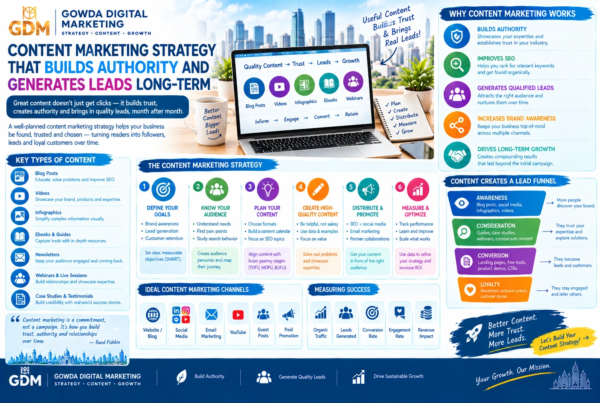
Content marketing should answer customer questions throughout the buying journey.
Instead of randomly publishing articles, create content clusters.
Example: Bangalore Dental Clinic
Awareness
- How often should you visit a dentist?
- What causes tooth sensitivity?
Consideration
- Root canal vs tooth extraction
- How much does a dental consultation cost?
Decision
- Dental clinic in Bangalore
- Root canal treatment in Bangalore
Retention
- How to maintain oral health after treatment
- When should you schedule your next dental check-up?
This creates a content ecosystem.
10. Use the 70–20–10 Content Framework
A simple evergreen model can be:
70% — Core Educational Content
Examples:
- Guides
- How-to articles
- FAQs
- Industry explanations
- Problem-solving content
20% — Authority Content
Examples:
- Case studies
- Original insights
- Expert interviews
- Customer stories
- Research
10% — Promotional Content
Examples:
- Offers
- Product announcements
- Service campaigns
- Events
- New launches
The exact percentage is not a universal rule.
The purpose is to prevent your content from becoming one continuous sales pitch.
11. Build a Social Media Strategy
Social media should have a job.
Do not define success simply as:
“We need to post every day.”
Instead, define the purpose.
Social media can support:
- Brand awareness
- Education
- Trust
- Community
- Customer support
- Lead generation
- Product discovery
- Recruitment
- Reputation
Content Pillars
A business could use five pillars:
- Education
- Behind the scenes
- Customer stories
- Industry insights
- Offers/products/services
This makes content planning easier.
12. Choose Platforms Based on the Audience
You do not need every platform.
Useful for:
- Visual brands
- Restaurants
- Fashion
- Beauty
- Lifestyle
- Local businesses
Useful for:
- B2B
- Consulting
- SaaS
- Professional services
- Recruitment
- Founder-led content
YouTube
Useful for:
- Tutorials
- Product demonstrations
- Reviews
- Education
- Long-form expertise
Can still be useful for:
- Local communities
- Certain customer demographics
- Events
- Groups
- Local businesses
The correct platform depends on where your customers actually spend attention.
13. Use Google Ads and Paid Advertising Strategically
Paid advertising can generate traffic faster than organic channels, but traffic alone is not the goal.
The goal is:
Qualified traffic → conversion → customer
Paid Advertising Funnel
Search / Social Ad
↓
Landing Page
↓
Lead Form / Call / WhatsApp
↓
CRM
↓
Follow-Up
↓
Sales
↓
Customer
↓
Repeat / Referral
If the landing page is weak, increasing the advertising budget can simply increase wasted traffic.
14. Separate Campaigns by Intent
Consider separating:
High Intent
Examples:
- “SEO agency Bangalore”
- “dentist near me”
- “website developer Bangalore”
Problem Awareness
Examples:
- “how to improve website traffic”
- “how to generate leads online”
Remarketing
Target people who have previously:
- Visited your website
- Viewed a key page
- Engaged with content
- Started but did not complete an enquiry
Different audiences require different messages.
15. Build a Lead Generation System
Getting enquiries is not the same as generating customers.
You need a process for managing leads.
Lead Management Framework
| Stage | Action |
| Visitor | Understand the offer |
| Lead | Submit form/call/WhatsApp |
| Qualification | Determine fit |
| Follow-up | Respond promptly |
| Sales conversation | Understand requirements |
| Proposal | Present solution |
| Decision | Follow up |
| Customer | Deliver service |
| Retention | Maintain relationship |
| Referral | Encourage advocacy |
This is where website development, CRM systems, WhatsApp workflows and automation can work together.
16. Add Marketing Automation
Automation should remove repetitive work, not remove human relationships.
Useful automation examples include:
- Lead acknowledgement
- Appointment reminders
- Email sequences
- WhatsApp notifications
- CRM lead assignment
- Follow-up reminders
- Social media scheduling
- Customer feedback requests
- Newsletter distribution
- Lead-status updates
Example
A website enquiry arrives.
Automation:
New enquiry → CRM entry → acknowledgement → salesperson notification → follow-up task → proposal → reminder → status update
Instead of manually remembering every lead, the system creates a repeatable workflow.
17. Connect Your Tools
A growing business may eventually use:
- Website
- Google Business Profile
- Google Analytics
- Search Console
- Google Ads
- Social platforms
- CRM
- Email marketing
- Scheduling software
- Accounting systems
The goal is not to collect tools.
The goal is to connect useful tools around a customer journey.
CALL OUT:
More software does not automatically create more growth. A smaller number of well-connected systems can be more useful than a large collection of disconnected tools.
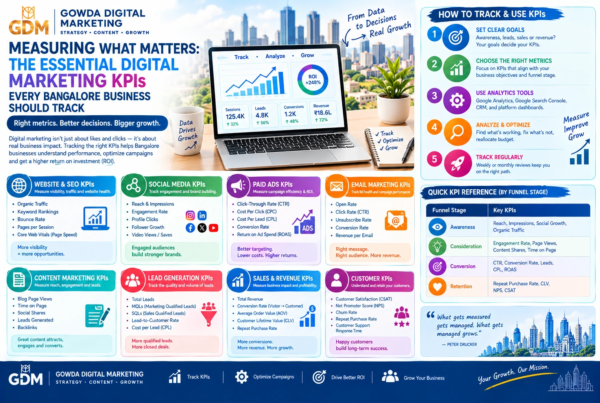
18. Measure What Actually Matters
One of the biggest marketing mistakes is measuring activity instead of outcomes.
Activity Metrics
- Number of posts
- Website sessions
- Impressions
- Followers
- Clicks
Business Metrics
- Qualified leads
- Cost per lead
- Conversion rate
- Customer acquisition cost
- Revenue
- Repeat customers
- Average order value
- Return on advertising spend
- Lead-to-customer rate
Activity metrics can provide context.
Business metrics tell you whether marketing is contributing to commercial objectives.
19. Create a Simple Marketing Dashboard
A monthly dashboard could contain:
| Area | Metric |
| SEO | Organic clicks |
| Local SEO | Calls / website actions |
| Website | Conversion rate |
| Google Ads | Cost per qualified lead |
| Social | Qualified enquiries |
| Click-through rate | |
| CRM | Lead-to-customer conversion |
| Sales | Revenue from marketing leads |
| Retention | Repeat purchase rate |
Do not track 50 metrics just because software makes them available.
Track the numbers that influence decisions.
20. Build a Practical Digital Marketing Budget
There is no universal marketing budget that works for every Bangalore business.
Budget should depend on:
- Revenue
- Margins
- Customer lifetime value
- Competition
- Sales cycle
- Target geography
- Growth stage
- Existing organic visibility
- Average customer value
A useful allocation model is:
| Activity | Example Share |
| SEO & Content | 20–30% |
| Paid Advertising | 25–40% |
| Website / CRO | 10–15% |
| Social Media | 10–20% |
| Automation / CRM | 5–10% |
| Testing / Experimental | 5–10% |
These percentages are a planning framework, not a universal formula.
For a business with strong organic demand, the balance may be different.
For a new business that needs immediate enquiries, paid acquisition may receive a larger share.
21. Compare Short-Term and Long-Term Marketing
| Factor | Organic Marketing | Paid Marketing |
| Initial speed | Slower | Faster |
| Long-term asset | Strong | Limited after spending stops |
| Cost structure | Time/content/SEO investment | Advertising spend |
| Targeting | Search intent/content | Detailed audience targeting |
| Compounding effect | Possible | Usually limited |
| Best use | Sustainable discovery | Immediate campaigns/testing |
| Main risk | Takes time | Can become expensive without optimization |
A mature strategy often combines both rather than treating them as competitors.
22. Use the PESO-Style Channel Model
A useful planning model is:
Owned
Assets you control:
- Website
- Blog
- Email list
- CRM
- Customer database
Paid
Channels where you pay for distribution:
- Google Ads
- Social ads
- Sponsored placements
Earned
Exposure gained through:
- Reviews
- PR
- Mentions
- Links
- Customer recommendations
Shared
Distribution through:
- Social sharing
- Communities
- Partnerships
- Customer-generated content
This framework helps identify whether your business is becoming dependent on one platform.
23. Build a 90-Day Digital Marketing Plan
A growing business does not need to implement everything on day one.
Days 1–30: Foundation
Week 1
- Define business goals
- Identify ideal customers
- Research competitors
- Map services
- Identify target locations
Week 2
- Audit website
- Audit Google Business Profile
- Review analytics
- Review social accounts
- Identify conversion problems
Week 3
- Keyword research
- Content planning
- Website page planning
- Tracking setup
- Lead management setup
Week 4
- Fix critical website issues
- Optimize local presence
- Create conversion paths
- Launch initial content
Days 31–60: Acquisition
Focus on:
- SEO implementation
- Local SEO
- Content publishing
- Google Ads testing
- Social media system
- Landing pages
- Lead generation
- Email/WhatsApp follow-up
At this stage, measure early signals.
Do not immediately make large decisions based on a few days of data.
Days 61–90: Optimization
Review:
- Which keywords attract relevant visitors?
- Which pages generate leads?
- Which ads generate qualified enquiries?
- Which content receives meaningful engagement?
- Which locations perform well?
- Where are leads dropping out?
- How quickly are enquiries receiving responses?
Then improve the system.
Step-by-Step Digital Marketing Visual
Use this as a graphic/infographic inside the article:
BUSINESS GOAL
↓
CUSTOMER RESEARCH
↓
POSITIONING
↓
WEBSITE + LOCAL PRESENCE
↓
SEO + CONTENT
↓
PAID ADS + SOCIAL
↓
LANDING PAGE
↓
LEAD / CALL / WHATSAPP
↓
CRM + FOLLOW-UP
↓
SALE
↓
RETENTION + REVIEW
↓
ANALYTICS
↓
OPTIMIZATION
The cycle then repeats.
24. Case Study Example: Bangalore Dental Clinic
Consider a fictional dental clinic in West Bangalore.
Initial Situation
The clinic has:
- Basic website
- Google Business Profile
- Instagram account
- Some existing reviews
- No structured SEO
- No lead tracking
Strategy
Month 1
Improve:
- Website service pages
- Location information
- Google Business Profile
- Tracking
- Conversion buttons
Month 2
Create content around:
- Common dental problems
- Treatment questions
- Pricing considerations
- Local service searches
Month 3
Test Google Ads for high-intent searches.
Create a lead follow-up system.
Measurement
Instead of focusing only on website traffic, track:
Search visibility → calls → WhatsApp enquiries → appointments → completed treatments
This is a more meaningful measurement chain.
25. Case Study Example: Bangalore B2B Service Company
Consider a fictional industrial services company targeting Bangalore manufacturers.
Its strategy might look like:
Technical SEO
Industry landing pages
LinkedIn content
Google Search Ads
Case studies
Lead form
CRM automation
Sales follow-up
The content could focus on practical questions buyers ask before contacting a supplier.
The strategy therefore combines search demand, expertise and lead management.
26. Case Study Example: Bangalore Restaurant
A restaurant has different requirements.
Its digital strategy might include:
- Google Business Profile
- Local SEO
- Menu page
- Food photography
- Instagram Reels
- Customer reviews
- Location-based content
- Reservation system
- Local advertising
- Event promotion
The key conversion may not be a traditional contact form.
It might be:
Directions + Call + Reservation + WhatsApp
This demonstrates why marketing strategy should start with customer behavior rather than copying another company’s channel mix.
27. Common Digital Marketing Mistakes
Mistake 1: Trying to Be Everywhere
Being active on six platforms does not automatically create growth.
Start with the platforms relevant to your customers.
Mistake 2: Publishing Without a Search or Business Objective
A blog should ideally answer a customer question, support a service, build authority or create a useful resource.
Mistake 3: Treating Followers as Customers
Followers can be useful, but the business needs measurable commercial outcomes.
Mistake 4: Sending All Ads to the Homepage
A dedicated landing page may communicate a specific offer more clearly.
Mistake 5: Ignoring Follow-Up
A lead that receives no timely response can become a lost opportunity.
Mistake 6: Changing Strategy Too Quickly
Marketing data often needs enough time and volume to reveal patterns.
Mistake 7: Using Location Keywords Everywhere
Writing unnatural content such as “best digital marketing Bangalore digital marketing agency Bangalore” can damage readability.
Google explicitly recommends people-first content rather than search-engine-first content.
Mistake 8: Buying Fake Reviews or Links
Shortcuts can create long-term problems and undermine trust.
Mistake 9: Measuring Only Traffic
Traffic is useful only when it contributes to the business objective.
28. How SEO, Ads, Social Media and Automation Work Together
Think of your strategy as a connected system.
| Channel | Primary Role |
| SEO | Long-term discovery |
| Local SEO | Local discovery |
| Website | Education + conversion |
| Content | Trust + search visibility |
| Google Ads | Demand capture |
| Social Media | Awareness + engagement |
| Retention | |
| Communication | |
| CRM | Lead management |
| Automation | Process efficiency |
| Analytics | Decision-making |
No single channel has to perform every job.
29. The Bangalore Local Marketing Framework
For a local business, use this sequence:
Discover
Customer searches:
“service near me”
Evaluate
They see:
- Google results
- Reviews
- Website
- Photos
- Social media
Trust
They look for:
- Experience
- Testimonials
- Expertise
- Transparency
- Professional presentation
Contact
They:
- Call
- Fill out a form
- Visit
- Book
Experience
They receive the service.
Review
They provide feedback.
Return
They purchase again or recommend the business.
Your digital strategy should support every stage.
30. Expert Guidance to Keep in Mind
Google’s Search Essentials emphasize three broad areas: technical requirements, spam policies and key best practices.
Its people-first content guidance also emphasizes whether content provides substantial value and whether readers leave with enough information to accomplish their goal.
For local businesses, Google’s Business Profile guidance says local ranking is based primarily on relevance, distance and prominence, while also recommending accurate and complete business information.
These principles are more durable than chasing individual algorithm rumors.
31. Complete Digital Marketing Strategy Checklist
Business Strategy
- Define primary business objective
- Identify ideal customer
- Define geographic market
- Research competitors
- Define positioning
- Identify customer problems
Website
- Mobile-friendly website
- Clear navigation
- Service pages
- Location information
- Strong calls to action
- Contact options
- Trust signals
- Analytics
- Conversion tracking
SEO
- Keyword research
- Search intent mapping
- On-page SEO
- Technical SEO
- Internal linking
- Content strategy
- Backlink/authority strategy
- Local SEO
Local Marketing
- Google Business Profile
- Accurate NAP information
- Correct business category
- Service information
- Photos
- Genuine reviews
- Review responses
- Local citations
- Relevant local partnerships
Content
- Educational content
- Commercial content
- Case studies
- FAQs
- Videos
- Social posts
- Email content
Paid Advertising
- Define campaign objective
- Keyword/audience research
- Landing page
- Conversion tracking
- Budget
- Ad testing
- Lead qualification
- Performance review
Automation
- Lead capture
- CRM
- Follow-up
- Scheduling
- Reporting
10 FAQs
1. What is the best digital marketing strategy for a Bangalore business?
There is no single strategy that fits every business.
A local service business may rely heavily on local SEO, Google Business Profile, search advertising and reviews.
A B2B company may place more emphasis on SEO, LinkedIn, content, case studies and lead generation.
A consumer brand may prioritize social media, content, paid advertising and e-commerce optimization.
The correct strategy begins with the business objective and customer journey.
2. How much does digital marketing cost in Bangalore?
There is no universal price.
Cost depends on:
- Business size
- Number of services
- Competition
- Geographic targeting
- Advertising budget
- SEO requirements
- Content volume
- Website requirements
- Automation needs
Separate your service/marketing management cost from your advertising spend when planning a budget.
3. Is SEO better than Google Ads?
SEO and Google Ads serve different purposes.
SEO can build long-term organic visibility, while paid advertising can provide faster access to targeted traffic.
Many businesses can use both.
The important question is how each channel contributes to the customer journey and business economics.
4. How long does SEO take to produce results?
SEO timelines vary considerably.
They depend on:
- Website condition
- Competition
- Search demand
- Content quality
- Existing authority
- Technical issues
- Local competition
- Consistency
Businesses should generally treat SEO as a long-term marketing investment rather than expecting guaranteed rankings within a fixed number of days.
5. Does a Google Business Profile help local businesses?
A Google Business Profile can help businesses appear in Google Search and Maps when customers search for relevant local businesses.
Google says local results are primarily based on relevance, distance and prominence.
Keeping information accurate and complete is therefore an important part of local visibility.
6. How often should a business post on social media?
There is no universal ideal number.
Consistency and usefulness matter more than blindly maximizing posting frequency.
A business should choose a sustainable publishing schedule based on:
- Audience
- Content resources
- Platform
- Business goals
- Quality
7. Should small businesses invest in paid advertising?
Paid advertising can be useful when the business has:
- A clear offer
- A defined target audience
- A conversion mechanism
- Proper tracking
- A process for handling leads
Advertising should not be used as a substitute for fixing a poor website or unclear offer.
8. What should a digital marketing dashboard track?
A useful dashboard can track:
- Organic traffic
- Search visibility
- Leads
- Qualified leads
- Cost per lead
- Conversion rate
- Advertising spend
- Customer acquisition cost
- Revenue
- Repeat purchases
The exact metrics should reflect the business model.
9. Can automation replace a marketing team?
Automation can reduce repetitive work, but it does not eliminate the need for strategy, creativity, judgment, customer understanding and relationship management.
The best use of automation is often to make people more efficient.
10. Should a Bangalore business target the whole city?
Not necessarily.
A local business can begin with its immediate service area and expand geographically after understanding demand and operational capacity.
Google’s local results also consider distance, so location is inherently relevant to local search.
The Simple Strategy
If you remember only one framework, use this:
1. Know your customer.
2. Define your business goal.
3. Build a strong digital foundation.
4. Become discoverable through SEO and local search.
5. Create useful content.
6. Use paid advertising where it makes economic sense.
7. Convert visitors into leads.
8. Follow up systematically.
9. Automate repetitive tasks.
10. Measure results and improve continuously.
Summary: 6 Key Takeaways
- Start with the business objective, not a marketing channel.
- Understand your Bangalore customer and the locations you actually serve.
- Build a strong website and local digital foundation before scaling traffic.
- Combine SEO, local search, content, paid advertising and social media instead of relying on one channel.
- Connect lead generation with CRM, follow-up and automation.
- Measure business outcomes—not just impressions, followers or website traffic.
Actionable To-Do List
This Week
- Define your primary marketing objective.
- Identify your three most valuable customer segments.
- List your main services/products.
- Identify your top Bangalore service areas.
- Audit your website.
- Audit your Google Business Profile.
- Review your current social media channels.
- Check whether conversion tracking is installed.
- Document how new leads are currently handled.
Next 30 Days
- Fix major website issues.
- Build or improve service pages.
- Create a local SEO plan.
- Build a content calendar.
- Establish a review process.
- Launch or improve lead tracking.
- Test relevant paid campaigns.
- Create a basic reporting dashboard.
Next 90 Days
- Develop SEO content clusters.
- Improve conversion rates.
- Expand successful campaigns.
- Introduce useful automation.
- Build case studies.
- Review customer acquisition costs.
- Identify your highest-performing channels.
- Reallocate resources based on evidence.
Conclusion
A complete digital marketing strategy is not a list of services.
It is a system.
For a growing business in Bangalore, that system can begin with a simple sequence:
Understand the customer → define the goal → build the foundation → become discoverable → create useful content → attract qualified traffic → convert visitors → follow up → automate repetitive processes → measure → improve.
SEO can help people discover the business.
Local SEO can help customers find relevant local businesses.
A website can explain the offer and build trust.
Content can answer questions before a customer contacts the business.
Paid advertising can provide targeted traffic for suitable campaigns.
Social media can strengthen visibility and relationships.
CRM and automation can make lead management more systematic.
Analytics can reveal what deserves more attention.
The important principle is that these activities should not operate as isolated projects.
They should work together around the customer’s journey.
For Bangalore businesses, that means moving beyond the question:
“Which digital marketing service should we buy?”
and asking:
“What system do we need to move the right customer from discovery to decision and from first purchase to long-term relationship?”
That is the foundation of a sustainable digital marketing strategy.
External References & Sources
- Google Search Essentials — technical requirements, spam policies and search best practices.
- Google: Creating Helpful, Reliable, People-First Content — guidance on creating content for users rather than primarily for search engines.
- Google Business Profile Help: Tips to Improve Your Local Ranking on Google — guidance covering relevance, distance, prominence and business-profile information.
- Google SEO Starter Guide — guidance on understanding search terms and creating useful, accessible content.
Want more practical digital marketing frameworks for growing businesses?
Subscribe to the Gowda Digital Marketing newsletter for practical insights on SEO, websites, Google Ads, social media, automation, local marketing and business growth.
And if you are building a digital marketing strategy for your Bangalore business, leave a comment with your industry, target location and biggest marketing challenge. Your experience may also help other business owners facing the same problem.