
How Small Businesses in Bangalore Can Turn Local Relevance Into More Calls, Visits, Enquiries and Customers
Introduction
A small business does not need to look bigger than it is to compete in Google Search.
It needs to look more relevant to the customer standing nearby.
Imagine someone in Vijayanagar searching for a dental clinic. Another person in Indiranagar searches for a digital marketing agency. A homeowner in Whitefield searches for a plumber. Someone in Rajajinagar searches for a vegetarian restaurant.
They are not necessarily looking for the biggest company in India.
They are looking for a business that can solve their problem near them.
That is where hyper-local SEO becomes powerful.
Instead of trying to rank for broad, highly competitive searches such as:
“digital marketing agency”
a small business can build visibility around searches with stronger local intent, such as:
“digital marketing agency in Vijayanagar”
or:
“SEO company near Rajajinagar”
or:
“website development agency in West Bangalore”
The goal isn’t simply to add a city name to every page.
Effective hyper-local SEO is about building a consistent connection between:
Business → Service → Location → Customer Need → Local Evidence
Google states that local search results are primarily influenced by relevance, distance and prominence. Google also recommends keeping Business Profile information complete and accurate, responding to reviews and adding photos and videos.
That gives small businesses a useful strategic framework.
You cannot completely control distance.
You cannot instantly become a nationally recognized brand.
But you can improve how clearly Google and potential customers understand what you do, where you do it and why your business is relevant to that local audience.
The Local Search Advantage Big Brands Cannot Easily Copy
A national company can spend heavily on SEO.
A local business can spend its effort on becoming exceptionally useful to a specific community.
That difference matters.
A small Bangalore business serving customers in Vijayanagar, Basaveshwaranagar, Rajajinagar and surrounding areas can create content, reviews, partnerships and local resources that are genuinely connected to those communities.
The strategy is not:
“How do I beat a huge company everywhere?”
It is:
“How do I become one of the most relevant businesses for the customers I actually serve?”
That is the foundation of hyper-local SEO.
KEY IDEA
You don’t have to win every search.
You need to become highly relevant for the searches that can realistically turn into customers.
Why Hyper-Local SEO Matters for Small Businesses
Broad SEO keywords are often extremely competitive.
For example:
| Broad Search | More Local Search |
| Digital marketing agency | Digital marketing agency in Bangalore |
| Dental clinic | Dental clinic in Vijayanagar |
| Restaurant | Restaurants in Rajajinagar |
| Interior designer | Interior designer in Whitefield |
| CA | CA near Jayanagar |
| Web developer | Website development agency in Bangalore |
| Gym | Gym in Indiranagar |
| Preschool | Preschool in HSR Layout |
The second column generally provides more geographical context.
Google explains that local results use relevance, distance and prominence to determine which businesses may be useful for a local search.
There is another important point.
Google Search can use the searcher’s location when determining locally relevant results.
This means that two people searching for the same service can potentially see different local results depending on their location and search context.
What this means for small businesses
A small company doesn’t necessarily need:
- 10,000 website pages
- a massive advertising budget
- a national brand
- hundreds of employees
- thousands of backlinks
Instead, it can focus on:
- strong local relevance
- accurate business information
- useful location-specific content
- genuine customer reviews
- local relationships
- useful service pages
- a technically sound website
- consistent business information
- measurable conversions
What Is Hyper-Local SEO?
Hyper-local SEO is the practice of optimizing a business’s online presence for highly specific geographic areas and customer needs.
Traditional local SEO might target:
“SEO agency Bangalore”
Hyper-local SEO can go deeper:
“SEO agency in Vijayanagar”
“SEO services for restaurants in West Bangalore”
“Google Business Profile optimization for clinics in Bangalore”
The objective isn’t to create dozens of nearly identical pages stuffed with locality names.
It is to build genuine local relevance.
The Hyper-Local SEO Formula
A useful framework is:
Local SEO = Relevance + Proximity + Trust + Local Evidence + Usability
Where:
- Relevance = how closely your business matches the search
- Proximity = how close the business is to the searcher’s location or requested area
- Trust = reviews, reputation and credibility
- Local evidence = local content, links, mentions and community presence
- Usability = website quality, mobile experience and clear conversion paths
Google describes local ranking using the related concepts of relevance, distance and prominence.
The 12 Hyper-Local SEO Strategies Small Businesses Can Use
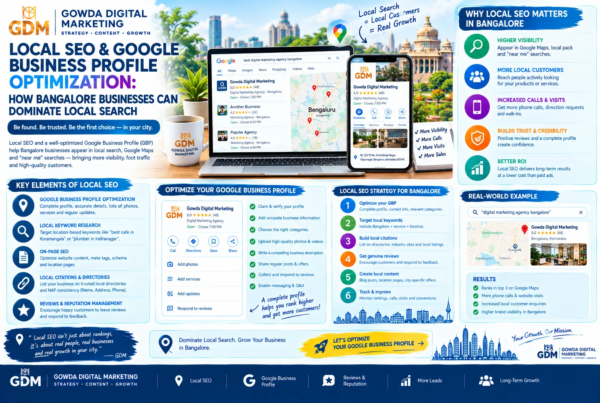
1. Build a Google Business Profile That Clearly Explains Your Business
Your Google Business Profile can function as your local search storefront.
Google describes Business Profiles as a way for businesses to appear on Google Search and Maps, with information such as location, contact information, website, hours, photos and reviews.
The first objective is simple:
Make your profile accurate and complete.
Check these elements
- Business name
- Primary category
- Additional relevant categories
- Address
- Service area where applicable
- Phone number
- Website
- Opening hours
- Special hours
- Services
- Products where applicable
- Photos
- Videos
- Business description
- Attributes
- Review responses
- Appointment or booking information where applicable
Google specifically recommends complete and accurate business information for improving local visibility.
Don’t keyword-stuff your business name
If your real-world business name is:
Gowda Digital Marketing
don’t artificially change it to:
Best SEO & Digital Marketing Agency in Bangalore – Gowda Digital Marketing
unless that is genuinely the business’s real-world name.
Google’s guidelines say businesses should represent themselves accurately and consistently as they are represented in the real world.
2. Create a Local Keyword Map
Don’t start local SEO by randomly adding city names to pages.
Start with a keyword map.
Step 1: Identify your services
For example:
- SEO
- Website Development
- Social Media Management
- Google Ads
- Branding
- Content Writing
- Business Automation
Step 2: Identify your actual service locations
For example:
- Bangalore
- Vijayanagar
- Rajajinagar
- Basaveshwaranagar
- Nagarbhavi
- Malleshwaram
- Jayanagar
- JP Nagar
- Indiranagar
- Whitefield
- HSR Layout
- Electronic City
Only include areas you genuinely serve.
Step 3: Combine service + location + intent
For example:
Service + Location
- SEO agency in Vijayanagar
- website development in Rajajinagar
- social media marketing in Bangalore
Problem + Location
- improve Google ranking for Bangalore business
- local SEO for restaurants in Bangalore
Service + Audience + Location
- SEO for dentists in Bangalore
- social media marketing for cafes in Bangalore
- website development for schools in Bangalore
This produces a more useful keyword architecture.
3. Create Location Pages — But Only When They Add Real Value
Location landing pages can help businesses communicate where they operate.
But creating 50 pages that differ only by replacing “Vijayanagar” with “Rajajinagar” is not a strong long-term strategy.
Instead, make each important location page genuinely useful.
A strong local landing page can include:
- Services available in the area
- Specific customer problems
- Local market context
- Service process
- Relevant examples
- Nearby service coverage
- FAQs
- Customer testimonials where appropriate
- Photos from legitimate local work
- Directions or accessibility information
- Contact options
- Internal links to relevant service pages
Example
Instead of:
Digital Marketing Agency in Bangalore
create a useful page around:
Digital Marketing Services for Businesses in West Bangalore
Then explain:
- who you serve
- which services are available
- what problems you solve
- which parts of West Bangalore you cover
- what the engagement process looks like
- how businesses can contact you
That creates more useful content than simply repeating location keywords.
4. Build a Bangalore Neighborhood Content Cluster
This is one of the most underused opportunities for local businesses.
Instead of publishing only generic blog posts, build content around the communities and commercial areas you actually serve.
For a Bangalore business, potential topics might include:
Business-focused topics
- Local SEO Checklist for Bangalore Small Businesses
- How Bangalore Customers Search for Local Services
- Google Business Profile Guide for Bangalore Businesses
- How Restaurants in Bangalore Can Improve Local Search Visibility
- Local SEO for Dental Clinics in Bangalore
- Local SEO for Schools and Educational Institutions
- SEO for Cafes and Restaurants in Bangalore
- Website SEO Checklist for Bangalore Service Businesses
Area-specific topics
Where genuinely relevant:
- Digital Marketing for Businesses in Vijayanagar
- Local Business Marketing in Rajajinagar
- SEO Strategy for Businesses in Indiranagar
- Website SEO for Businesses in Whitefield
- Local Search Marketing for Businesses in Jayanagar
The content should answer real questions.
Don’t write an article simply because a neighborhood name has search volume.
Write it because the neighborhood represents a meaningful market for your business.
5. Turn Customer Reviews Into a Local SEO Asset
Reviews are not simply reputation-management material.
They are also valuable customer-generated content.
Google says reviews can help businesses stand out and provide useful information to potential customers. Google also recommends asking customers for reviews through a Google review link or QR code and responding to reviews.
Create a review process
After a successful customer interaction:
- Ask for honest feedback.
- Give the customer a direct review link.
- Make the process easy.
- Never offer incentives for reviews.
- Respond professionally.
- Learn from recurring feedback.
Google explicitly prohibits offering free or discounted goods or services in exchange for reviews, changing reviews or removing negative reviews.
Encourage specificity naturally
You should never tell customers what rating to give or what they must write.
But you can ask an open-ended question such as:
“What did you find most useful about working with us?”
A genuine customer may naturally mention:
- the service
- the neighborhood
- the problem solved
- the communication
- the outcome
- the experience
Those details can help future customers understand the business.
6. Build Local Backlinks Through Real Relationships
Small businesses often overlook one of their biggest advantages:
They are part of a local ecosystem.
A Bangalore business might already have relationships with:
- suppliers
- associations
- local publications
- chambers of commerce
- community organizations
- schools
- colleges
- event organizers
- complementary businesses
- local bloggers
- industry groups
- business directories
- professional networks
These relationships can create legitimate opportunities for online mentions.
Example
A digital marketing agency collaborates with a local startup community on a workshop.
The community website publishes:
“Digital Marketing Workshop for Bangalore Small Businesses”
and references the agency.
That can become a useful local mention.
Local link-building principle
Don’t ask:
“Where can I buy 100 backlinks?”
Ask:
“Which legitimate local organizations already have a reason to mention my business?”
That’s a much more sustainable approach.
7. Create Local Resource Content
A local business can become useful without constantly promoting itself.
For example, a Bangalore digital marketing agency could create:
Bangalore Small Business Marketing Toolkit
Including:
- Google Business Profile checklist
- Local keyword worksheet
- Review request template
- Website SEO checklist
- Social media planning template
- Local citation checklist
- Lead tracking spreadsheet
This type of resource can attract:
- local businesses
- entrepreneurs
- bloggers
- business communities
- consultants
- startup organizations
Useful resources can create organic mentions and referral traffic.
8. Use Internal Linking to Build Local Relevance
Your local SEO strategy should not depend entirely on external backlinks.
Your own website can establish relationships between pages.
For example:
Homepage
→ SEO Services
→ Local SEO Services
→ Bangalore Local SEO
→ Google Business Profile Optimization
→ Local SEO Blog Posts
→ Contact
A blog post about:
“Google Business Profile Optimization for Bangalore Businesses”
could link to:
- Local SEO service page
- Google Business Profile service page
- SEO service page
- contact page
- related local SEO articles
This creates a logical information architecture.
Internal linking rule
Link because the next page is useful.
Don’t insert links simply because you want to use a keyword.
9. Make Your Website Locally Useful — Not Just Locally Optimized
A website should answer the questions a potential local customer has before contacting you.
For example:
A local service business should make it easy to discover:
- What do you do?
- Where do you operate?
- How much does it roughly cost?
- Who do you serve?
- What is your process?
- How quickly can you start?
- How can I contact you?
- Do you have examples?
- What happens after I enquire?
For businesses serving Bangalore, location information can also be useful:
- service areas
- office location
- directions
- parking information
- appointment instructions
- service availability
The objective is to remove friction.
10. Optimize for “Near Me” Without Stuffing “Near Me” Everywhere
You don’t need to create pages titled:
Best SEO Agency Near Me
SEO Near Me
Digital Marketing Near Me
over and over again.
Google can use location information when serving locally relevant results.
Instead, make your location and service information clear.
Use natural language such as:
“We provide SEO, website development and digital marketing services for businesses across Bangalore.”
Then support that statement with:
- accurate Business Profile information
- service pages
- location information
- genuine local reviews
- local content
- relevant links and mentions
- consistent business details
11. Use Local Images and Original Visual Content
Stock photographs can make every business website look identical.
Original photography can provide a stronger local signal and improve trust.
Consider creating:
- office photos
- storefront photos
- team photos
- project photographs
- local event photographs
- customer-approved project images
- behind-the-scenes images
- local workshop photographs
- service demonstrations
Image SEO checklist
For each useful image:
- descriptive filename
- accurate alt text
- appropriate compression
- relevant surrounding text
- correct dimensions
- no unnecessary keyword stuffing
Example Alt Text
Poor:
seo-bangalore-best-seo-agency.jpg
Better:
digital marketing team discussing local SEO strategy in Bangalore office
Alt text should describe the image rather than function as a keyword list.
12. Measure Local SEO by Business Outcomes
Ranking is useful.
But ranking is not the final business objective.
Track:
| Metric | Why It Matters |
| Google Business Profile views | Measures profile visibility |
| Website clicks | Shows traffic generated |
| Calls | Indicates high-intent activity |
| Direction requests | Useful for physical businesses |
| Contact-form submissions | Measures lead generation |
| WhatsApp enquiries | Useful for conversational leads |
| Organic traffic | Measures website visibility |
| Local landing-page traffic | Shows location-specific interest |
| Leads by location | Connects SEO to business outcomes |
| Conversion rate | Measures traffic quality |
Google says Business Profiles can appear across Search and Maps, while local information may be sourced from business owners, public web content, third parties and user contributions.
That means your local presence extends beyond a single webpage.
Key Facts: What Google Says About Local Search
LOCAL SEO FACT BOX
1. Local ranking: Google says local results are primarily based on relevance, distance and prominence.
2. Complete information: Google recommends complete and accurate Business Profile information to help businesses appear for relevant local searches.
3. Reviews: Google says reviews can help businesses stand out and provide useful information to potential customers.
4. Review incentives: Google prohibits offering incentives in exchange for reviews or review manipulation.
5. Local information: Google can use information from the business, public websites, third parties and user contributions when compiling local listings.
A Simple Hyper-Local SEO Framework
Use this six-layer model:
Layer 1 — Business
Who are you?
- Business name
- Category
- Services
- Contact information
↓
Layer 2 — Location
Where do you operate?
- City
- Neighborhoods
- Service areas
- Physical location
↓
Layer 3 — Intent
What does the customer need?
- Buy
- Book
- Call
- Visit
- Compare
- Learn
- Request a quote
↓
Layer 4 — Evidence
Why should customers trust you?
- Reviews
- Testimonials
- Case studies
- Photos
- Credentials
- Local mentions
↓
Layer 5 — Content
Can your website answer the customer’s questions?
- Service pages
- Location pages
- Guides
- FAQs
- Local resources
↓
Layer 6 — Conversion
Can the visitor easily take action?
- Call
- Enquiry
- Appointment
- Directions
- Quote request
Step-by-Step Visual: The Hyper-Local Customer Journey
Google Search / Maps
↓
Local Query
“SEO agency near Vijayanagar”
↓
Business Profile / Organic Result
↓
Website or Google Business Profile
↓
Trust Signals
Reviews + services + photos + local information
↓
Service Page
SEO + Bangalore + relevant business problem
↓
Conversion
Call / WhatsApp / Form / Appointment
↓
Customer
↓
Review + Referral + Local Mention
↓
Stronger Local Presence
This creates a cycle rather than a one-time SEO activity.
Comparison: Traditional Local SEO vs Hyper-Local SEO
| Traditional Approach | Hyper-Local Approach |
| Targets an entire city | Targets meaningful service areas |
| Focuses heavily on keywords | Focuses on customer intent |
| Generic location pages | Useful location-specific resources |
| Directory submissions | Relevant local relationships |
| Review collection | Genuine, detailed customer feedback |
| Generic blog content | Local problem-solving content |
| Rankings as primary KPI | Leads and conversions as business KPIs |
| Website-focused | Website + Business Profile + local ecosystem |
| One-size-fits-all | Neighborhood and audience specific |
Hyper-local SEO is not necessarily about doing more SEO.
It is about making the SEO you already do more specific and useful.
Case Study Example: A Bangalore Dental Clinic
Consider a hypothetical dental clinic in Vijayanagar.
The clinic wants more local patients.
Weak strategy
The clinic creates one page:
Best Dental Clinic in Bangalore
and repeatedly uses:
- dental clinic Bangalore
- best dentist Bangalore
- dentist Bangalore
- dental treatment Bangalore
Hyper-local strategy
The clinic builds:
Core pages
- Dental Services
- Dental Implants
- Root Canal Treatment
- Pediatric Dentistry
Local information
- Dental clinic in Vijayanagar
- Service coverage around nearby neighborhoods where it genuinely serves patients
Helpful content
- How much does a root canal typically involve?
- What should you ask before choosing a dentist?
- Dental emergency checklist
- Questions to ask before dental implant treatment
Trust
- genuine patient reviews
- doctor credentials
- clinic photographs
- treatment information
Local discovery
- Google Business Profile
- local business relationships
- relevant community references
The clinic isn’t trying to become the most famous dental practice in Karnataka.
It is building a stronger connection with people who are actually looking for dental services in its service area.
Case Study Example: A Bangalore Restaurant
Consider a hypothetical restaurant in Rajajinagar.
Instead of only targeting:
“Best restaurant in Bangalore”
it can build content and local relevance around:
- restaurant in Rajajinagar
- family dining in Rajajinagar
- vegetarian food in Rajajinagar
- lunch options near Rajajinagar
- group dining in Rajajinagar
- dishes and cuisine actually offered by the restaurant
The website could also provide:
- menu
- opening hours
- directions
- parking information
- reservation options
- event/group dining information
- original food photographs
- customer reviews
The strategy is built around real customer needs, not keyword repetition.
Case Study Example: Gowda Digital Marketing
Consider the positioning of Gowda Digital Marketing itself.
The company operates from Bangalore and offers services such as:
- SEO
- Google Ads
- Social Media Management
- Website Development
- App Development
- Branding
- Content Writing
- Creative Design
- Google Business Profile optimization
- Business automation
Instead of trying to rank every service for every city immediately, a local SEO architecture could organize the website around:
Core service pages
- SEO Services
- Local SEO
- Website Development
- Social Media Management
- Google Ads
- Business Automation
Local commercial pages
- Digital Marketing Agency in Bangalore
- SEO Services in Bangalore
- Website Development in Bangalore
- Google Business Profile Optimization in Bangalore
Educational content
- Hyper-Local SEO Strategies
- Google Business Profile Guide
- Local SEO Checklist
- Bangalore Small Business SEO Guide
- SEO Mistakes Small Businesses Make
- How to Track Local SEO Leads
This structure allows educational content to naturally support commercial pages.
The important principle is that each page should exist because it serves a real search intent.
Don’t Make These 10 Hyper-Local SEO Mistakes
1. Keyword stuffing
Repeating “Bangalore” 50 times doesn’t automatically make a page locally relevant.
2. Fake location pages
Don’t create pages for locations where you don’t genuinely operate or serve.
3. Fake reviews
Don’t manufacture customer experiences.
4. Review incentives
Google prohibits incentives offered in exchange for reviews or review manipulation.
5. Incorrect business information
Keep address, hours, contact information and other business details accurate.
6. Duplicate location pages
Changing only the neighborhood name isn’t enough.
7. Buying random backlinks
Links should come from legitimate relationships and useful content.
8. Ignoring mobile users
A large portion of local discovery happens in situations where users need quick information.
9. Tracking rankings but not leads
A ranking without business impact is incomplete reporting.
10. Treating Google Business Profile as a one-time setup
Local visibility requires ongoing management.
90-Day Hyper-Local SEO Plan
Days 1–30: Foundation
Week 1
- Audit Google Business Profile
- Verify business information
- Review primary category
- Review services
- Check website NAP consistency
- Audit existing reviews
- Identify service areas
Week 2
- Perform local keyword research
- Map services to locations
- Identify priority commercial pages
- Review competitors
- Identify content gaps
Week 3
- Optimize core service pages
- Improve title tags and meta descriptions
- Add location context naturally
- Improve internal links
- Add relevant FAQs
Week 4
- Improve Business Profile
- Add original photos
- Create review-request workflow
- Fix technical SEO issues
- Set up conversion tracking
Days 31–60: Local Authority
Publish
- 2–4 useful local articles
- 1 major local resource
- 1 detailed service guide
Build relationships with
- local businesses
- associations
- community groups
- local publications
- complementary service providers
Start collecting
- genuine customer reviews
- customer stories
- project examples
- original photographs
Days 61–90: Optimization
Review:
- Search Console data
- Analytics data
- Business Profile performance
- calls
- forms
- WhatsApp enquiries
- local landing-page performance
- top-performing queries
- pages generating leads
Then ask:
Which searches are attracting qualified customers?
Which pages are generating enquiries?
Which locations are producing business?
Which content deserves expansion?
This turns SEO from a publishing exercise into a business-growth process.
Local SEO Content Calendar
A small business doesn’t need to publish every day.
A sustainable monthly plan could look like this:
| Week | Content |
| Week 1 | Local SEO guide |
| Week 1 | Customer FAQ |
| Week 2 | Service-specific article |
| Week 2 | Local case study |
| Week 3 | Local resource |
| Week 3 | Google Business Profile update |
| Week 4 | Customer success story |
| Week 4 | Local industry guide |
For a business with limited resources, even 2–4 genuinely useful pieces per month can create a stronger content foundation than publishing generic articles every day.
How to Find Hyper-Local Keywords
Start with five buckets.
Bucket 1: Service
- SEO
- website development
- dental treatment
- interior design
- restaurant
- accounting
Bucket 2: Location
- Bangalore
- Vijayanagar
- Rajajinagar
- Jayanagar
- Whitefield
- Indiranagar
Bucket 3: Intent
- near me
- services
- company
- agency
- price
- cost
- consultation
- appointment
Bucket 4: Problem
- improve Google ranking
- get more leads
- build website
- manage social media
- increase enquiries
Bucket 5: Audience
- small business
- startup
- restaurant
- clinic
- school
- hotel
- real estate company
Combine them naturally.
For example:
SEO + Bangalore + Small Business
→ SEO for Small Businesses in Bangalore
Google Business Profile + Bangalore + Service
→ Google Business Profile Optimization in Bangalore
Website + Bangalore + Startup
→ Website Development for Bangalore Startups
What Is Hyper-Local SEO?
Hyper-local SEO is the practice of optimizing a business’s online presence for highly specific geographic areas and local customer needs. It combines location relevance, useful content, Business Profile optimization, reviews, local authority, technical SEO and conversion-focused website improvements to help a business become more visible for searches connected to its service area.
How Can a Small Business Improve Local SEO?
A small business can improve local SEO by:
- Completing and accurately maintaining its Google Business Profile.
- Creating useful service and location pages.
- Publishing genuinely useful local content.
- Earning authentic customer reviews.
- Responding to reviews.
- Building relevant local relationships and mentions.
- Improving website speed, usability and technical SEO.
- Strengthening internal linking.
- Adding original local photographs and useful information.
- Measuring calls, enquiries and conversions rather than rankings alone.
Google’s own guidance emphasizes complete business information, relevance, distance, prominence, reviews and accurate representation.
Expert Opinion: What Google Says About Local Ranking
Google’s official guidance states that local results are primarily based on:
“relevance, distance, and prominence”
This is important because it prevents businesses from reducing local SEO to a single tactic.
A business can work on relevance through better information.
Distance is largely connected to the searcher’s location and the business’s location.
Prominence involves how well-known a business is, with Google noting that information such as links, articles and reviews can contribute to its understanding of a business.
The practical takeaway is that local SEO should be treated as an ecosystem rather than a keyword trick.
10 FAQs
1. What is hyper-local SEO?
Hyper-local SEO focuses on making a business more relevant to searches connected to a specific geographic area, neighborhood or local customer group. It combines local search optimization, location-specific content, Business Profile management, reviews, local authority and website optimization.
2. Is hyper-local SEO useful for small businesses?
Yes, it can be particularly relevant to businesses that serve defined geographic areas. Instead of competing for every broad search, a business can focus its resources on locations and customer needs that are commercially meaningful to it.
3. How is hyper-local SEO different from local SEO?
Local SEO generally targets geographic markets such as a city or service area. Hyper-local SEO goes further into specific neighborhoods, communities, service areas and customer situations.
For example:
Local: SEO agency in Bangalore
Hyper-local: SEO services for small businesses in West Bangalore
4. Does Google Business Profile improve local SEO?
A properly maintained Business Profile helps Google understand a business and provides customers with information through Search and Maps. Google recommends keeping business information complete and accurate.
However, setting up a profile does not guarantee a particular ranking position.
5. How many Google reviews does a business need?
There is no universal number that guarantees a ranking position.
The more useful objective is to consistently collect genuine customer feedback and respond appropriately.
Google says reviews can help businesses stand out and provide useful information to potential customers.
6. Should every local business create separate pages for every neighborhood?
No.
Create location pages when the location represents a meaningful service area and you can provide genuinely useful information.
Avoid creating dozens of near-identical pages.
7. Should I put “Bangalore” in every heading?
No.
Use location terms naturally where they help users understand the service.
Overusing location keywords can make content awkward and less useful.
8. Can a small business outrank a larger company locally?
Local rankings depend on multiple factors, including relevance, distance and prominence.
A smaller business may therefore appear prominently for some locally relevant searches even when larger companies have greater overall brand recognition.
But there is no guaranteed formula for outranking a specific competitor.
9. How long does local SEO take?
There is no universal timeline.
Results depend on factors such as:
- existing authority
- competition
- location
- website quality
- Business Profile status
- content
- reviews
- local mentions
- technical SEO
- consistency of execution
Measure progress over time rather than expecting a fixed number of days.
10. Should a business hire a local SEO agency?
It depends on the business’s resources, internal expertise and goals.
An agency can help with:
- local keyword research
- Business Profile optimization
- technical SEO
- content
- location pages
- local authority building
- reporting
- conversion tracking
A business with an experienced internal team may prefer to manage some or all of these activities itself.
The important question is not simply who performs the work, but whether the work is based on accurate business information, genuine local relevance and measurable outcomes.
6-Point Summary: What Small Businesses Should Remember
- Local relevance beats generic keyword repetition. Make your business, services and service areas easy to understand.
- Google Business Profile is foundational. Keep information complete, accurate and current.
- Create genuinely useful local content. Don’t produce location pages merely to capture keywords.
- Build genuine local trust. Reviews, community relationships, customer stories and local mentions can strengthen your presence.
- Connect SEO to conversions. Calls, WhatsApp enquiries, forms, bookings and sales are more meaningful business outcomes than rankings alone.
- Think in neighborhoods, customers and problems. Hyper-local SEO works best when it reflects how real people search and how real businesses operate.
Hyper-Local SEO Checklist
Google Business Profile
- Profile verified
- Business name accurate
- Primary category appropriate
- Relevant services added
- Address accurate
- Service area accurate where applicable
- Phone number correct
- Website correct
- Opening hours updated
- Photos updated
- Reviews monitored
- Reviews answered
Website
- Clear service pages
- Local service information
- Useful location pages
- Mobile-friendly design
- Fast loading experience
- Strong internal linking
- Clear contact information
- Conversion-focused CTAs
- Accurate metadata
- Descriptive image alt text
- Structured data where appropriate
Content
- Local guides
- FAQs
- Case studies
- Original photography
- Customer stories
- Local resources
- Industry-specific content
Authority
- Relevant local partnerships
- Local publications
- Industry associations
- Community involvement
- Genuine business mentions
- Relevant backlinks
Measurement
- Search Console
- Analytics
- Business Profile insights
- Calls
- Forms
- WhatsApp enquiries
- Appointment conversions
- Leads by location
Actionable To-Do List
If you’re starting today, complete these 15 tasks:
Today
- Search your business name on Google.
- Check your Business Profile.
- Verify your phone number and website.
- Check your opening hours.
- Review your primary category.
- Identify your five most important services.
- Identify your five most commercially important locations.
This Week
- Create a local keyword map.
- Audit your main service pages.
- Identify missing location/service pages.
- Create a review-request process.
- Add or update original business photographs.
- Identify five relevant local partnership opportunities.
This Month
- Publish two useful local articles.
- Create one high-value local resource.
Then measure what happens.
Conclusion
Hyper-local SEO is not about trying to make a small business look like a national corporation.
It is about making the business more discoverable, understandable and useful to the people it genuinely serves.
A small business in Bangalore can compete for meaningful local searches by building a strong foundation around:
accurate business information + relevant services + useful local content + genuine reviews + local relationships + strong website UX + measurable conversions.
The most important shift is strategic.
Don’t ask:
“How can I rank everywhere?”
Ask:
“Where are my best customers, what are they searching for, and how can my business become the most useful result for those needs?”
That question leads to a much more sustainable SEO strategy.
For a small business, the goal isn’t to dominate the entire internet.
It is to build local visibility that turns into real business.
If you found this guide useful, subscribe to the Gowda Digital Marketing newsletter for practical SEO, digital marketing, website and automation strategies for growing businesses.
What is the biggest local SEO challenge your business currently faces — Google Maps visibility, reviews, website traffic, local keywords or generating enquiries?
Share your experience in the comments.
If you’re a Bangalore business owner, you can also use the checklist above to perform your first hyper-local SEO audit today.
References & Sources
- Google Business Profile Help — Tips to improve your local ranking on Google
Google: Tips to improve your local ranking on Google - Google Search Help — Learn search tips and how results relate to your search
Google Search Help - Google Business Profile Help — Tips to get more reviews
Google: Tips to get more reviews - Google Business Profile Help — Guidelines for representing your business on Google
Google Business Profile Guidelines - Google Business Profile Help — How Google sources and uses information in local listings
Google: How local listing information is sourced - Google Business Profile Help — About Business Profiles
Google Business Profile overview