
Turn “near me” searches into calls, visits, enquiries and customers with a practical local SEO framework
Your next customer may already be searching for you
Imagine someone in Vijayanagar searches:
“dentist near me”
Another person in Indiranagar searches:
“best cafe near me”
Someone in Whitefield searches:
“digital marketing agency Bangalore.”
A customer in Jayanagar searches:
“car service near me.”
The customer has already identified a need.
The question is not whether they want a product or service.
The question is:
Will your business appear when they are ready to act?
That is where Local SEO and Google Business Profile optimization become important.
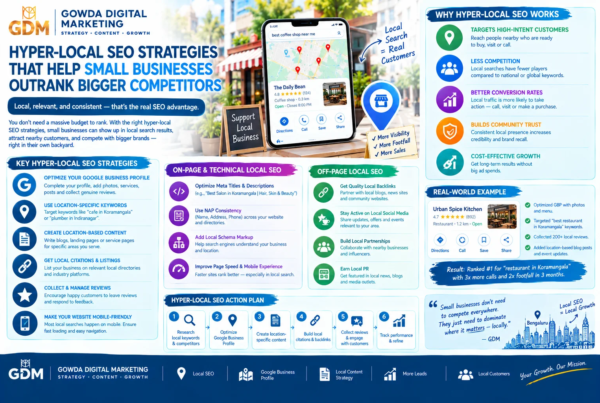
For a Bangalore business, local search is not simply about adding the word “Bangalore” to a website page. It is about helping Google understand what your business does, where it operates, which customers it serves and why your business is relevant to a particular local search.
Google states that local results are primarily influenced by relevance, distance and prominence.
Those three concepts provide a useful foundation for building an evergreen local SEO strategy.
Why Local SEO Matters for Bangalore Businesses
Bangalore is a highly competitive business market.
From technology companies and SaaS startups to restaurants, clinics, salons, educational institutions, automotive businesses, professional services, hotels and local retailers, customers have a huge number of options.
That creates a visibility problem.
Having a good product is not enough.
Having a website is not enough.
Having an Instagram account is not enough.
And simply creating a Google Business Profile does not guarantee strong visibility.
Google itself explains that local ranking depends primarily on relevance, distance and prominence, and that businesses cannot simply pay Google to receive a better local organic ranking.
This means local SEO should be treated as a long-term visibility system rather than a one-time profile setup.
The basic local-search journey
A simplified customer journey looks like this:
Customer has a need
↓
Customer searches Google
↓
Google interprets the search and location
↓
Local businesses are displayed
↓
Customer compares businesses
↓
Customer checks reviews, photos, services, website and other information
↓
Customer calls, messages, visits or submits an enquiry
Local SEO influences several stages of this journey.
What Is Local SEO?
Local SEO is the process of improving a business’s visibility for searches connected to a specific geographical area.
Examples include:
- Digital marketing agency in Bangalore
- Dentist in Vijayanagar
- Cafe in Indiranagar
- Hotel near Whitefield
- Interior designer in Bangalore
- Car service near me
- Web development company in Bengaluru
- Best salon near Jayanagar
- Tuition classes in Rajajinagar
Local SEO combines several elements:
- Google Business Profile optimization
- Website optimization
- Local keyword research
- Reviews and reputation management
- Local content
- Business information consistency
- Local links and mentions
- Relevant photographs and media
- Technical SEO
- Conversion optimization
The objective is not simply to “rank.”
The objective is to make it easier for the right local customer to discover, trust and contact your business.
What Is Google Business Profile?
Google Business Profile is Google’s business listing system for businesses appearing across Google Search and Google Maps.
A verified Business Profile allows businesses to manage information such as:
- Business name
- Address
- Service area
- Phone number
- Website
- Opening hours
- Business category
- Photos
- Videos
- Services
- Reviews
- Other eligible business information
Google describes Business Profiles as a way for businesses to manage how they appear on Search and Maps and interact with customers through information, photos, videos and reviews.
For a local business, the profile can function like a mini landing page inside Google.
A potential customer may see your business before visiting your website.
That makes profile optimization part of the customer experience, not just an SEO task.
KEY FACTS
Google’s documented local-ranking framework
Local results are primarily based on:
1. Relevance — How well the business matches the search
2. Distance — How close the business is to the searcher or relevant location
3. Prominence — How well-known the business is based on Google’s available information and signals
Google also says that complete and accurate business information can improve a business’s chances of appearing for relevant local searches.
The Three-Part Local SEO Framework
A useful evergreen framework for Bangalore businesses is:
Relevance + Proximity + Prominence
Relevance
Google needs to understand what your business offers.
For example, suppose your business provides:
- Website development
- SEO
- Google Ads
- Social media management
- Business automation
Your profile and website should communicate these services clearly.
Proximity
Google considers the relationship between the searcher’s location and the business.
This is why a search for:
“restaurant near me”
can produce different results depending on where the person is searching from.
Google confirms that distance is one of the primary factors used in local results.
Prominence
Prominence relates to how established or well-known a business appears to be.
Google says prominence can be influenced by information such as links from websites and reviews.
This is why local SEO should not stop at the Google Business Profile.
Your website, reviews, mentions and broader online presence can all contribute to how Google understands the business.
Step 1: Claim and Verify Your Google Business Profile
The first step is basic but critical.
Make sure your business owns and controls its Google Business Profile.
Google states that businesses need to add or claim their business and verify the profile to show their business information across Search and Maps.
Check the following:
- Is the profile verified?
- Does the business name match the real-world business?
- Is the address accurate?
- Is the phone number correct?
- Is the website correct?
- Are business hours updated?
- Is the primary category appropriate?
- Are relevant secondary categories available?
- Are services properly represented?
- Are photos current?
- Are reviews being monitored?
A profile that has not been properly claimed and maintained creates unnecessary uncertainty for customers and search engines.
Step 2: Choose the Right Primary Business Category
Your primary category tells Google what your business fundamentally does.
This decision should be made carefully.
Do not choose a category merely because you think it has a higher search volume.
Choose the category that most accurately represents your core business.
Example
Suppose a company provides:
- SEO
- Website development
- Social media
- Paid advertising
- Branding
If its core positioning is as a digital marketing agency, the primary category should accurately represent that business.
The supporting services can then be represented through the appropriate profile fields and website pages.
Avoid category stuffing
Do not attempt to make the business relevant to every possible category.
Local SEO works better when your business identity is clear.
Step 3: Write a Useful Business Description
Your Google Business Profile description should answer:
What do you offer?
Who do you serve?
Where do you operate?
What makes the business useful or distinctive?
Google allows businesses to provide a description of what they offer and what makes them special. Google also specifies that the description field should not exceed 750 characters and should not contain URLs or HTML.
Example structure
We help Bangalore businesses improve their online presence through SEO, website development, Google Ads, social media management, branding and business automation. Our approach combines practical strategy, measurable goals and technology to help growing businesses attract relevant customers and improve their digital operations.
Notice the difference.
The description communicates:
- Service relevance
- Location relevance
- Target audience
- Business positioning
It does not read like a list of 20 keywords.
Step 4: Build a Strong Local Keyword Strategy
One of the biggest mistakes in local SEO is assuming that every page needs the exact phrase:
“best [service] in Bangalore.”
Modern search is more contextual.
Google explains that its systems can understand related terms rather than requiring exact keyword matches for every result.
Instead of creating dozens of awkward keyword variations, build topical coverage.
Example: Digital Marketing Agency
Potential keyword themes include:
Core service
- digital marketing agency Bangalore
- digital marketing company Bangalore
- online marketing agency Bangalore
SEO
- SEO agency Bangalore
- local SEO Bangalore
- SEO services Bangalore
Website development
- website development Bangalore
- web development company Bangalore
- business website design Bangalore
Paid advertising
- Google Ads agency Bangalore
- PPC agency Bangalore
- lead generation agency Bangalore
Local intent
- digital marketing agency near me
- SEO company near me
- website developer near me
The goal is to create a semantic map of customer needs, not a keyword stuffing exercise.
Step 5: Optimize Your Website for Local Search
Your Google Business Profile and website should support each other.
A Business Profile can introduce the customer to your business.
The website can provide the deeper information required to make a decision.
Your website should clearly communicate:
- Business name
- Location
- Service areas
- Main services
- Contact details
- Business hours where relevant
- About the business
- Customer proof
- FAQs
- Service-specific information
- Location-specific information
Your website should also be technically sound.
Check:
- Mobile usability
- Page speed
- HTTPS
- Internal links
- Crawlability
- Indexing
- Structured data where appropriate
- Clear navigation
- Descriptive page titles
- Meta descriptions
- Image optimization
- Broken links
- Core Web Vitals
Local SEO is therefore closely connected to technical SEO and on-page SEO.
Step 6: Create Dedicated Service Pages
One page should not try to rank for every service.
For example, a Bangalore digital marketing agency could have separate pages for:
- SEO Services
- Local SEO
- Google Ads
- Social Media Management
- Website Development
- App Development
- Branding
- Content Writing
- Google Business Profile Optimization
- Business Automation
Each page can explain:
- What the service is
- Who needs it
- Problems it solves
- How the process works
- What customers should consider
- Common mistakes
- FAQs
- Relevant examples
- How to get started
This creates a stronger topical structure.
Step 7: Build Location-Relevant Pages Carefully
Location pages can be useful when the business genuinely serves those locations.
For Bangalore, that might include areas such as:
- Vijayanagar
- Rajajinagar
- Indiranagar
- Jayanagar
- Koramangala
- Whitefield
- Electronic City
- HSR Layout
- Yelahanka
- Malleshwaram
- Banashankari
- Hebbal
But there is an important distinction.
Do not create 30 nearly identical pages simply by replacing the neighbourhood name.
That creates thin content.
Instead, a useful location page should contain genuinely relevant information such as:
- Services available in that area
- Typical customer needs
- Service coverage
- Nearby commercial zones
- Relevant case examples
- Frequently asked questions
- Directions or accessibility information where appropriate
- Unique local context
Better approach
Weak:
SEO Agency in Whitefield
with almost identical content to:
SEO Agency in Indiranagar
Stronger:
SEO Services for Businesses in Whitefield
with meaningful information about the types of businesses served, commercial context, service delivery and local customer behaviour.
Step 8: Build a Genuine Review Strategy
Reviews are one of the most visible elements of a local business profile.
They can influence customer trust and provide additional context about the business.
Google states that reviews can help businesses stand out and help potential customers make decisions. Google also allows businesses to request reviews through a link or QR code.
A sustainable review process
After a genuine customer interaction:
Customer receives service
↓
Business asks for honest feedback
↓
Customer receives review link/QR code
↓
Customer independently writes review
↓
Business responds professionally
This should become a repeatable operational process.
What not to do
Do not:
- Buy fake reviews
- Create reviews yourself
- Ask employees to pretend to be customers
- Offer incentives specifically for positive reviews
- Ask customers to remove negative reviews in exchange for benefits
- Copy the same review across multiple accounts
Google explicitly prohibits incentivized or manipulated reviews.
Step 9: Respond to Reviews Properly
Responding to reviews is not merely about SEO.
It is customer communication.
A useful response should:
- Acknowledge the customer
- Address the specific experience
- Remain professional
- Avoid revealing private information
- Thank customers for genuine feedback
- Handle complaints constructively
Instead of:
Thank you for your review!
Try:
Thank you for sharing your experience. We’re glad the team could help with your website project, and we appreciate you taking the time to share your feedback.
For negative feedback:
Thank you for bringing this to our attention. We’re sorry the experience did not meet expectations. We’d like to understand what happened and work toward resolving the issue. Please contact our team directly so we can review the matter.
Do not turn review replies into keyword-stuffed advertisements.
Step 10: Add Real Business Photos
Photos can dramatically affect how customers perceive a local business.
Google recommends clear, well-lit photos that represent the business accurately. Google also provides specific guidance for exterior, interior and other business-specific imagery.
Useful photo categories
For a restaurant:
- Exterior
- Entrance
- Interior
- Food
- Staff
- Seating
- Menu
- Kitchen where appropriate
For a clinic:
- Exterior
- Reception
- Treatment environment
- Staff
- Facilities
- Equipment
For an agency:
- Office
- Team
- Work environment
- Client-facing spaces
- Events
- Behind-the-scenes work
Think beyond the logo
A logo helps recognition.
But real photographs answer an important customer question:
“What will I actually experience if I choose this business?”
Google’s current guidance recommends photos that are authentic, in focus, well lit and representative of reality.
Step 11: Keep Your Business Information Consistent
Your business information should be consistent across important online properties.
Pay particular attention to:
- Business name
- Address
- Phone number
- Website
- Opening hours
- Service information
This consistency helps customers avoid confusion and helps search engines connect information about the same business.
Google explains that local listing information can come from multiple sources, including public web content, third-party data, user contributions and information supplied through Business Profiles.
That means your website should not contradict your Google Business Profile.
Step 12: Build Local Authority
Local SEO is not only about your own website.
Your business can become more discoverable through relevant third-party websites.
Potential sources include:
- Local business directories
- Industry associations
- Local publications
- Chamber or business organizations
- Relevant blogs
- Local event websites
- Partner businesses
- Professional organizations
- Community websites
- Local news coverage
The key word is:
Relevant.
A hundred low-quality directory listings are not necessarily better than a handful of credible, contextually relevant mentions.
Example
A Bangalore restaurant could potentially benefit from being mentioned by:
- A Bangalore food publication
- A local event website
- A relevant hospitality organization
- A local blogger
- A neighbourhood guide
A software company may have more relevant opportunities through:
- Technology publications
- Startup communities
- Business associations
- Industry directories
- Local technology events
Local authority should be built naturally.
Step 13: Create Content Around Local Customer Problems
A local SEO blog strategy should not consist of endless posts titled:
“Best [Service] in Bangalore.”
Instead, answer the questions customers actually have.
For a dental clinic
- How much does a dental consultation cost in Bangalore?
- How often should you get a dental check-up?
- What should you ask before choosing a dentist?
- What happens during a root canal consultation?
For an agency
- How much does SEO cost for a small business in Bangalore?
- SEO vs Google Ads: Which should a local business use?
- How long does local SEO take?
- How should a Bangalore business optimize Google Maps?
For a restaurant
- How to choose a restaurant for a corporate event in Bangalore
- Best questions to ask before booking a private dining space
- How restaurant reviews influence customer decisions
The content should solve a problem before asking the reader to become a lead.
Step 14: Use Google Business Profile Content Carefully
Eligible businesses can use their Business Profile to communicate relevant information through supported content formats.
However, profile content should be useful rather than repetitive.
Possible content themes include:
- New services
- Events
- Frequently asked questions
- Seasonal information
- New products
- Business updates
- Helpful customer information
Google’s Business Profile content policies apply to posts, photos and videos, and businesses are responsible for ensuring their content complies with Google’s requirements.
Step 15: Connect Local SEO With Conversion Optimization
Ranking is not the final goal.
Imagine two businesses appear for the same local search.
Business A has:
- Poor photos
- No recent reviews
- Unclear services
- Broken website
- No obvious call button
- No useful information
Business B has:
- Clear services
- Strong reviews
- Professional photos
- Helpful website
- Easy contact options
- Clear location information
- Useful FAQs
Visibility gets the customer to the profile.
Trust and usability influence what happens next.
Local SEO Conversion Funnel
Search
Customer searches for a service.
↓
Discovery
Business appears in Google Search or Maps.
↓
Evaluation
Customer checks:
- Reviews
- Photos
- Services
- Location
- Hours
- Website
↓
Trust
Customer finds sufficient evidence to consider the business.
↓
Action
Customer:
- Calls
- Messages
- Visits
- Books
- Requests a quote
- Submits a form
↓
Follow-up
Business responds quickly.
↓
Conversion
Lead becomes customer.
Local SEO Is Not Just a Ranking Exercise
A business can receive impressions without receiving meaningful enquiries.
Always connect visibility metrics with business outcomes such as:
Calls → Messages → Website visits → Enquiries → Appointments → Sales
Bangalore Local SEO Example: A Hypothetical Dental Clinic
Consider a fictional dental clinic in Vijayanagar.
The clinic has:
- A verified Google Business Profile
- A basic website
- 25 reviews
- Few photographs
- Generic service descriptions
- No dedicated treatment pages
- No local content strategy
The clinic decides to build a structured local SEO system.
Month 1: Foundation
The clinic reviews:
- Primary category
- Services
- Opening hours
- Address
- Phone
- Website
- Business description
- Photos
Month 2: Website
It develops useful pages for:
- Dental consultation
- Root canal treatment
- Dental cleaning
- Children’s dentistry
- Emergency dental care
Month 3: Reputation
The clinic establishes a genuine review-request process after completed appointments.
Month 4 onward: Content
The website publishes helpful content around common patient questions.
Measurement
Instead of asking only:
“What position are we ranking at?”
The clinic tracks:
- Google Business Profile interactions
- Calls
- Website clicks
- Direction requests where available
- Contact forms
- Appointment enquiries
- New reviews
- Organic traffic
- Organic leads
This is a much more useful framework for judging local SEO progress.
This is a hypothetical example, not a reported client case study.
Another Example: Bangalore Digital Marketing Agency
Consider a fictional agency serving Bangalore SMEs.
Instead of creating one generic homepage, it develops a structured ecosystem:
Homepage
→ Digital Marketing
→ SEO
→ Local SEO
→ Google Ads
→ Social Media
→ Website Development
→ Business Automation
→ Local SEO Bangalore Guide
→ Industry-specific resources
This structure allows different pages to address different customer needs.
Someone searching for:
“local SEO Bangalore”
may need a specialized page.
Someone searching for:
“website development Bangalore”
may need another.
Someone searching for:
“Google Business Profile optimization”
may need a detailed service or educational page.
The website becomes a network of useful answers rather than one page attempting to rank for everything.
Google Business Profile Optimization Checklist
Use this as a practical audit.
| Area | What to Check |
| Verification | Is the profile claimed and verified? |
| Business name | Does it accurately reflect the real-world business? |
| Category | Is the primary category accurate? |
| Additional categories | Are relevant categories represented where available? |
| Address | Is the physical location accurate? |
| Service area | Is the service area accurately represented? |
| Phone | Is the correct number displayed? |
| Website | Does the link work? |
| Hours | Are opening hours current? |
| Special hours | Are temporary changes updated when relevant? |
| Description | Is it clear and customer-focused? |
| Services | Are important services represented? |
| Photos | Are real, high-quality images available? |
| Reviews | Are genuine reviews being requested and monitored? |
| Replies | Are reviews being answered professionally? |
| Website | Does it reinforce local relevance? |
| Local content | Does the site answer customer questions? |
| Links | Does the business have credible local mentions? |
| Tracking | Are calls and enquiries being measured? |
Local SEO vs Google Business Profile Optimization
These concepts overlap but are not identical.
| Local SEO | Google Business Profile Optimization |
| Broad strategy | Specific Google property |
| Includes website SEO | Focuses on Search and Maps profile |
| Includes local content | Includes profile information and media |
| Includes local authority | Includes reviews and profile activity |
| Includes technical SEO | Includes categories, services and business details |
| Includes local links | Includes customer interactions |
| Long-term ecosystem | Important component of the ecosystem |
Think of Google Business Profile optimization as one major component of Local SEO, rather than a replacement for it.
Local SEO vs Google Ads
Both can help businesses reach customers, but they work differently.
| Local SEO | Google Ads |
| Primarily organic | Paid advertising |
| Builds long-term visibility | Can provide paid visibility while campaigns run |
| Requires ongoing optimization | Requires campaign and budget management |
| Reviews and local authority matter | Ad targeting, bidding and relevance matter |
| Website and profile quality matter | Landing pages and ad quality matter |
| Results can compound over time | Traffic depends on active advertising |
A business may use one or both depending on its objectives, budget and customer acquisition strategy.
The 90-Day Local SEO Framework
Instead of trying to do everything at once, divide the work into phases.
Days 1–30: Foundation
Week 1
Audit:
- Google Business Profile
- Website
- Search visibility
- Business information
- Reviews
- Competitors
- Existing local citations
Week 2
Fix:
- Business information
- Categories
- Services
- Description
- Website contact details
- Location information
Week 3
Improve:
- Website service pages
- Local landing pages
- Internal links
- Metadata
- Mobile usability
- Technical issues
Week 4
Begin:
- Review process
- Photo strategy
- Local content calendar
- Measurement framework
Days 31–60: Authority
Focus on:
- Helpful local content
- Review acquisition
- Review responses
- Relevant business mentions
- Local partnerships
- Industry directories
- Community participation
- Service-page improvements
Avoid chasing volume for its own sake.
The objective is to build useful, credible signals.
Days 61–90: Conversion & Refinement
Analyze:
- Search impressions
- Search queries
- Website organic traffic
- Calls
- Form submissions
- Messages
- Reviews
- Profile interactions
- Landing-page performance
Then identify:
What is getting visibility but not producing enquiries?
What is producing enquiries?
Which services attract the strongest commercial intent?
Which pages need improvement?
That creates the next optimization cycle.
A Simple Local SEO Measurement Dashboard
Track these metrics monthly.
Visibility
- Local search impressions
- Search queries
- Map/Search visibility
- Organic traffic
- Local landing-page impressions
Engagement
- Website clicks
- Phone calls
- Direction requests where available
- Messages
- Profile interactions
- Review volume
Conversion
- Leads
- Calls that become enquiries
- Form submissions
- Appointments
- Quote requests
- Sales
Reputation
- New reviews
- Review response rate
- Recurring customer feedback themes
- Negative feedback patterns
Business impact
Ultimately:
Leads × Conversion Rate × Average Customer Value
is more meaningful than obsessing over a single ranking position.
Common Local SEO Mistakes Bangalore Businesses Should Avoid
1. Keyword stuffing the business name
Adding extra keywords to a business name simply to influence rankings can create policy and trust problems.
Represent the business accurately.
Google’s guidelines emphasize representing businesses as they are recognized in the real world.
2. Buying reviews
Fake reviews can damage trust and violate Google’s policies.
Build reviews from genuine customer experiences instead.
3. Creating hundreds of thin location pages
If every Bangalore neighbourhood receives the same page with the location name changed, the pages provide little additional value.
Create location pages only where there is meaningful content to provide.
4. Ignoring the website
A Business Profile should not be treated as a substitute for a useful website.
The website provides an opportunity to explain:
- Services
- Expertise
- Process
- Pricing context
- FAQs
- Case studies
- Contact options
5. Uploading generic stock images everywhere
Real business photography can provide much stronger customer context.
Google specifically recommends images that accurately represent the business.
6. Tracking rankings but not leads
A ranking is an intermediate metric.
The business outcome is usually:
Visibility → Engagement → Lead → Customer
Track the entire journey.
7. Expecting instant results
Local SEO is not a guaranteed overnight ranking system.
Google says ranking is determined by algorithms and that changes to business information can take time to appear.
Treat local SEO as an ongoing process.
How Do I Improve Local SEO in Bangalore?
To improve local SEO in Bangalore, start by claiming and verifying your Google Business Profile, keeping business information accurate, selecting relevant categories, adding genuine business photos, collecting and responding to authentic customer reviews, optimizing your website for local intent, creating useful service and location content, building relevant local authority and tracking calls, enquiries and conversions. Google says local results are primarily influenced by relevance, distance and prominence.
Step-by-Step Visual: The Local SEO Flywheel
1. Understand Customer Search Intent
↓
2. Optimize Google Business Profile
↓
3. Improve Website & Service Pages
↓
4. Create Useful Local Content
↓
5. Earn Genuine Reviews
↓
6. Build Relevant Local Authority
↓
7. Generate Local Visibility
↓
8. Convert Searches Into Enquiries
↓
9. Measure Results
↓
10. Improve the System
↓
Back to Customer Search Intent
This is a flywheel rather than a one-time project.
Step-by-Step Visual: From Google Search to Customer
Search
“SEO agency near me”
↓
Google evaluates relevance + distance + prominence
↓
Business Profile appears
↓
Customer checks reviews
↓
Customer views photos
↓
Customer visits website
↓
Customer compares services
↓
Customer calls / messages
↓
Business follows up
↓
Lead becomes customer
The goal of Local SEO is therefore broader than simply appearing in the map results.
10 FAQs
1. What is Local SEO?
Local SEO is the process of improving a business’s visibility for geographically relevant searches. It can include Google Business Profile optimization, website SEO, reviews, local content, local links, business information consistency and conversion optimization.
2. Is Google Business Profile free?
Google provides Business Profiles at no charge. Businesses can use them to manage their presence across Google Search and Maps, subject to Google’s eligibility and policies.
3. How do I rank higher on Google Maps in Bangalore?
There is no guaranteed method for achieving a particular Google Maps position.
Google says local results are primarily based on relevance, distance and prominence. Businesses can improve their fundamentals by maintaining accurate information, building a relevant profile, earning genuine reviews and developing a credible online presence.
4. How long does Local SEO take?
There is no universal timeline.
Results depend on factors such as:
- Competition
- Business history
- Location
- Existing authority
- Website quality
- Reviews
- Search demand
- Profile completeness
- Technical SEO
- Content quality
Local SEO should generally be treated as an ongoing optimization process rather than a one-time campaign.
5. Do Google reviews help Local SEO?
Google says reviews can help businesses stand out and provide useful information to potential customers. Google also identifies reviews as one factor related to prominence.
However, businesses should focus on genuine customer feedback rather than attempting to manipulate review volume or sentiment.
6. Should I add Bangalore to every page?
No.
Use location terms where they are genuinely relevant.
A page should primarily help the user rather than repeatedly inserting “Bangalore” into every paragraph.
Use natural local context across:
- Titles
- Headings
- Service pages
- Location pages
- Content
- Business information
7. Can a small business compete with large companies in local search?
Local search is contextual.
A smaller business can build visibility by becoming highly relevant to its target audience and geographical market.
However, there is no universal formula guaranteeing that a small business will outrank a larger competitor.
Focus on accurate information, customer experience, relevance, useful content and genuine reputation.
8. Should I create a separate Google Business Profile for every Bangalore neighbourhood?
Not unless there is a legitimate business location that qualifies for its own profile.
Do not create duplicate or fictional locations simply to target neighbourhood keywords.
Google’s business representation guidelines require businesses to represent themselves accurately.
9. Do I need a website if I have a Google Business Profile?
A website is not simply another listing.
It gives customers a place to understand your services in greater depth.
A strong website can provide:
- Service details
- FAQs
- Case studies
- Pricing information where appropriate
- Contact forms
- Educational content
- Trust signals
For many businesses, the profile and website should work together.
10. Can an SEO agency guarantee Google Maps rankings?
Be cautious with guarantees.
Google does not provide a legitimate mechanism for businesses to pay for or request a specific organic local ranking.
A responsible SEO strategy should focus on improving the underlying signals and business outcomes rather than promising a fixed position.
Local SEO Action Plan: Your 15-Point To-Do List
Use this checklist to start.
Google Business Profile
- Claim and verify the profile
- Check business name
- Check primary category
- Review additional categories
- Verify address/service area
- Check phone number
- Check website URL
- Update opening hours
- Improve business description
- Add relevant services
Reputation
- Create a genuine review-request process
- Respond to existing reviews
- Monitor recurring customer feedback
- Never buy or incentivize fake reviews
Website
- Create dedicated service pages
- Add local relevance naturally
- Improve mobile performance
- Check technical SEO
- Add useful FAQs
- Strengthen internal links
Local authority
- Audit existing business listings
- Identify relevant local directories
- Build industry relationships
- Seek legitimate local mentions
- Publish useful local content
Measurement
- Track organic traffic
- Track calls
- Track enquiries
- Track forms
- Track reviews
- Review results monthly
The Evergreen Principle: Optimize for Customers First
Search algorithms change.
Interface designs change.
Ranking systems evolve.
Customer behaviour changes.
But several principles remain remarkably durable:
Accurate information matters.
Relevant content matters.
Useful websites matter.
Authentic reputation matters.
Good customer experiences matter.
Clear communication matters.
That is why an evergreen Local SEO strategy should not depend on one algorithm trick.
Build an online presence that makes sense even if the search interface changes tomorrow.
Summary: 6 Key Takeaways
- Google Business Profile is a major part of Local SEO, not the entire strategy.
- Google says local results are primarily influenced by relevance, distance and prominence.
- Accurate business information, useful services, genuine reviews and authentic photographs improve the information customers can use to evaluate your business.
- Your website should support your Business Profile with useful service pages, local content, strong technical foundations and clear conversion paths.
- Avoid shortcuts such as fake reviews, keyword stuffing and mass-produced location pages.
- Measure Local SEO by business outcomes—not rankings alone. Track calls, enquiries, appointments and customers alongside visibility.
Conclusion
For Bangalore businesses, Local SEO is ultimately about being visible at the moment a customer needs what you offer.
A person searching for a dentist, restaurant, digital marketing agency, hotel, automotive service, school, clinic or professional service is often much closer to taking action than someone casually browsing social media.
That makes local search an important part of the customer acquisition journey.
But strong local visibility is not created by one optimization trick.
It comes from a connected system:
Accurate Google Business Profile
Relevant local website content
Strong technical SEO
Genuine customer reviews
Authentic business photographs
Relevant local authority
Clear conversion paths
Consistent measurement
For Bangalore businesses, the opportunity is not simply to “rank on Google Maps.”
It is to build a digital presence that answers the customer’s most important questions:
Are you relevant to what I need?
Are you actually near me or serving my area?
Can I trust this business?
Can I easily contact them?
What happens if I choose them?
When those questions are answered clearly, Local SEO becomes more than a traffic strategy.
It becomes part of a sustainable customer acquisition system.
Want more practical SEO, digital marketing and business-growth strategies for your business?
Subscribe to the Gowda Digital Marketing newsletter for actionable insights on SEO, Google Ads, social media, websites, automation and online growth.
If this guide helped you, leave a comment and tell us what local SEO challenge your Bangalore business is facing.
Have a Google Business Profile but aren’t sure whether it is properly optimized?
Start with a Local SEO and Google Business Profile audit.
References & Sources
Google Business Profile Help
Tips to improve your local ranking on Google
Get started with Google Business Profile
Manage your Business Profile photos and videos
Tips for business-specific photos
Business Profile content policy
Guidelines for representing your business on Google