
How to Build a Sustainable Customer Acquisition System Using SEO, Content, Social Media, Websites, Email & Marketing Automation
What if your website could keep attracting potential customers even when you are not running an ad campaign?
Imagine a potential customer in Bengaluru searching Google for a solution to a problem your business solves.
They find one of your articles.
The article answers their question.
They explore another page.
They discover a useful checklist.
They visit your services page.
They read your reviews and case study.
They subscribe to your newsletter or request a consultation.
A few days later, they receive a helpful follow-up email.
Eventually, they become a customer.
That is the basic idea behind inbound marketing.
Instead of constantly paying to interrupt people with advertisements, you build useful digital assets that help potential customers discover, understand and trust your business.
Paid advertising can still be valuable. But the objective of inbound marketing is to build an acquisition system that does not depend entirely on buying attention every day.
What Is Inbound Marketing?
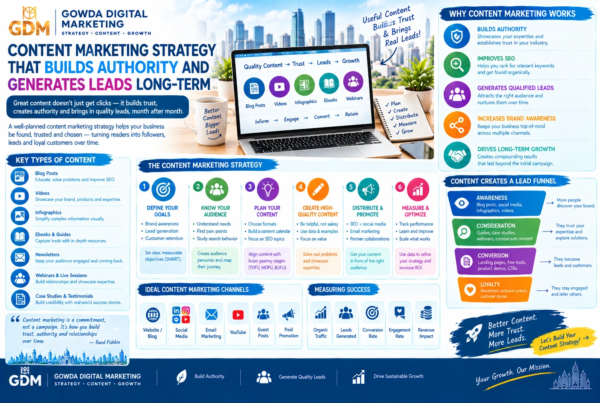
Inbound marketing is a customer-focused approach that attracts potential customers through useful content, search visibility, educational resources and helpful digital experiences.
Rather than beginning with:
“How can we advertise this product?”
Inbound marketing begins with:
“What problem is our potential customer trying to solve?”
The business then creates useful resources around that problem.
These resources can include:
- Blog articles
- SEO landing pages
- Service pages
- Local business content
- Guides
- Checklists
- Videos
- Social media posts
- Case studies
- Email newsletters
- Calculators
- Templates
- FAQs
- Webinars
- Downloadable resources
- Comparison guides
- Customer stories
The broader inbound methodology is commonly described around attracting, engaging and delighting customers, with the goal of building trust throughout the customer journey.
For practical lead generation, however, businesses can simplify the process into four operational stages:
Attract → Engage → Convert → Retain
This makes it easier to turn the concept into an actual marketing system.
Why Inbound Marketing Matters for Businesses
Many businesses have become dependent on a simple cycle:
- Run advertisements.
- Generate leads.
- Stop advertising.
- Lead volume falls.
- Start another campaign.
- Repeat.
There is nothing inherently wrong with advertising.
The problem occurs when advertising becomes the only reliable source of new customers.
A stronger approach is to build multiple acquisition channels.
For example:
| Channel | Primary Role |
| SEO | Capture existing search demand |
| Blog content | Answer customer questions |
| Local SEO | Reach nearby customers |
| Social media | Build awareness and trust |
| Website | Educate and convert visitors |
| Lead magnets | Capture interested prospects |
| Nurture leads | |
| Facilitate conversations | |
| Automation | Reduce repetitive follow-up |
| Paid ads | Accelerate targeted demand |
Inbound does not mean “never use advertising.”
It means build assets that continue creating value beyond the lifespan of an individual advertisement.
The Inbound Marketing Flywheel
A traditional marketing funnel often looks like this:
Awareness → Interest → Consideration → Purchase
But customer relationships don’t necessarily end after the purchase.
A customer can:
- Buy again
- Leave a review
- Refer someone
- Share your content
- Follow your social channels
- Recommend your company
- Become a long-term client
That creates a loop.
The practical inbound loop
Attract → Engage → Convert → Deliver Value → Retain → Encourage Advocacy → Attract More People
This is why inbound marketing should not be treated simply as a blogging strategy.
It is an interconnected customer acquisition and relationship system.
KEY FACTS
- Content marketing was reported by 74% of B2B marketers surveyed by Content Marketing Institute as helping generate demand or leads in its 2025 benchmark research.
- The same research found that 62% reported content marketing helping nurture subscribers, audiences or leads.
- 49% said content marketing helped generate sales or revenue.
- Only 22% of surveyed B2B marketers described their content marketing as extremely or very successful, demonstrating that simply producing content is not enough.
- Google says local search visibility is primarily influenced by relevance, distance and prominence, making complete business information, reviews and broader online prominence important considerations for local businesses.
Important: These statistics are benchmarks, not guarantees for an individual business. Results depend on industry, competition, audience, execution, website quality, content quality and measurement.
The Four Stages of an Effective Inbound Marketing Strategy
A practical inbound system can be organized into four stages.
1. Attract
Bring the right people to your business.
Typical channels:
- Google Search
- Google Maps
- Blog content
- YouTube
- Social media
- Industry publications
- Referrals
- Community participation
2. Engage
Give visitors enough useful information to continue the relationship.
Examples:
- Helpful service pages
- Guides
- FAQs
- Case studies
- Videos
- Comparison pages
- Email newsletters
- Social content
- Chat
3. Convert
Turn anonymous visitors into identifiable prospects.
Conversion mechanisms include:
- Contact forms
- Consultation requests
- Quote requests
- Newsletter subscriptions
- Downloads
- Demo requests
- Free assessments
- Booking forms
- WhatsApp conversations
4. Retain
Continue providing value after conversion.
Examples:
- Onboarding emails
- Customer education
- Follow-up messages
- Support resources
- Loyalty programs
- Reviews
- Referral campaigns
- Educational newsletters
Stage One: Attract the Right Customers
The first mistake businesses make is trying to attract everyone.
A better question is:
Who is most likely to become a profitable customer?
Create a basic customer profile.
Define your ideal customer
Document:
- Industry
- Business size
- Location
- Customer type
- Typical problem
- Buying motivation
- Budget range
- Urgency
- Common objections
- Search behavior
- Preferred communication channel
For a Bangalore-based digital marketing agency, for example, the audience could include:
- Restaurants
- Clinics
- Dental practices
- Educational institutions
- Hotels
- Automotive businesses
- Local retailers
- Professional services
- Startups
- Small and medium businesses
- B2B companies
The content strategy should then reflect their actual questions.
Build a Customer Question Bank
Before creating content, collect questions customers repeatedly ask.
Ask:
Pre-purchase questions
- How much does this cost?
- Do I actually need this?
- What should I look for?
- Which option is suitable?
- How long does it take?
- What mistakes should I avoid?
Comparison questions
- Option A vs Option B?
- Agency vs freelancer?
- Paid ads vs SEO?
- WordPress vs custom development?
- Local SEO vs broader SEO?
Problem questions
- Why am I not getting leads?
- Why isn’t my website ranking?
- Why are my ads expensive?
- Why do people visit my website but not contact me?
Post-purchase questions
- How do I use this?
- What should I expect?
- How can I measure results?
- What should I do next?
These questions become your content roadmap.
The Search Intent Framework
One of the most important concepts in SEO-driven inbound marketing is search intent.
A keyword alone is not enough.
You need to understand why someone is searching.
Informational intent
The user wants to learn.
Examples:
- What is inbound marketing?
- How does SEO work?
- What is Google Business Profile?
- How does marketing automation work?
Commercial investigation
The user is comparing options.
Examples:
- SEO vs Google Ads
- WordPress vs custom website
- Best CRM for small business
- Digital marketing agency vs freelancer
Transactional intent
The user is closer to taking action.
Examples:
- SEO agency Bangalore
- website development company Bangalore
- Google Ads agency Bangalore
- social media marketing agency Bangalore
Navigational intent
The user wants a specific brand, website or destination.
Examples:
- Gowda Digital Marketing
- Google Business Profile
- HubSpot login
The inbound opportunity
Do not only target transactional keywords.
Build a journey across all stages.
Informational article → Related guide → Service page → Lead magnet → Consultation
Local SEO: Make Inbound Marketing Work in Bangalore
For a local business, national visibility is not always the objective.
A business may want customers from:
- Vijayanagar
- Rajajinagar
- Basaveshwaranagar
- Malleshwaram
- Jayanagar
- JP Nagar
- Indiranagar
- Koramangala
- Whitefield
- Yeshwanthpur
- Hebbal
- Electronic City
- surrounding Bengaluru areas
Google states that local results are primarily influenced by relevance, distance and prominence. It also recommends maintaining complete and accurate Business Profile information.
That means local inbound marketing should extend beyond simply adding “Bangalore” to a webpage.
A local inbound SEO system can include:
- Google Business Profile optimization
- Local service pages
- Location-specific landing pages where genuinely useful
- Local business schema
- Consistent business information
- Customer reviews
- Local backlinks
- Community content
- Bangalore-specific case studies
- Local FAQs
- Location-based search intent
- Helpful local social content
Don’t Create 50 Location Pages Just to Rank
Creating dozens of almost identical pages such as:
- Digital Marketing Agency Bangalore
- Digital Marketing Agency Koramangala
- Digital Marketing Agency Indiranagar
- Digital Marketing Agency Jayanagar
- Digital Marketing Agency Whitefield
does not automatically create a stronger SEO strategy.
Each page should have a genuine purpose.
A useful location page can include:
- Local customer problems
- Relevant services
- Local examples
- Service availability
- Directions or service area
- FAQs
- Reviews
- Relevant case studies
- Original information
The objective should be to help the user—not manufacture pages for search engines.
Stage Two: Create Content That Builds Trust
Publishing content is easy.
Publishing content people actually need is harder.
A strong inbound content strategy should answer four questions:
- Who is this for?
- What problem does it solve?
- What does the reader learn?
- What should the reader do next?
The Evergreen Content Framework
Evergreen content remains useful for a long period because it focuses on principles, processes and recurring problems.
Examples include:
- How to create a marketing strategy
- How to choose an SEO agency
- Website conversion checklist
- Beginner’s guide to local SEO
- How to create a social media calendar
- How to calculate advertising ROI
- Email marketing fundamentals
- Lead qualification framework
- Marketing automation checklist
Avoid building your entire content strategy around temporary trends.
Instead, use a 70/20/10 model:
70% Evergreen
Timeless guides, frameworks and educational resources.
20% Industry-specific
Content addressing current market conditions, customer behavior and industry developments.
10% Experimental
New platforms, formats, emerging technologies and original experiments.
This balance can help maintain long-term search value while leaving room for timely content.
The Pillar-and-Cluster Model
One effective way to organize inbound content is to build a pillar page around a broad topic and connect supporting articles to it.
For example:
Pillar
Complete Guide to Digital Marketing for Small Businesses
Supporting articles:
- SEO for small businesses
- Local SEO checklist
- Google Business Profile optimization
- Social media strategy
- Google Ads basics
- Email marketing
- Marketing automation
- Website conversion optimization
- Lead generation
- Digital marketing budget planning
Then connect relevant articles through contextual internal links.
This creates a structured knowledge ecosystem rather than a collection of disconnected blog posts.
Content Should Match the Buyer’s Journey
A visitor who has just discovered your brand should not necessarily receive the same content as someone requesting a quotation.
Awareness content
Examples:
- What is SEO?
- Why does local search matter?
- What is inbound marketing?
Consideration content
Examples:
- SEO vs Google Ads
- How much does SEO cost?
- What should a business expect from a digital marketing agency?
Decision content
Examples:
- SEO service process
- Website development packages
- Case studies
- Client results
- FAQs
- Consultation pages
Retention content
Examples:
- Monthly marketing reports explained
- Website maintenance checklist
- How to improve Google Business Profile visibility
- Social media performance guide
Stage Three: Turn Visitors Into Leads
Traffic is not the final objective.
A website can receive thousands of visitors and still generate very few enquiries.
That is why inbound marketing needs conversion architecture.
Think about the website as a journey.
Visitor → Content → Trust → Offer → Action
What Is a Lead Magnet?
A lead magnet is a useful resource offered in exchange for contact information.
Examples:
- SEO checklist
- Website audit checklist
- Social media calendar
- Marketing budget calculator
- Local SEO checklist
- Lead-generation worksheet
- Digital marketing planning template
- Email marketing checklist
- Website redesign checklist
The resource should solve a small but meaningful problem.
A Good Lead Magnet Has Three Characteristics
1. It is specific
“Digital Marketing Guide” is broad.
“30-Point Local SEO Checklist for Bangalore Businesses” is specific.
2. It is immediately useful
The person should be able to apply it quickly.
3. It connects naturally to your service
If someone downloads a website conversion checklist, they may eventually need website development or conversion optimization.
That is a natural connection—not a forced sales pitch.
The Content Upgrade Model
Instead of putting the same generic CTA on every article, match the offer to the topic.
For example:
Blog: How to Improve Your Google Business Profile
CTA: Download the Local SEO Checklist
Or:
Blog: Website Redesign Checklist
CTA: Download the Website Conversion Audit Template
Or:
Blog: Social Media Content Strategy
CTA: Download the 30-Day Social Media Calendar
Relevance generally makes the next step feel more natural.
Build Better Service Pages
Service pages are often treated as sales pages.
They should also function as educational resources.
A strong service page can include:
- What the service is
- Who needs it
- Problems it solves
- Process
- Deliverables
- Typical timelines
- FAQs
- Common mistakes
- Examples
- Reporting
- Pricing guidance where appropriate
- CTA
For a digital marketing agency, useful service pages might include:
- SEO Services
- Local SEO
- Google Ads
- Social Media Management
- Website Development
- App Development
- Branding
- Content Writing
- Marketing Automation
The 5-Second Website Test
When someone lands on your homepage, they should quickly understand:
What do you do?
Who do you help?
Why should they care?
What should they do next?
A simple homepage structure could be:
Above the fold
Clear value proposition + primary CTA
Trust section
Clients, reviews, experience, certifications or proof
Problem section
Explain the customer’s pain points
Solution section
Explain services
Process
Show how engagement works
Proof
Case studies, results and testimonials
Resources
Guides and educational content
FAQ
Answer objections
CTA
Make the next action obvious
Stage Four: Engage Leads With Email & WhatsApp
Someone downloading a guide is not necessarily ready to buy.
This is where nurturing becomes important.
Instead of immediately sending:
“Book a call today!”
create a useful follow-up sequence.
Example 5-Email Lead Nurturing Sequence
Email 1 — Deliver the resource
“Here is your requested SEO checklist.”
Keep it simple.
Email 2 — Explain the problem
Explain common SEO mistakes businesses make.
Email 3 — Provide a framework
Show how to evaluate SEO performance.
Email 4 — Share an example
Explain how a hypothetical or documented business could approach the problem.
Email 5 — Offer the next step
Invite the reader to request an audit, consultation or relevant service.
The sequence should educate before selling.
Marketing Automation: The Scaling Layer
Inbound marketing becomes much more powerful when repetitive tasks are automated.
For example:
Visitor downloads guide
↓
CRM creates lead
↓
Welcome email sent
↓
Lead enters nurture sequence
↓
Lead visits pricing page
↓
Lead receives relevant follow-up
↓
Sales team receives notification
↓
Lead becomes customer
The exact workflow depends on the tools and business.
The principle remains the same:
Automate repetitive processes, not human relationships.
What Should You Automate?
Good automation candidates include:
- Lead capture
- Email delivery
- Lead tagging
- Follow-up reminders
- Appointment confirmations
- Newsletter distribution
- Social media scheduling
- Lead notifications
- Customer onboarding
- Review requests
- CRM updates
- Basic chatbot responses
What Should Stay Human?
Do not automate everything.
Human interaction is particularly valuable for:
- Complex sales
- Complaints
- Negotiation
- Strategic consultation
- High-value customers
- Sensitive issues
- Custom proposals
- Relationship building
Automation should create more time for meaningful human interaction.
Social Media as an Inbound Channel
Social media does not need to function as an endless promotional billboard.
Use it to distribute useful ideas.
A simple content mix:
Educational
“3 reasons your website isn’t generating enquiries”
Demonstration
“How we structure a local SEO audit”
Behind the scenes
“How a website project moves from discovery to launch”
Opinion
“What small businesses often misunderstand about SEO”
Proof
Customer result or case study
Engagement
Question, poll or discussion
Conversion
Relevant guide or consultation
The objective is not to make every post promotional.
The objective is to build recognition, credibility and trust.
The 80/20 Content Promotion Principle
A useful starting point is to make most content educational or relationship-oriented while keeping direct promotion selective.
For example:
8 useful posts
1 proof-oriented post
1 direct offer
This is not a universal rule.
The right mix depends on the audience and business model.
Website + SEO + Content: The Inbound Core
Think of these three elements as interconnected.
SEO
Helps people discover you.
Content
Helps them understand you.
Website
Helps them take action.
If one element is weak, the entire journey suffers.
For example:
Great SEO + weak website
= traffic but poor conversion.
Great website + poor discoverability
= good experience but insufficient visitors.
Great content + no CTA
= attention without enough business value.
The Inbound Conversion Equation
A useful conceptual model is:
Qualified Traffic × Trust × Conversion Experience = Leads
Then:
Leads × Sales Process × Customer Experience = Customers
This is not a formal industry formula.
It is a practical way to identify bottlenecks.
If traffic is high but leads are low, don’t automatically publish more content.
Investigate the conversion experience.
SEO vs Paid Ads: How They Fit Together
Inbound marketing and advertising should not be treated as enemies.
They solve different problems.
| Factor | Inbound / Organic | Paid Advertising |
| Primary mechanism | Earn attention | Buy targeted attention |
| Main assets | Content, SEO, website | Ads and landing pages |
| Immediate traffic | Usually slower | Usually faster |
| Long-term asset value | Can compound | Campaign-dependent |
| Testing speed | Moderate | Often fast |
| Cost structure | Investment in assets/content | Media spend + management |
| Best use | Sustainable discovery | Targeted acceleration |
| Stopping spend | Organic assets can remain live | Traffic generally falls when campaigns stop |
| Ideal strategy | Build authority and demand capture | Accelerate specific offers |
A mature marketing strategy may use both.
For example:
SEO creates long-term discovery
while
Google Ads captures immediate high-intent searches.
A Practical Bangalore Inbound Marketing Funnel
Consider a hypothetical Bengaluru dental clinic.
Attract
The clinic publishes:
“How Much Does a Dental Implant Cost in Bangalore?”
Engage
The article explains:
- Factors affecting cost
- Treatment stages
- Questions to ask a dentist
- Common misconceptions
Convert
A relevant CTA offers:
Dental Treatment Planning Checklist
Nurture
The visitor receives educational emails.
Decision
The website provides:
- Dentist information
- Treatment pages
- Reviews
- FAQs
- Location
- Appointment options
Convert
The visitor books an appointment.
Notice what happened.
The business did not begin by saying:
“Book now.”
It first answered a question.
That is the essence of inbound.
Example: Inbound Marketing for a Bangalore Restaurant
Suppose a restaurant wants to increase local discovery.
Instead of posting only:
“Visit us today!”
it could create content around:
- Best dishes to try
- Local food guides
- Behind-the-scenes preparation
- Ingredient stories
- Event menus
- Private dining information
- Customer stories
- Local celebration menus
- Frequently asked questions
- Location and parking information
Then connect that content to:
Google Business Profile → Website → Menu → Reservation/WhatsApp → Review
This turns individual content pieces into part of a customer journey.
Example: Inbound Marketing for a B2B Company
Suppose a Bengaluru technology company sells business software.
Its inbound strategy could include:
Awareness
“Common inventory management problems in growing businesses”
Consideration
“Spreadsheet vs inventory management software”
Decision
“How our inventory platform works”
Proof
Customer case study
Conversion
Demo request
Nurture
Email education sequence
Retention
Customer education and product resources
The same framework works across industries.
Only the customer questions change.
Step-by-Step Visual: Build Your Inbound System
Step 1: Identify the audience
Who are you trying to attract?
↓
Step 2: Identify problems
What are they struggling with?
↓
Step 3: Map search intent
What are they searching for?
↓
Step 4: Create useful content
Can you answer those questions better?
↓
Step 5: Build conversion paths
What should the visitor do next?
↓
Step 6: Capture leads
Can you continue the relationship?
↓
Step 7: Nurture
Can you provide more value?
↓
Step 8: Convert
Is the buying process simple?
↓
Step 9: Retain
How do you create a successful customer?
↓
Step 10: Turn customers into advocates
Can satisfied customers generate referrals and reviews?
The Inbound Content Matrix
| Customer Stage | Customer Question | Content | CTA |
| Awareness | What is this problem? | Educational blog | Read guide |
| Awareness | Why is this happening? | Explainer | Related article |
| Consideration | Which solution is suitable? | Comparison | Download checklist |
| Consideration | How much does it cost? | Pricing guide | Request estimate |
| Decision | Who should I choose? | Case study | Book consultation |
| Decision | How does it work? | Service page | Contact |
| Retention | How do I get more value? | Guide | Subscribe |
| Advocacy | How can I recommend you? | Referral content | Refer a friend |
The Inbound Marketing Technology Stack
You do not need dozens of tools.
A simple system can include:
Website
Your central owned asset.
Analytics
Measures traffic and conversions.
Search Console
Helps monitor search performance.
CRM
Stores and organizes leads.
Email platform
Manages newsletters and nurturing.
Marketing automation
Triggers repetitive workflows.
Social scheduling
Helps maintain publishing consistency.
Business Profile
Supports local discovery.
Chat or WhatsApp
Provides direct communication.
The technology should support the strategy—not become the strategy.
Measure What Actually Matters
Vanity metrics can be useful for context, but they should not become the entire reporting system.
Instead of asking only:
“How many visitors did we get?”
ask:
- Which pages attracted qualified visitors?
- Which keywords generated enquiries?
- Which landing pages converted?
- Which lead magnets generated leads?
- Which channels generated customers?
- How many leads became opportunities?
- What was the cost per qualified lead?
- What percentage of leads became customers?
- Which content influenced conversions?
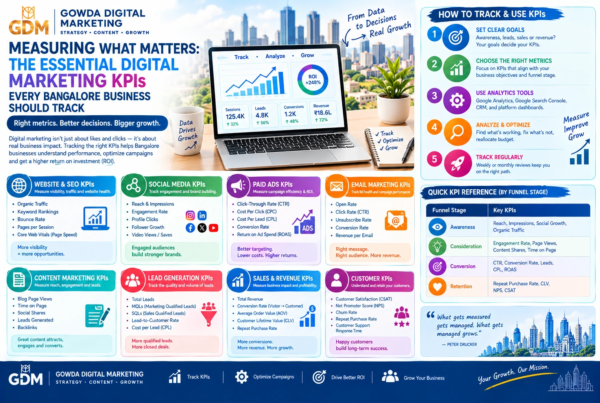
Core Inbound Marketing KPIs
Traffic
- Organic sessions
- Referral traffic
- Direct traffic
- Local search visibility
Engagement
- Engaged sessions
- Content consumption
- Returning visitors
- Email engagement
Lead generation
- Form submissions
- Calls
- WhatsApp conversations
- Downloads
- Consultation requests
Sales
- Qualified leads
- Opportunities
- Customers
- Revenue influenced by marketing
Retention
- Repeat purchases
- Referrals
- Reviews
- Customer lifetime value
A Simple Inbound ROI Framework
You can calculate a basic customer acquisition picture using:
Customer Acquisition Cost (CAC)
= Total marketing and sales acquisition cost ÷ Number of new customers
For example:
If a business spends ₹1,00,000 across marketing and sales activities and acquires 20 customers:
₹1,00,000 ÷ 20 = ₹5,000 CAC
Then compare that with customer value.
If the average customer generates substantially more gross profit over their relationship with the business, the acquisition economics may be attractive.
The exact calculation should account for margins, repeat purchases, refunds, sales costs and attribution methodology.
Common Inbound Marketing Mistakes
Mistake 1: Publishing Without Strategy
Writing 100 articles does not automatically create 100 lead-generating assets.
Better approach:
Build content around:
- Customer problems
- Search intent
- Business priorities
- Conversion paths
Mistake 2: Targeting Only High-Volume Keywords
A keyword with 100,000 searches is not automatically better than one with 500 highly relevant searches.
A smaller keyword can be more commercially valuable if the searcher has strong buying intent.
Mistake 3: Making Every Article Promotional
Readers can recognize sales content.
Teach first.
Then provide the next relevant step.
Mistake 4: Ignoring Local SEO
A local business should not rely entirely on generic national keywords.
Build genuine local relevance.
Mistake 5: No Lead Capture
Visitors leave.
Without a conversion mechanism, you may never know who was interested.
Mistake 6: No Follow-Up
A lead that does not buy immediately is not necessarily a bad lead.
Nurturing can bridge the gap between interest and purchase.
Mistake 7: Automating Everything
Automation without strategy can produce irrelevant communication.
Use automation to improve consistency—not remove empathy.
Mistake 8: Measuring Only Traffic
More traffic does not necessarily mean more business.
Measure the path from:
Traffic → Lead → Qualified Lead → Customer → Revenue
How Long Does Inbound Marketing Take?
Inbound marketing is usually not an overnight acquisition strategy.
Results can vary significantly depending on:
- Website authority
- Competition
- Industry
- Search demand
- Existing content
- Technical SEO
- Content quality
- Local competition
- Publishing consistency
- Conversion optimization
- Sales process
Some activities can generate relatively quick results.
Others may take considerably longer.
This is why businesses should establish both short-term and long-term goals.
Short-term
- Improve website conversion
- Fix technical SEO issues
- Optimize Google Business Profile
- Create high-intent service pages
- Build lead capture
Long-term
- Build topical authority
- Earn backlinks
- Grow organic traffic
- Develop email audience
- Build brand recognition
- Create referral loops
The 90-Day Inbound Marketing Plan
Days 1–30: Foundation
Week 1
- Define ideal customers
- Identify core services
- Research customer problems
- Review competitors
- Audit website
Week 2
- Perform keyword research
- Map search intent
- Identify content gaps
- Review local SEO
Week 3
- Improve homepage
- Improve service pages
- Create conversion CTAs
- Set up tracking
Week 4
- Create first lead magnet
- Set up email capture
- Create welcome sequence
Days 31–60: Content & Distribution
Publish:
- 2–4 high-quality evergreen articles
- 1 comparison guide
- 1 case study
- Supporting social media content
- Email newsletter
Improve internal linking.
Update existing pages.
Build relationships with relevant websites and communities.
Days 61–90: Optimization
Review:
- Organic traffic
- Search impressions
- Click-through rates
- Leads
- Conversion rates
- Top-performing pages
- Underperforming pages
- Local visibility
- Email engagement
Then improve the pages already showing potential.
Do not automatically respond to weak results by producing more content.
Sometimes the better move is to improve what already exists.
Evergreen Inbound Marketing Checklist
Use this checklist before launching your strategy.
Audience
- Ideal customer defined
- Customer problems documented
- Buying objections documented
- Customer journey mapped
SEO
- Keyword research completed
- Search intent mapped
- Local SEO reviewed
- Technical SEO reviewed
- Internal linking planned
Content
- Pillar topics identified
- Supporting topics identified
- Content calendar created
- Evergreen content prioritized
- Case studies planned
Website
- Clear value proposition
- Strong service pages
- Clear CTAs
- Lead capture
- Mobile-friendly experience
- Fast, usable pages
Lead Generation
- Lead magnet created
- Forms configured
- Thank-you page created
- Email sequence created
Automation
- CRM configured
- Lead notifications configured
- Follow-up workflow created
- Newsletter system configured
Measurement
- Analytics configured
- Search performance monitored
- Conversion tracking configured
- Leads attributed where practical
- Monthly review process established
How Bangalore Businesses Can Use Inbound Marketing
Bengaluru has an unusually diverse business environment.
A single inbound strategy will not work identically for:
- A local restaurant
- A dental clinic
- A SaaS startup
- A school
- An automobile workshop
- A hotel
- A real estate company
- A manufacturing supplier
- A professional service firm
The framework stays the same.
The content changes.
For a restaurant
Focus on:
Local discovery + food content + reviews + menu + reservations
For a clinic
Focus on:
Educational content + expertise + trust + FAQs + appointment conversion
For a B2B company
Focus on:
Problem-solving content + case studies + comparisons + lead nurturing
For an education business
Focus on:
Guides + career information + course comparisons + success stories
For an automotive business
Focus on:
Maintenance guides + local search + service pages + reviews + booking
This is why inbound marketing should begin with the customer rather than the marketing channel.
A Powerful Rule: Build Assets, Not Just Campaigns
A campaign has a start and an end.
An asset can continue producing value.
Examples of marketing assets include:
- Evergreen articles
- Service pages
- Case studies
- Videos
- Lead magnets
- Email lists
- Customer reviews
- Local listings
- Educational resources
- Templates
- Tools
- Original research
The objective is to gradually build a library of useful assets.
Over time, those assets can support one another.
The “One Idea, Many Assets” Framework
Suppose you publish a comprehensive article:
“The Complete Local SEO Guide for Bangalore Businesses.”
That single idea can become:
- Blog article
- Instagram carousel
- LinkedIn post
- Short video
- YouTube video
- Email newsletter
- Checklist
- Infographic
- FAQ
- Lead magnet
- Sales enablement resource
This makes content production more efficient.
Instead of constantly inventing new ideas, you extract multiple formats from strong original ideas.
Inbound Marketing and AI
AI can help businesses with:
- Research organization
- Topic clustering
- Content outlines
- First drafts
- Repurposing
- Data analysis
- Personalization
- Workflow automation
- Customer-service assistance
But AI should not become an excuse for publishing large amounts of generic content.
Content Marketing Institute’s research highlights challenges around strategy effectiveness, audience research, clear goals and scalable content creation.
The strategic questions remain human:
- What does the customer actually need?
- Which problem matters most?
- What expertise can we contribute?
- What evidence do we have?
- What makes our experience different?
- What should the customer do next?
Use technology to increase efficiency.
Do not outsource strategic thinking.
Expert Perspective
Inbound marketing is fundamentally about creating value before asking for value in return.
HubSpot describes inbound as a methodology centered on attracting, engaging and delighting people by providing value and building trust.
Content Marketing Institute’s research also illustrates an important lesson: content performance is not simply a matter of publishing more. More successful marketers are more likely to have effective strategies, scalable creation models, appropriate technology and stronger measurement practices.
The practical takeaway is simple:
Don’t build a content factory. Build a customer-help system.
What Is Inbound Marketing?
Inbound marketing is a customer-focused marketing strategy that attracts potential customers through useful content and experiences, engages them with relevant information and interactions, converts interested prospects into customers, and continues providing value after the sale.
Common inbound channels include:
- SEO
- Content marketing
- Social media
- Websites
- Email marketing
- Lead magnets
- Local SEO
- Marketing automation
- Educational resources
- Customer advocacy
How Does Inbound Marketing Work?
Inbound marketing works by connecting customer needs with useful digital resources.
The process generally follows:
Identify customer problems → Create helpful content → Attract relevant visitors → Build trust → Capture leads → Nurture prospects → Convert customers → Retain and delight customers
Is Inbound Marketing Better Than Paid Advertising?
Inbound and paid advertising serve different purposes.
Inbound marketing focuses on building long-term organic assets such as content, SEO, email audiences and customer relationships, while paid advertising can provide faster access to targeted audiences through advertising platforms.
Many businesses can use both approaches as part of a broader acquisition strategy.
How Long Does Inbound Marketing Take?
Inbound marketing does not have a universal timeline.
SEO, content authority and organic discovery can take time to develop, while conversion optimization, local profile improvements, email nurturing and targeted campaigns may produce changes sooner.
The timeframe depends on competition, website quality, search demand, content quality, authority, consistency and execution.
10 FAQs
1. What is inbound marketing in simple terms?
Inbound marketing means helping potential customers discover and trust your business instead of relying exclusively on interruptive advertising.
You answer their questions, solve their problems and provide useful resources.
When they need your service, your business is already familiar to them.
2. Is inbound marketing only for large companies?
No.
Small businesses can use inbound marketing effectively because many inbound assets can be built incrementally.
A small business might begin with:
- A useful website
- A Google Business Profile
- Five strong service pages
- Ten helpful articles
- One lead magnet
- An email sequence
- A simple CRM
The system can grow as the business grows.
3. Can inbound marketing work for Bangalore businesses?
Yes, particularly where customers research businesses online before making decisions.
Local businesses can combine:
- Local SEO
- Google Business Profile
- Website content
- Reviews
- Location-specific information
- Social media
- Lead nurturing
Google specifically identifies relevance, distance and prominence as key factors in local search results.
4. Does inbound marketing mean I should stop running Google Ads?
No.
Paid advertising can complement inbound marketing.
A business might use Google Ads for immediate visibility while simultaneously building SEO, content and conversion assets for long-term growth.
The right combination depends on the business model and goals.
5. What type of content works best for inbound marketing?
The best content depends on customer intent.
Useful formats include:
- How-to guides
- Problem-solving articles
- Comparisons
- Checklists
- Case studies
- FAQs
- Tutorials
- Calculators
- Templates
- Research reports
- Videos
Focus on customer usefulness rather than content volume.
6. How much does inbound marketing cost?
There is no universal price.
Costs can include:
- Strategy
- Content creation
- SEO
- Website development
- Design
- Software
- CRM
- Email marketing
- Automation
- Analytics
- Staff or agency resources
A small business can start with a focused system and expand it over time.
7. What is the difference between inbound marketing and SEO?
SEO is one component of inbound marketing.
SEO helps potential customers discover your website through search engines.
Inbound marketing is broader and can include:
- SEO
- Content
- Social media
- Lead magnets
- Websites
- Automation
- Customer experience
- Retention
Think of SEO as one engine inside the larger inbound system.
8. Can social media be part of inbound marketing?
Yes.
Social media can attract people, distribute useful content, build credibility and encourage conversations.
The strongest social strategy is not necessarily the one that generates the most likes.
It should support broader business objectives.
9. How do I know whether inbound marketing is working?
Track the complete customer journey.
Monitor:
Traffic → Engagement → Leads → Qualified Leads → Opportunities → Customers → Revenue
Also monitor individual channels such as organic search, local search, email, referrals and social media.
10. What is the biggest inbound marketing mistake?
Creating content without a customer journey.
A business may publish hundreds of articles but fail to answer:
- Who is this content for?
- What problem does it solve?
- What should the reader do next?
- How can we capture interested visitors?
- How will we nurture them?
- How does this contribute to revenue?
Strategy should come before volume.
Inbound Marketing vs Traditional Outbound Marketing
| Element | Inbound Marketing | Outbound Marketing |
| Attention | Earned | Purchased/interrupted |
| Starting point | Customer problem | Business message |
| Typical channels | SEO, content, email, social | Ads, cold outreach, direct campaigns |
| Relationship | Usually educational | Often promotional |
| Content role | Central | Supporting |
| Long-term assets | Strong emphasis | Varies |
| Speed | Often gradual | Can be immediate |
| Best measurement | Journey and conversion | Campaign performance |
| Customer involvement | Pull-oriented | Push-oriented |
The distinction is not absolute.
Modern businesses frequently combine both.
The GDM-Aligned Inbound Marketing Ecosystem
For a business seeking an integrated digital marketing strategy, inbound marketing can connect multiple disciplines.
SEO
Attract search traffic.
Local SEO & Google Business Profile
Capture nearby search demand.
Content Writing
Answer customer questions.
Website Development
Create the destination where customers learn and convert.
Social Media Management
Distribute ideas and build familiarity.
Branding & Creative Design
Make the experience recognizable and credible.
Paid Ads
Accelerate high-intent acquisition.
Marketing Automation
Automate repetitive follow-up.
Email / SMS / WhatsApp Marketing
Nurture prospects and customers.
Analytics
Measure what works.
The advantage is not any individual service.
It is how the pieces work together.
Action Plan: What to Do This Week
If you want to start building inbound marketing immediately, complete these tasks.
Day 1
Define your ideal customer.
Day 2
Write down 25 questions customers frequently ask.
Day 3
Group the questions into:
- Awareness
- Consideration
- Decision
- Retention
Day 4
Choose your five highest-priority topics.
Day 5
Audit your website.
Check:
- Homepage
- Service pages
- Contact forms
- CTAs
- Mobile experience
- Page speed
- Trust signals
Day 6
Create one useful lead magnet.
Day 7
Create your first email follow-up sequence.
Then repeat the process consistently.
6 Key Takeaways
- Inbound marketing is about earning attention through usefulness, not simply avoiding advertising.
- SEO and content are powerful attractors, but they need strong websites and conversion paths to generate business value.
- Local businesses should connect inbound marketing with local search, Google Business Profile, reviews and genuinely useful location-based content.
- Lead magnets, email and automation help turn one-time visitors into ongoing relationships.
- Traffic alone is not the goal; businesses should measure the journey from traffic to leads, customers and revenue.
- The strongest inbound systems are built as long-term assets that become more useful over time rather than depending entirely on individual campaigns.
Your Inbound Marketing To-Do List
Strategy
- Define ideal customer
- Document customer problems
- Map customer journey
- Identify buying objections
SEO
- Research keywords
- Map search intent
- Audit technical SEO
- Optimize local presence
- Improve internal linking
Content
- Select pillar topics
- Create evergreen articles
- Create comparison content
- Create case studies
- Update older content
Website
- Improve homepage messaging
- Improve service pages
- Add clear CTAs
- Add FAQs
- Add trust signals
Lead Generation
- Create lead magnet
- Add forms
- Create thank-you page
- Set up CRM
Nurturing
- Create welcome email
- Build nurture sequence
- Segment leads
- Create follow-up process
Measurement
- Track organic traffic
- Track conversions
- Track leads
- Track qualified leads
- Track customers
- Review results monthly
Conclusion: Build a Marketing System, Not an Endless Campaign
Inbound marketing is ultimately a shift in mindset.
Instead of asking:
“How can we get more people to see our advertisement?”
ask:
“How can we become useful enough that the right people discover us, trust us and choose to continue the relationship?”
That shift changes how you approach SEO.
It changes how you create content.
It changes how you design websites.
It changes how you use social media.
It changes how you think about email.
And it changes how you approach automation.
For Bangalore businesses, the opportunity is particularly practical.
A well-optimized local presence can help people discover you.
Helpful content can answer their questions.
A strong website can demonstrate your expertise.
Lead magnets can create an ongoing relationship.
Email and WhatsApp can nurture interested prospects.
Automation can reduce repetitive work.
And a strong customer experience can turn customers into reviewers and advocates.
The goal is not to eliminate paid advertising.
The goal is to avoid making paid advertising your only engine of growth.
Build useful assets.
Answer real questions.
Create trust.
Make the next step easy.
Measure the entire customer journey.
Then improve the system continuously.
That is the foundation of sustainable inbound marketing.
If you found this guide useful, subscribe to our newsletter for practical SEO, digital marketing, website, social media and automation strategies for growing businesses.
Have you already tried inbound marketing for your business?
Share your biggest challenge in the comments: getting traffic, generating leads, converting visitors, nurturing prospects or measuring ROI.
Your question may also become the topic of a future guide.
References & Sources
- Google Business Profile Help — Local ranking factors, including relevance, distance and prominence.
Google Business Profile: Improve your local ranking on Google - HubSpot — Inbound marketing methodology and the attract, engage and delight framework.
HubSpot: What Is Inbound Marketing? - HubSpot Academy — Fundamentals of inbound marketing.
HubSpot Academy: Understanding the Fundamentals of Inbound - Content Marketing Institute — B2B Content Marketing Benchmarks, Budgets and Trends: Outlook for 2025.
Content Marketing Institute: B2B Content Marketing Research - Content Marketing Institute — Content marketing statistics and benchmarks.
Content Marketing Institute: Content Marketing Statistics