
Great Content Is No Longer Written Just for Google—It’s Written for People and AI
Content marketing has changed dramatically over the past few years.
In the past, businesses focused mainly on writing articles filled with keywords to rank higher on Google.
Today, the search landscape is much more advanced.
People now search using Google, Google AI Overviews, ChatGPT, Gemini, Perplexity, voice assistants, and other AI-powered search platforms.
Instead of simply displaying a list of websites, AI search engines summarize information and recommend trusted sources directly to users.
This means businesses must create content that satisfies both human readers and AI search systems.
The future belongs to content that is helpful, trustworthy, structured, and genuinely valuable—not content written only to manipulate search rankings.
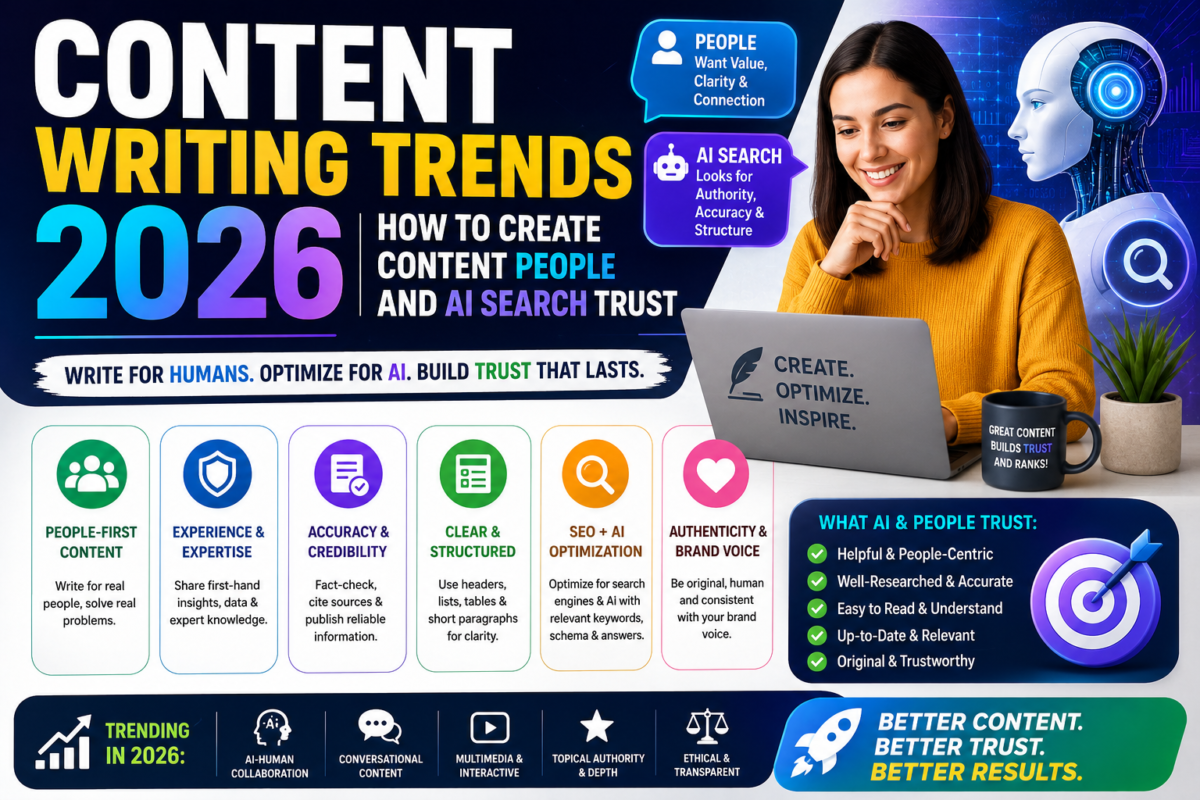
This guide explores the biggest content writing trends shaping 2026 and explains how businesses can create content that both people and AI trust.
Why It Matters
Many businesses continue using outdated SEO strategies.
Common mistakes include:
❌ Keyword stuffing
❌ Publishing generic AI-generated articles
❌ Creating thin content
❌ Ignoring search intent
❌ Writing without expertise
❌ Failing to update existing content
The result?
Lower rankings.
Reduced engagement.
Poor AI visibility.
Declining organic traffic.
Businesses that adapt to modern content strategies will build stronger authority and long-term search visibility.
What You Will Learn
By the end of this guide, you’ll understand:
✅ The biggest content writing trends in 2026
✅ How AI is changing content marketing
✅ What Google and AI search engines value
✅ How to write trustworthy content
✅ Ways to improve SEO and GEO simultaneously
✅ Best practices for long-term organic growth
Table of Contents
- Why Content Is Changing
- Google’s Helpful Content Evolution
- AI Search and Content Discovery
- SEO vs GEO Content Strategy
- The Rise of Human Expertise
- Topic Clusters and Topical Authority
- Content Structure Best Practices
- AI-Assisted Content Creation
- Common Content Mistakes
- Case Study
- Content Writing Workflow
- Frequently Asked Questions
- Conclusion
Why Content Is Changing
Consumers no longer search the same way they did five years ago.
Instead of typing short keywords like:
“best laptop”
Users now ask complete questions such as:
“What is the best laptop for video editing under ₹80,000?”
AI-powered search understands natural language and delivers conversational answers.
Content must now answer questions comprehensively rather than simply targeting keywords.
Google’s Helpful Content Evolution
Google increasingly rewards content that demonstrates:
Experience
Expertise
Authority
Trustworthiness
(EEAT)
Helpful content focuses on solving user problems rather than ranking for search terms alone.
Businesses that publish valuable educational content consistently outperform websites filled with low-quality AI-generated articles.
AI Search Is Changing Content Discovery
AI search engines don’t simply match keywords.
They evaluate:
Context
Authority
Accuracy
Structure
Originality
Trust signals
When users ask AI platforms questions, they often receive summarized answers instead of multiple search results.
Your goal is to create content that AI systems trust enough to reference.
SEO vs GEO Content Strategy
Traditional SEO helps users discover your website.
Generative Engine Optimization (GEO) helps AI systems discover and recommend your content.
Businesses should optimize for both.
SEO focuses on:
Keywords
Technical optimization
Backlinks
User experience
GEO focuses on:
Authority
Expertise
Structured information
Original insights
Trustworthy sources
Human Expertise Is Becoming More Valuable
AI can generate articles quickly.
However, AI cannot replace:
Real experiences
Professional insights
Original case studies
Customer success stories
Industry expertise
Businesses should combine AI assistance with genuine human knowledge.
Original perspectives make content stand out.
Search Intent Matters More Than Keywords
Before writing any article, understand why users are searching.
Four primary search intents include:
Informational
Navigational
Commercial
Transactional
Content that matches search intent performs significantly better than keyword-focused articles.
Topic Clusters Build Authority
Instead of publishing isolated articles, build content clusters.
Example:
Main Topic:
Digital Marketing
Supporting Articles:
SEO
Local SEO
Google Ads
Meta Ads
Content Marketing
AI Marketing
Email Marketing
Social Media Marketing
This approach improves topical authority and internal linking.
Content Structure Best Practices
AI and search engines prefer organized content.
Use:
Clear H2 headings
H3 subheadings
Bullet lists
Tables
Short paragraphs
FAQs
Definitions
Step-by-step instructions
Structured formatting improves readability and AI understanding.
Write for Humans First
Successful content answers real customer questions.
Instead of writing:
“Our agency provides SEO services.”
Write:
“How can SEO help a small business generate more leads?”
Educational content builds trust.
Sales naturally follow.
Original Research Builds Authority
AI search increasingly values unique information.
Publish:
Customer surveys
Case studies
Industry reports
Original statistics
Performance data
Research-backed content has greater citation potential.
AI Can Assist—but Not Replace Writers
AI is useful for:
Brainstorming
Research
Outlines
Grammar
SEO suggestions
Summaries
Humans remain responsible for:
Strategy
Storytelling
Creativity
Fact-checking
Brand voice
Original ideas
Update Existing Content Regularly
Fresh content performs better.
Update articles by:
Refreshing statistics
Adding new examples
Expanding sections
Improving internal links
Updating screenshots
Improving readability
Regular updates help maintain rankings.
Common Content Writing Mistakes
Avoid these mistakes:
❌ Publishing unedited AI content
❌ Ignoring user intent
❌ Overusing keywords
❌ Weak introductions
❌ No internal linking
❌ No FAQs
❌ No author credibility
❌ Poor readability
❌ Outdated information
Case Study
Digital Marketing Agency
Challenge
The agency published frequent blog articles but struggled to appear in AI-generated search results.
Strategy
Created topic clusters
Added FAQs
Improved article structure
Published original case studies
Updated older content
Implemented schema markup
Results
Higher Google rankings
Improved AI visibility
Longer session duration
More qualified leads
Higher engagement
Content Creation Workflow
Keyword Research
↓
Search Intent Analysis
↓
Topic Planning
↓
Outline Creation
↓
AI-Assisted Draft
↓
Human Editing
↓
SEO Optimization
↓
Publishing
↓
Performance Analysis
↓
Content Updates
Future Content Trends for 2026
The future of content marketing includes:
Human-first writing
AI-assisted production
Video integration
Interactive content
Conversational search optimization
Experience-based content
Original research
Community-driven publishing
Hyper-personalization
AI citation optimization
Businesses adopting these strategies will maintain stronger organic visibility.
Frequently Asked Questions
Is SEO content still important?
Yes. Quality SEO content remains essential.
What is GEO content?
Content optimized for AI-powered search engines.
Can AI write blog articles?
Yes, but human editing and expertise remain critical.
Does Google penalize AI content?
Google evaluates quality—not whether AI assisted in writing.
How long should blog articles be?
The length should match user intent. Comprehensive guides often perform well.
What type of content ranks best?
Helpful, well-structured, original, and trustworthy content.
How often should I publish blogs?
Consistency matters more than volume. A realistic, sustainable schedule works best.
Should every article include FAQs?
Frequently asked questions often improve user experience and search visibility.
Does internal linking matter?
Yes. Internal links strengthen topical authority and help users navigate your content.
What is the future of content writing?
Content will increasingly focus on expertise, authenticity, and AI-friendly structure.
Key Takeaways
- Helpful content outperforms keyword stuffing.
- Human expertise remains a major ranking factor.
- AI assists content creation but doesn’t replace strategy.
- Search intent matters more than individual keywords.
- Topic clusters improve topical authority.
- Structured content helps AI understand your articles.
- Original research increases trust.
- Regular updates maintain rankings.
- SEO and GEO should work together.
- Trustworthy content wins in both Google and AI search.
Final Thoughts
Content writing in 2026 is no longer about producing the highest number of articles or inserting keywords into every paragraph.
Success belongs to businesses that create genuinely valuable content designed to educate, solve problems, and build trust.
As AI-powered search continues reshaping how people discover information, the best-performing content will combine human expertise, thoughtful storytelling, structured formatting, and data-backed insights.
Rather than writing for algorithms alone, focus on writing for people first—while making your content easy for AI systems to understand and reference.
Businesses that embrace this balanced approach will continue earning higher rankings, stronger authority, and greater visibility across both traditional search engines and AI-powered search platforms.