
Introduction
The way people search online is changing dramatically.
Instead of clicking through multiple search results, users increasingly rely on AI-generated answers from:
- Google AI Overviews
- ChatGPT
- Google Gemini
- Perplexity AI
- Microsoft Copilot
- Other AI-powered assistants
These systems summarize information from trusted sources and present direct answers to users.
For businesses, this means traditional SEO is no longer enough.
Your website must be structured, authoritative, and trustworthy so AI systems can understand, reference, and recommend your content.
This new approach is often called Generative Engine Optimization (GEO)—the practice of optimizing content for AI-powered search experiences.
Problem Statement: Why It Matters
Many business websites still focus only on:
- Keywords
- Meta tags
- Backlinks
While ignoring:
- AI readability
- Structured content
- Entity optimization
- Topical authority
- Trust signals
As AI search grows, websites that fail to adapt may experience:
❌ Reduced organic visibility
❌ Fewer qualified visitors
❌ Missed brand mentions
❌ Lower authority in AI-generated answers
Promise of Value
By the end of this guide, you’ll learn:
✅ How Google AI Overviews work
✅ How AI chatbots select sources
✅ Website optimization strategies for AI search
✅ Technical SEO improvements for AI
✅ Content structures that AI understands
Table of Contents
- What Are Google AI Overviews?
- How AI Chatbots Discover Content
- Traditional SEO vs AI SEO
- Website Structure for AI Search
- Content Optimization Strategies
- Technical SEO Best Practices
- Trust & Authority Signals
- Schema Markup for AI
- Common Mistakes
- FAQs
- Conclusion
Featured Snippet Section
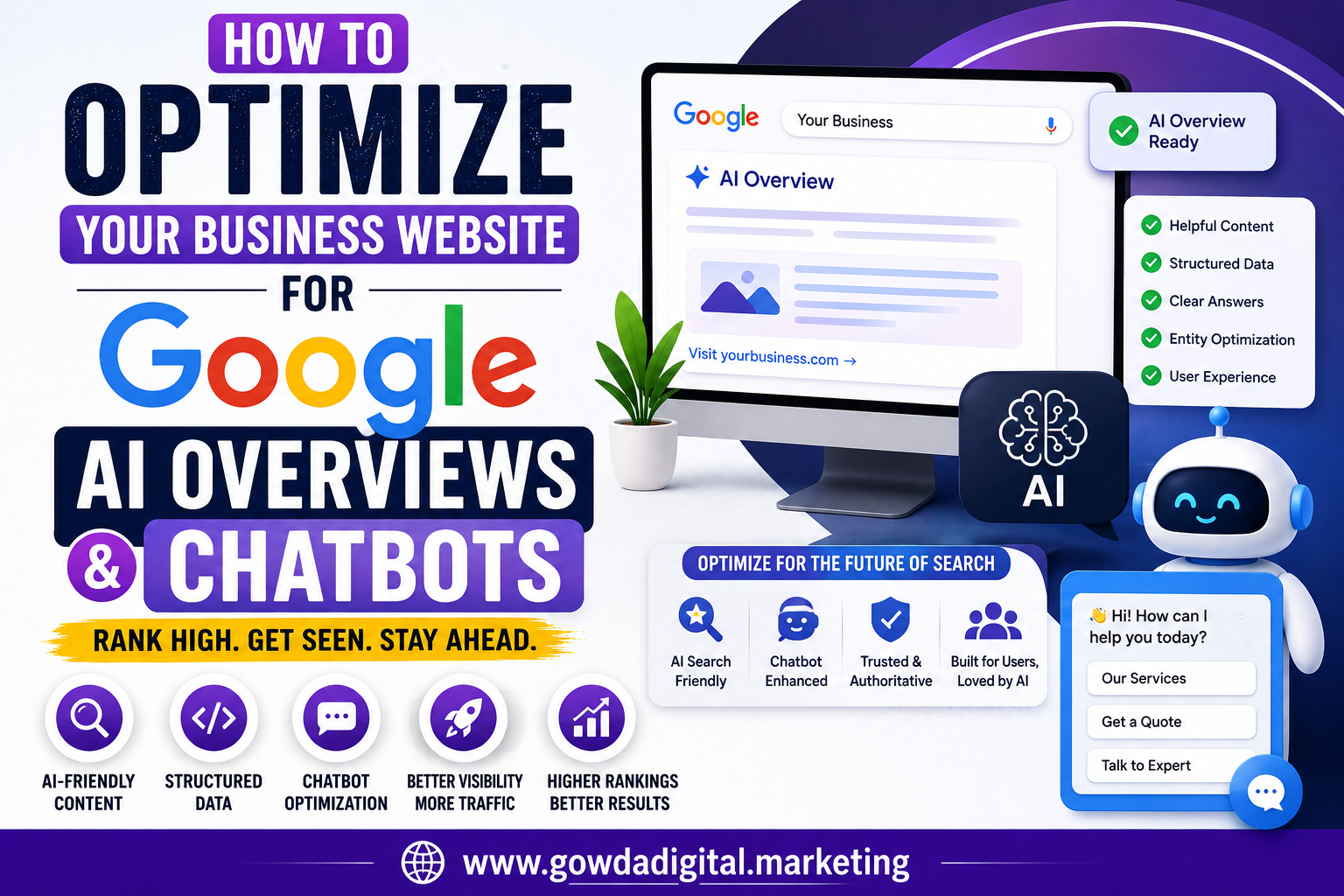
How Do You Optimize a Website for Google AI Overviews and AI Chatbots?
To optimize your website for Google AI Overviews and AI chatbots:
- Publish high-quality, expert-written content.
- Use clear headings and structured formatting.
- Answer common questions with FAQ sections.
- Implement Schema.org structured data.
- Build topical authority with related content.
- Improve page speed and mobile usability.
- Demonstrate expertise, experience, authority, and trust (E-E-A-T).
- Earn high-quality backlinks and brand mentions.
- Keep information accurate and updated.
- Create content that directly answers user intent.
Key Facts & Statistics Box
📊 AI Search Trends 2026
- AI-assisted search continues to grow across industries.
- Google AI Overviews summarize trusted sources rather than relying on a single website.
- Structured content improves machine understanding.
- Long-form expert content often performs well in AI-powered search.
- Brand authority is becoming increasingly important.
What Are Google AI Overviews?
Google AI Overviews are AI-generated summaries displayed for many search queries.
Instead of showing only blue links, Google may generate:
- Quick summaries
- Step-by-step answers
- Product comparisons
- Local recommendations
- Educational explanations
These summaries often include information from multiple trusted sources.
How AI Chatbots Discover Content
AI systems evaluate:
- Content quality
- Context
- Website authority
- Technical accessibility
- Structured information
- Freshness
- User value
The clearer your content, the easier it is for AI systems to understand it.
Highlight Box
🚀 Pro Tip:
Write every important page as if an AI assistant needs to explain it to someone in one clear answer. Well-structured, easy-to-understand content is more likely to be surfaced.
Traditional SEO vs AI SEO
| Traditional SEO | AI SEO (GEO) |
| Keyword Focus | Topic Focus |
| Ranking Pages | Becoming a Trusted Source |
| Search Results | AI Citations & Summaries |
| Backlinks | Authority + Expertise |
| Clicks | Brand Visibility + Clicks |
| Search Intent | Conversational Intent |
Build a Clear Website Structure
A logical structure helps both users and AI.
Recommended structure:
Home
↓
Services
↓
Industry Pages
↓
Location Pages
↓
Blog
↓
Case Studies
↓
FAQs
↓
Contact
Include breadcrumb navigation and descriptive internal links.
Create AI-Friendly Content
Answer Questions Directly
Example:
“What is Local SEO?”
Begin with a concise definition before adding detail.
Use Proper Headings
Organize content with:
- H2
- H3
- H4
This improves readability and machine understanding.
Use Lists and Tables
AI systems can more easily interpret:
- Bullet points
- Numbered steps
- Comparison tables
- Checklists
Include FAQs
Add frequently asked questions to important pages.
These often align with conversational search queries.
Build Topical Authority
Instead of writing isolated articles, develop comprehensive topic clusters.
Example:
Main Topic:
Digital Marketing
Supporting Topics:
- SEO
- Google Ads
- Social Media Marketing
- Content Marketing
- Local SEO
- AI SEO
- Email Marketing
This demonstrates expertise.
Expert Opinion
“The websites most likely to appear in AI-generated answers are those that consistently publish accurate, comprehensive, and trustworthy content across an entire subject—not just individual keywords.”
Optimize Technical SEO
Technical improvements include:
- Fast loading pages
- Mobile-friendly design
- HTTPS security
- Clean URL structure
- XML sitemap
- Robots.txt
- Crawlable navigation
- Canonical tags
Technical SEO helps search engines and AI systems access your content efficiently.
Implement Structured Data
Use Schema.org markup where appropriate.
Common schemas include:
- Organization
- LocalBusiness
- Article
- FAQPage
- Product
- Review
- BreadcrumbList
Structured data provides additional context to search systems.
Demonstrate E-E-A-T
Google emphasizes:
Experience
Show practical expertise.
Expertise
Publish content by knowledgeable authors.
Authoritativeness
Build recognition through citations and quality content.
Trustworthiness
Keep information accurate, transparent, and current.
Improve Brand Signals
AI systems may consider overall brand presence.
Strengthen your brand by:
- Publishing consistently
- Earning media mentions
- Encouraging customer reviews
- Maintaining active social profiles
- Building quality backlinks
Comparison Table
AI-Friendly Website vs Traditional Website
| AI-Friendly Website | Traditional Website |
| Topic Clusters | Isolated Pages |
| Structured Content | Large Text Blocks |
| FAQs Included | No FAQs |
| Schema Markup | Minimal Structured Data |
| Expert Insights | Generic Content |
| Strong Internal Linking | Weak Navigation |
Step-by-Step Visual Workflow
Keyword Research
↓
User Intent Analysis
↓
Content Planning
↓
Expert Writing
↓
Structured Formatting
↓
Schema Markup
↓
Technical SEO
↓
Internal Linking
↓
Publishing
↓
AI & Search Visibility
Case Study 1
B2B SaaS Company
Challenge:
Strong Google rankings but limited AI visibility.
Strategy:
- Expanded topic clusters
- Added FAQ sections
- Implemented schema markup
- Improved internal linking
Results:
- Increased impressions
- Higher brand visibility
- Improved engagement
Case Study 2
Local Digital Marketing Agency
Challenge:
Competing in a crowded market.
Solution:
- Published expert guides
- Created location-specific pages
- Improved technical SEO
- Added customer case studies
Results:
- Better local rankings
- Increased website traffic
- More qualified inquiries
Common AI SEO Mistakes
❌ Publishing thin AI-generated articles
❌ Ignoring user intent
❌ Poor page structure
❌ Missing schema markup
❌ Weak internal linking
❌ Outdated content
❌ Lack of expert insights
10 Frequently Asked Questions
1. What are Google AI Overviews?
AI-generated summaries displayed within Google Search.
2. What is GEO?
Generative Engine Optimization focuses on improving visibility in AI-generated search results.
3. Is traditional SEO still important?
Yes. Traditional SEO remains the foundation of AI optimization.
4. Can AI-generated content rank?
Yes, if it is accurate, original, edited, and valuable.
5. Do FAQs help AI search?
Yes. They provide clear answers to common user questions.
6. Does schema markup matter?
Yes. Structured data improves machine understanding.
7. How do AI chatbots choose sources?
They evaluate relevance, authority, clarity, trustworthiness, and context.
8. Should I update old articles?
Yes. Fresh and accurate content is more valuable.
9. Does page speed affect AI visibility?
Fast, user-friendly websites support overall search performance.
10. What is the future of SEO?
The future combines traditional SEO with AI-focused optimization and authoritative content.
Image Alt Text Suggestions
- Google AI Overviews optimization workflow
- AI SEO strategy infographic
- Website structure for AI search engines
- Google AI Overview content example
- Technical SEO and GEO checklist
References & Sources
- Google Search Central
- Google AI Overview Information
- Schema.org Documentation
- Search Engine Journal
- Content Marketing Institute
Summary / Key Takeaways
✅ Optimize for both humans and AI
✅ Create comprehensive topic clusters
✅ Use structured headings and FAQs
✅ Implement Schema.org markup
✅ Improve technical SEO
✅ Build E-E-A-T signals
✅ Strengthen internal linking
✅ Publish expert, trustworthy content
Actionable Steps / To-Do List
Week 1
- Audit your website for AI readiness
- Identify high-priority pages
Week 2
- Add FAQs and improve headings
- Implement schema markup
Week 3
- Create topic clusters
- Strengthen internal linking
Week 4
- Update older content
- Monitor Google Search Console and AI visibility
Conclusion
Google AI Overviews and AI-powered chatbots are transforming how users discover businesses online.
Success in this new search landscape requires more than traditional keyword optimization. Businesses must focus on creating trustworthy, well-structured, authoritative content that directly answers user questions and demonstrates genuine expertise.
By combining strong technical SEO, comprehensive content, structured data, and a clear brand presence, your website can improve its chances of being featured not only in Google Search but also in AI-generated answers across multiple platforms.
The future of search belongs to businesses that optimize for people first—and make that content easy for AI to understand.
Call to Action
📩 Subscribe to our newsletter for weekly SEO, AI search, GEO, and digital marketing strategies.
💬 Is your website ready for Google AI Overviews? Share your biggest AI SEO challenge in the comments below.